Russia’s Kyiv Attack Puts Ukraine’s Air-Defense Gap Back at the Center of the War
Russia’s major attack on Kyiv showed again that Ukraine can intercept many incoming weapons, but not enough to fully protect civilians from missile and drone strikes.
Save Article
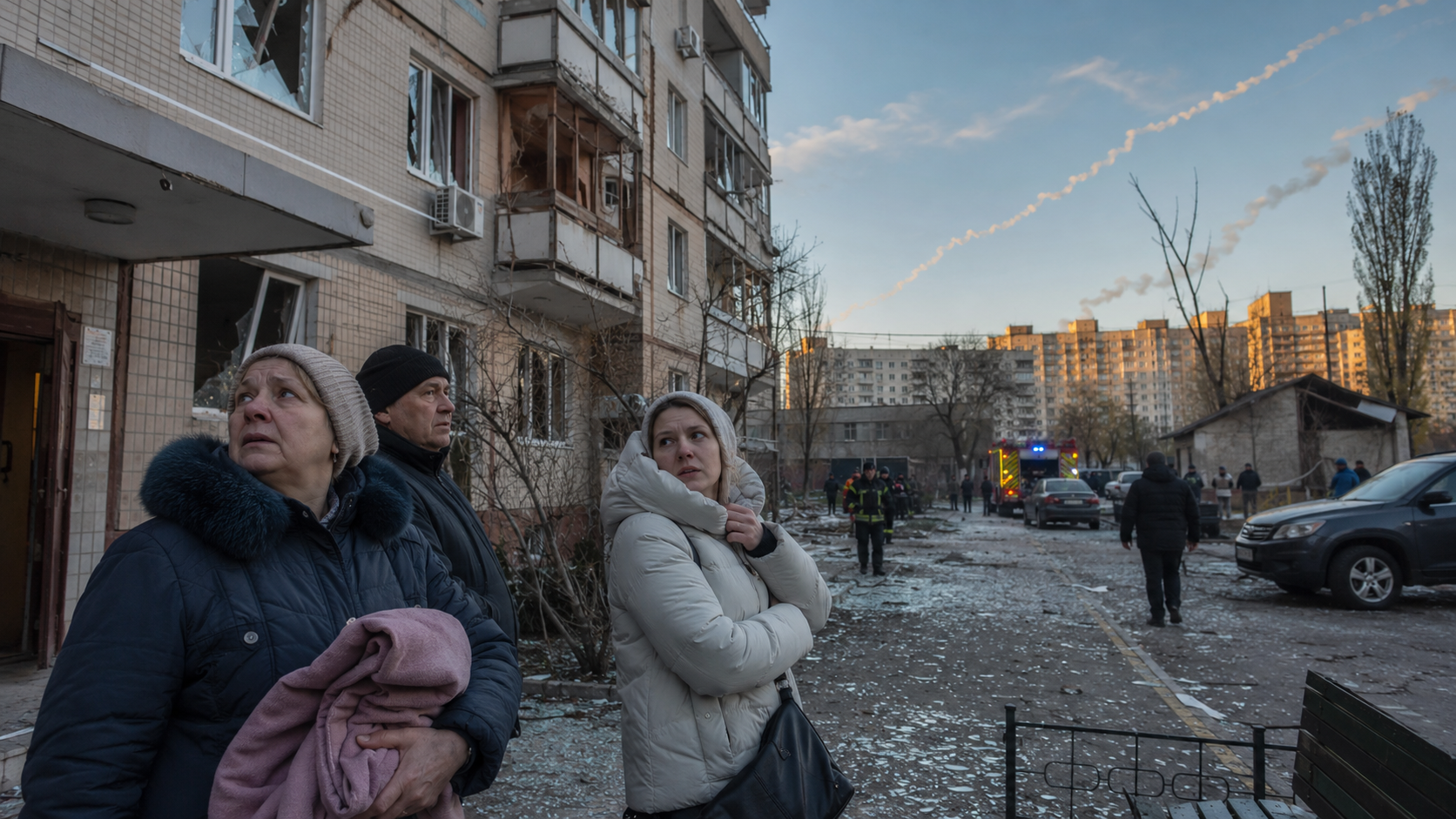
Russia’s major attack on Kyiv showed again that Ukraine can intercept many incoming weapons, but not enough to fully protect civilians from missile and drone strikes. Editorial illustration by TheDailyGlobe.
Key Facts
- AP reported Russia carried out a massive aerial attack on Kyiv using the hypersonic Oreshnik ballistic missile.
- AP reported the attack involved hundreds of drones and missiles.
- Ukrainian defenses intercepted many incoming weapons, but not all of them, according to AP.
- AP reported civilian deaths, dozens of injuries, and damage to residential areas and public buildings.
- UN Security Council coverage earlier in May warned the Ukraine war was becoming “deadlier by the day.”
Russia’s latest large attack on Kyiv has put Ukraine’s air-defense shortage back at the center of the war.
The Associated Press reported that Russia carried out a massive aerial attack on Kyiv using the hypersonic Oreshnik ballistic missile, along with hundreds of drones and missiles. Ukrainian defenses intercepted many of the incoming weapons, AP reported, but not all of them.
The result was not just another battlefield headline. AP reported civilian deaths, dozens of injuries, and damage to residential areas and public buildings. For people in Ukrainian cities, the practical question is whether air defenses can stop enough missiles and drones before they reach homes, schools, hospitals, power systems, and public streets.
What the Attack Shows
Ukraine’s air defenses have repeatedly limited damage from Russian aerial attacks, but this strike shows the gap between intercepting many weapons and protecting a city completely.
That gap matters because Russia does not have to hit every target for an attack to cause harm. A small number of missiles or drones getting through can still kill civilians, damage buildings, disrupt daily life, and force emergency crews into dangerous conditions before sunrise.
The reported use of the Oreshnik missile adds another layer. Hypersonic and ballistic missiles are harder to defend against than slower or more predictable threats. That does not mean every such weapon is unstoppable, but it does make the quality, quantity, and placement of Ukraine’s air-defense systems more important.
Civilian Risk Is the Immediate Issue
The attack’s civilian toll is the clearest reason the story matters. AP reported deaths, dozens of injuries, and damage in residential areas and public buildings.
Russia has said its strikes targeted military infrastructure. That claim should be attributed as Russia’s position. The confirmed public effect, according to AP reporting, included harm in civilian areas.
In attacks involving large numbers of drones and missiles, damage can come from direct strikes, failed intercepts, or falling debris after interceptions. The source material does not settle how much of the reported damage came from each cause. That uncertainty matters, but it does not erase the basic public-safety point: civilians remain exposed when air-defense systems cannot stop everything.
Why Air Defense Drives the Diplomacy
Ukraine’s need for air-defense systems is not only a military issue. It shapes diplomacy with Europe and the United States because those governments control much of the equipment, financing, and production capacity Ukraine needs.
UN Security Council coverage earlier in May warned that the war was becoming “deadlier by the day” after one of the largest aerial attacks since Russia’s full-scale invasion began. That warning fits the pattern shown again in Kyiv: long-range attacks remain a central part of Russia’s pressure on Ukrainian cities.
European Union materials also show continued sanctions pressure on Russia tied to the war against Ukraine. Sanctions do not stop an incoming missile over Kyiv, but they are part of Europe’s broader effort to pressure Moscow while Ukraine asks for more tools to defend its airspace.
What Remains Unclear
It remains unclear whether Russia will keep using Oreshnik missiles at this tempo. It is also unclear whether Ukraine’s allies will accelerate additional air-defense deliveries after this attack.
Another open question is how much of the damage in Kyiv came from direct strikes compared with intercepted debris. Intercept and damage figures should continue to be treated carefully unless independently confirmed.
For now, the attack shows the practical problem facing Ukraine and its allies. Ukraine can stop many drones and missiles, but “many” is not the same as “enough” when the weapons that get through land in a city where people are trying to live.
Reporting note: Reporting draws on AP reporting, UN Security Council coverage, European Union sanctions materials, European Commission materials, and reviewed conflict context. This article was produced with AI-assisted research and reviewed by an editor before publication.