Gaza Strike Targeting Hamas Commander Tests a Fragile Post-Ceasefire Reality
Israeli officials said a May 26 strike targeted a Hamas commander, while Palestinian hospital officials reported casualties, underscoring the uncertainty around Gaza's fragile ceasefire environment.
Save Article
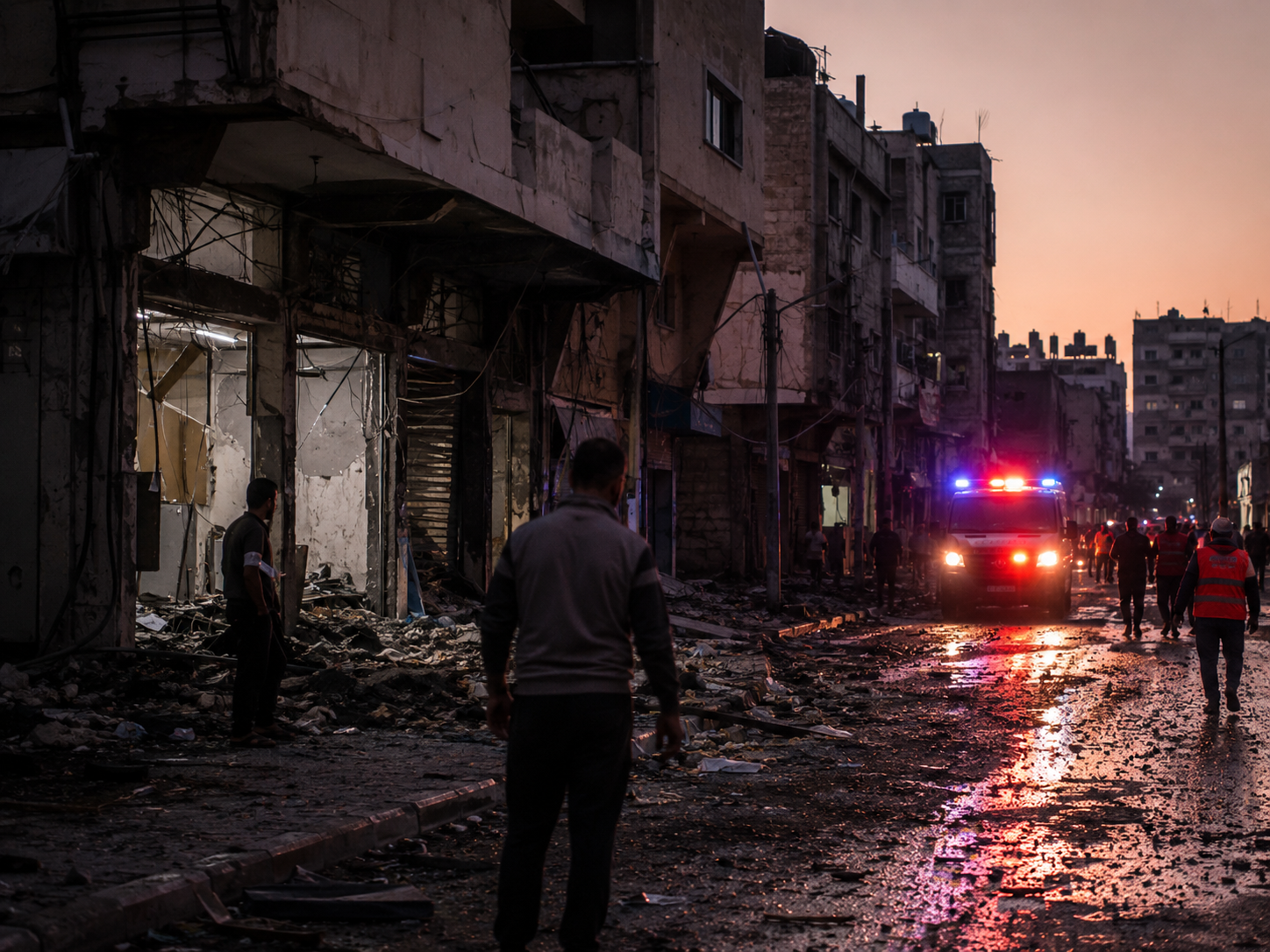
Conflict updates require careful separation between confirmed facts, official claims, and what remains unclear. Editorial illustration by TheDailyGlobe.
Key Facts
- AP reported Israeli strikes in Gaza City on May 26.
- Israeli leaders said the strikes targeted Mohammed Odeh, described as a Hamas military figure.
- Palestinian hospital officials reported casualties, according to AP.
- UN-related materials describe ongoing humanitarian risks in Gaza despite a ceasefire framework.
- The source material used for this draft does not confirm whether Odeh was killed or injured.
A reported Israeli strike in Gaza City on May 26 has put renewed attention on the fragile reality inside Gaza after a ceasefire framework, where military claims, civilian harm and humanitarian access remain closely connected.
The Associated Press reported that Israeli leaders said the strikes targeted Mohammed Odeh, described as a Hamas military figure. Palestinian hospital officials reported casualties, according to AP. The available source material does not confirm whether Odeh was killed or injured.
That distinction matters. In Gaza, a single strike can carry competing official claims, incomplete casualty information and wider consequences for civilians already living under severe humanitarian pressure.
What Is Confirmed and What Is Claimed
The confirmed part of the story is limited but important. AP reported Israeli strikes in Gaza City. Israeli leaders said the target was Mohammed Odeh. Palestinian hospital officials reported casualties.
Those details should not be blended together as if they all carry the same source basis. The targeting claim comes from Israeli officials. The casualty report comes from Palestinian hospital officials, as reported by AP. The outcome for the reported target remains unclear in the source material provided.
That kind of careful separation is especially important in conflict reporting. Military officials may describe a target and purpose. Medical officials may report deaths or injuries. Humanitarian organizations may describe broader conditions. Each can be relevant, but each should be attributed clearly.
Why the Strike Matters Beyond One Target
The strike matters because it occurred in a setting where Gaza remains under intense humanitarian strain and where a ceasefire framework has not removed the risk of renewed violence.
UN-related materials describe continuing humanitarian risks in Gaza, including conditions tied to aid, displacement and civilian need. That context does not answer every question about this specific strike. It does help explain why any new military action in Gaza is watched closely.
For civilians, the practical question is not only who was targeted. It is whether strikes, responses and security restrictions make daily survival harder, interrupt aid movement or deepen fear in communities already affected by months of conflict.
The Ceasefire Question
The source material does not show whether the May 26 strike will affect the broader ceasefire or humanitarian access. That remains one of the central unknowns.
A ceasefire framework can reduce fighting without eliminating every military action, accusation or security operation. It can also be tested by incidents that each side describes differently. That is why the language around this strike should stay narrow and factual.
It would be too much to say from the available material that the ceasefire is collapsing. It would also be too little to treat the strike as routine. The safer read is that the incident shows how fragile the post-ceasefire environment remains.
What Remains Unclear
The most immediate unknown is whether Mohammed Odeh was killed, injured or not harmed. The available source material does not confirm that outcome.
It also remains unclear whether the strike will lead to additional military action, affect humanitarian access or change the broader ceasefire environment. Those questions require further confirmation, not assumption.
That uncertainty should be visible to readers. In a conflict zone, early reports can be incomplete, and official claims can be shaped by the priorities of the people making them.
A Careful Way to Read the Moment
The May 26 strike should be understood as a serious conflict update, not as a spectacle and not as proof of more than the available reporting supports.
Israeli officials said they targeted a Hamas commander. Palestinian hospital officials reported casualties. UN-related materials continue to describe major humanitarian risks in Gaza. What remains unknown is the final status of the target and whether the strike changes the larger ceasefire or aid picture.
For readers, that is the clearest takeaway: the facts, claims and unknowns need to stay separate. Gaza remains a place where military action and civilian harm are tightly linked, and where careful wording is not caution for its own sake. It is how the story stays honest.
Reporting note: Reporting draws on reputable wire reporting, United Nations materials, humanitarian updates, conflict-monitoring context, and reviewed background materials. This article was produced with AI-assisted research and reviewed by an editor before publication.