Pickleball's Boom Is Turning Into a Fight Over Public Parks
Pickleball court growth has slowed after years of rapid expansion, but the sport is still forcing cities to make choices about noise, space and who public parks are for.
Save Article
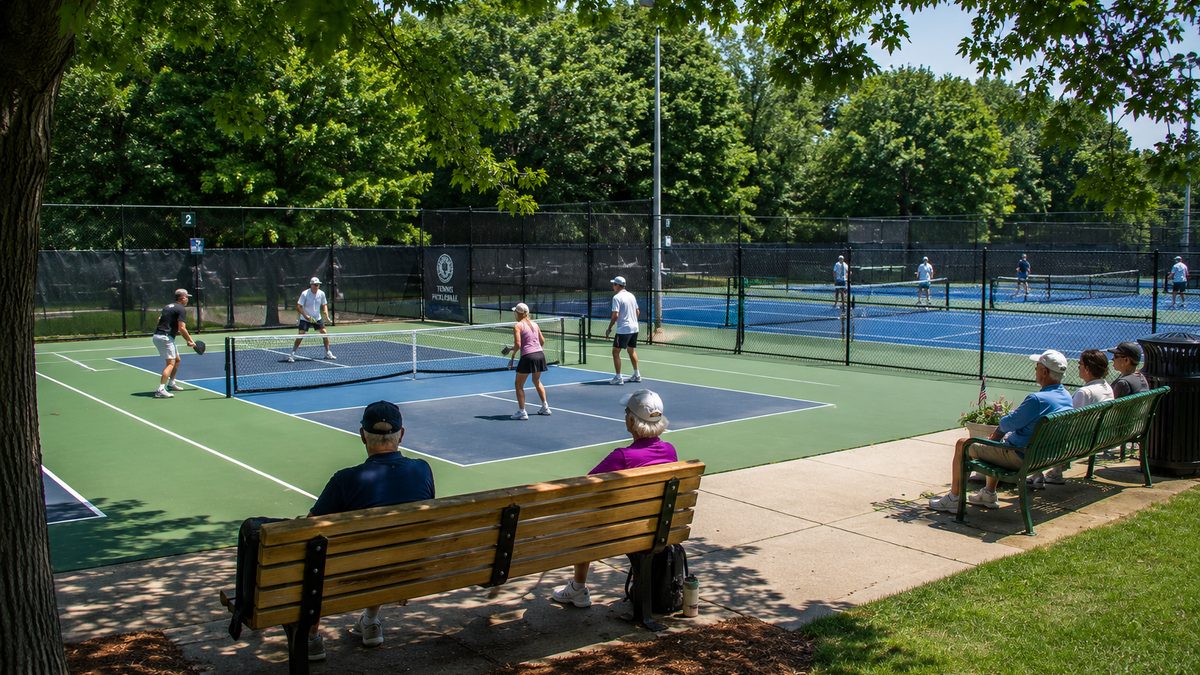
Pickleball's popularity is forcing cities to make ordinary but important choices about public space. Editorial illustration by TheDailyGlobe.
Key Facts
- Axios reported that pickleball court growth across the 100 largest U.S. cities slowed to 4% from 2025 to 2026.
- Axios reported that pickleball court availability has still risen dramatically since 2017.
- Local Axios coverage in several cities shows the trend playing out differently by region.
- It remains unclear whether the slowdown reflects saturation, local pushback, funding shifts or competing park priorities.
- Cities are weighing pickleball demand against tennis, basketball, open space and noise concerns.
The sound is easy to recognize now: a plastic ball popping back and forth across a small court, often in a park that used to be quieter or used for something else.
Pickleball's rise has turned a friendly, fast-growing sport into a local government question. Cities are being asked to decide where courts belong, how much space the sport should get, and how to handle neighbors who say the noise has changed the feel of nearby parks.
Axios reported that pickleball court growth across the 100 largest U.S. cities slowed to 4% from 2025 to 2026 after years of rapid expansion. The sport is not disappearing. The question is whether the building boom is running into the limits of public space.
Why a Court Slowdown Still Matters
A slowdown in new courts does not mean pickleball has faded from public life. It may mean the easiest conversions have already happened. Many cities added courts by repainting tennis courts, using unused hard surfaces or fitting multiple pickleball courts into spaces that once served fewer players.
That helped the sport grow quickly. It also created tradeoffs. Every court has a location, a cost and a set of neighbors. A new pickleball court may delight players who want more places to play, while frustrating tennis players, nearby residents or park users who want open space preserved.
The public question is not whether pickleball is good or bad. It is how cities should handle a sport that became popular faster than many park systems were built to absorb.
The Noise and Space Problem
Pickleball fits neatly into crowded parks because the courts are small and the game is easy to learn. That is part of its appeal. It also means several games can happen close together, creating more activity in a compact area.
For players, that can make a park feel lively and useful. For nearby residents, the repeated popping sound can feel constant, especially when courts sit close to homes. For city officials, the complaints can turn a recreation decision into a neighborhood dispute.
Those disputes are usually practical rather than dramatic. Should courts have limited hours? Should sound barriers be added? Should new courts go farther from homes? Should tennis courts be converted, shared or protected? None of those questions has one answer that fits every city.
Different Cities, Different Pressures
Local coverage shows the trend playing out differently by region. Some cities may still see strong demand and room for more courts. Others may already be hearing from residents, tennis players or park boards that say the growth needs limits.
That variation matters because public parks are local by design. A court that works well in a large regional park may not work the same way in a dense neighborhood park. A city with private pickleball venues may feel less pressure to build public courts than one where public parks are the main affordable option.
The sport's growth has also made the public-private divide more visible. Private clubs can serve players willing to pay, but public parks remain the place where recreation is supposed to be widely accessible. Cities have to decide how much of that shared space one fast-growing sport should receive.
What Remains Unclear
It is not yet clear what the slowdown means. It could reflect saturation after years of quick building. It could reflect pushback from neighbors. It could reflect park budgets, competing priorities or the rise of private pickleball businesses.
It is also unclear how cities will balance the sport against other public uses. Tennis, basketball, playgrounds, walking paths, picnic areas and open lawns all compete for attention in parks that may not be getting larger.
The answer will likely come city by city, not from one national trend line. Park boards, recreation departments and local councils will make the choices that determine whether pickleball keeps expanding, levels off or moves more of its growth indoors and into private venues.
What to Watch Locally
The next signs to watch are local park board decisions, noise rules, court-sharing policies and private venue openings. Those details will show whether cities see pickleball as a continuing public priority or as a sport that has reached its natural limit in some parks.
For now, pickleball remains more than a trend. It is a reminder that public parks are shared spaces, and shared spaces require choices. The harder part for cities is making those choices without treating players, neighbors or other park users as the problem.
Reporting note: Reporting draws on Axios coverage, Trust for Public Land data cited in reporting, local recreation coverage, and reviewed background materials. This article was produced with AI-assisted research and reviewed by an editor before publication.