Memorial Day Calls Americans to Remember the Cost of Service
Memorial Day is more than a long weekend. It is a national act of remembrance for the Americans who died in service across the country’s wars, conflicts and generations of military duty.
Save Article
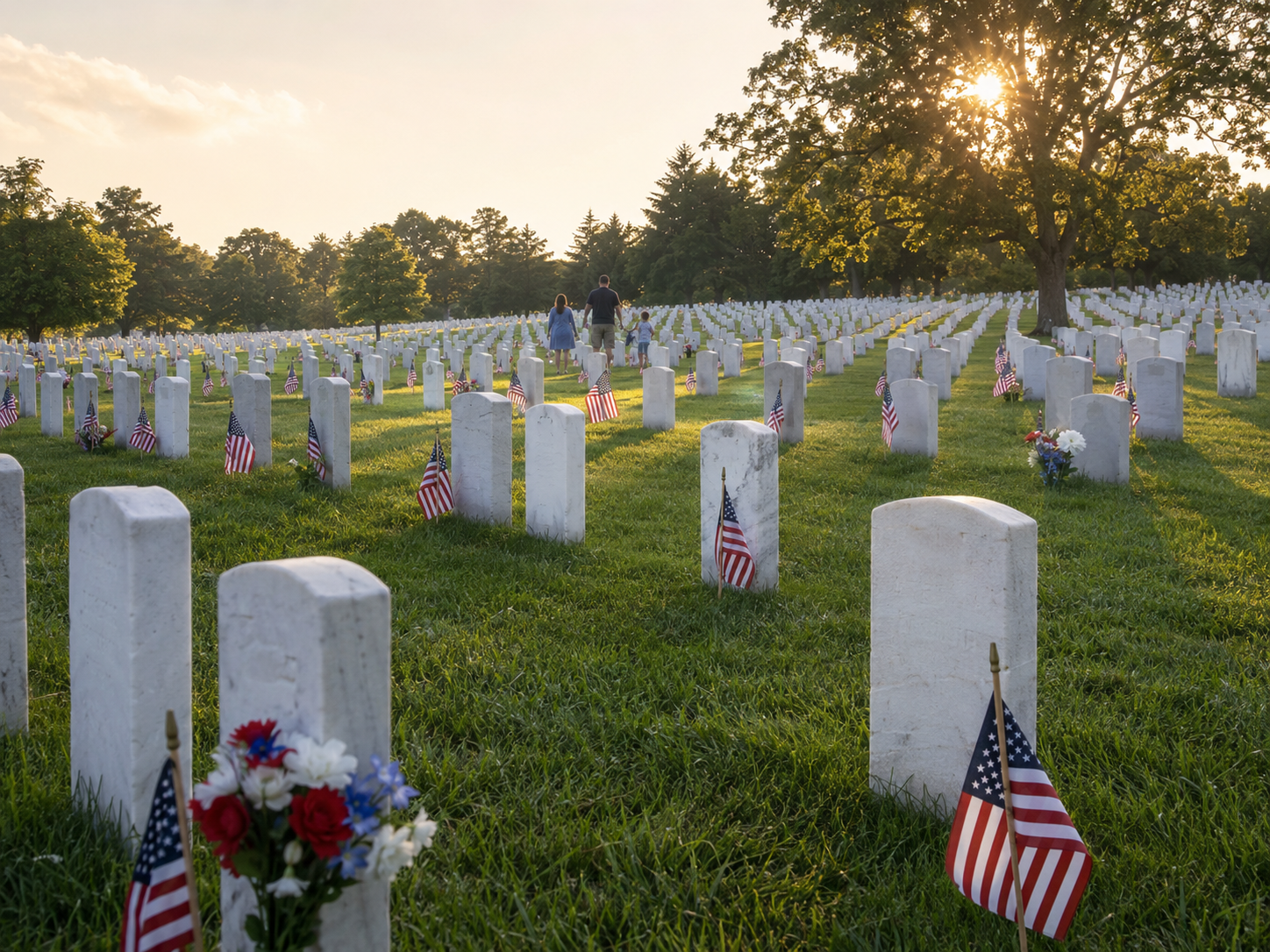
Memorial Day honors the Americans who died while serving in the United States Armed Forces. Editorial illustration by TheDailyGlobe.
Key Facts
- The holiday grew from Decoration Day observances after the Civil War.
- The first official national Decoration Day commemoration was held at Arlington National Cemetery on May 30, 1868.
- The holiday’s purpose remains solemn even as many Americans also mark the weekend as the unofficial start of summer.
Memorial Day asks something simple and difficult of the country: to pause, remember and measure the freedoms of American life against the lives lost defending them.
For many families, the holiday is personal. It is a name on a headstone, a folded flag, a photograph on a shelf, a story told carefully to children who never met the person being remembered. For the country as a whole, Memorial Day is a civic act of gratitude for the men and women who died while serving in the United States Armed Forces.
From Decoration Day to Memorial Day
Memorial Day’s modern roots reach back to the years after the Civil War, when communities across the country began decorating the graves of the dead. The war had left a national wound almost beyond measure. Families, veterans and local communities gathered in cemeteries to place flowers, pray, speak names aloud and give public form to private grief.
The first official national Decoration Day commemoration took place at Arlington National Cemetery on May 30, 1868, after the Grand Army of the Republic called for a day to decorate the graves of those who died in the Civil War. Arlington remains one of the country’s central places of remembrance, but the spirit of the day has always been larger than one cemetery or one ceremony.
Over time, Decoration Day became Memorial Day. What began as a way to remember the dead of the Civil War expanded to honor Americans who died in all U.S. military service. Since 1971, Memorial Day has been observed as a federal holiday on the last Monday in May.
A Tribute Across Generations
The history of the United States Armed Forces is also the history of generations asked to carry burdens most citizens never fully see. From the Continental Army of the Revolution to today’s soldiers, sailors, airmen, Marines, guardians and Coast Guard members, military service has taken Americans from farms, cities, reservations, factories, colleges and neighborhoods into conflicts across the world.
Those remembered on Memorial Day died in different uniforms, in different eras and under different political leaders. They served in wars Americans still debate and in missions many Americans barely remember. Some died in battle. Others died in training, at sea, in the air, in distant bases or while carrying out duties far from public attention.
The country does not have to pretend every war was simple to honor the people who served. A mature patriotism can hold both truths at once: citizens may debate policy, strategy and the use of force while still recognizing the sacrifice of those who gave their lives in uniform.
What Remembrance Requires
Remembrance is more than ceremony. It is a responsibility to tell the truth about cost. Military service is often discussed through words like courage, duty and honor. Those words matter. But Memorial Day also belongs to absence: the empty chair, the missed birthday, the parent who did not come home, the spouse who carried grief quietly for decades.
That is why small traditions endure. Flags are placed at graves. Names are read. Families visit cemeteries. Communities gather for parades and services. At 3 p.m. local time, Americans are encouraged to observe the National Moment of Remembrance, a brief pause meant to return the day to its central purpose.
Patriotism Without Forgetting
Memorial Day allows room for patriotism, but the best patriotism on this day is not loud or boastful. It is grateful. It understands that national pride should be tied to national memory. The United States has endured because many Americans believed it was worth serving, defending and, in too many cases, dying for.
The American flag on Memorial Day is not only a symbol of power. It is also a marker of debt. It represents the promise that the living will not forget the dead, and that freedom carries obligations beyond comfort, convenience or politics.
Why It Still Matters
In a divided country, Memorial Day remains one of the few observances that can still call Americans toward a shared posture of humility. People may disagree about wars, presidents, parties and policies. But the dead are not campaign material. They are sons and daughters, brothers and sisters, friends, parents and neighbors whose lives ended in service to the nation.
Remembering them does not require every American to feel the same way about history. It requires seriousness. It requires gratitude. It requires a willingness to pause long enough to recognize that the freedoms enjoyed in ordinary life were protected by people whose names most of us will never know.
That is the heart of Memorial Day. Not noise. Not performance. Not a slogan. A country stops for a day and remembers those who did not come home.
Reporting note: Reporting draws on materials from the Department of Veterans Affairs, Arlington National Cemetery, the U.S. Army Center of Military History, the National Archives, Associated Press background reporting, and reviewed historical context on Memorial Day and U.S. military remembrance. This article was produced with AI-assisted research and reviewed by an editor before publication.