Why Launching a Drone From Water Is Harder Than It Looks
Researchers at the University of Central Florida are studying one of the biggest challenges facing future amphibious drones: the moment a vehicle leaves the water and enters the air.
Save Article
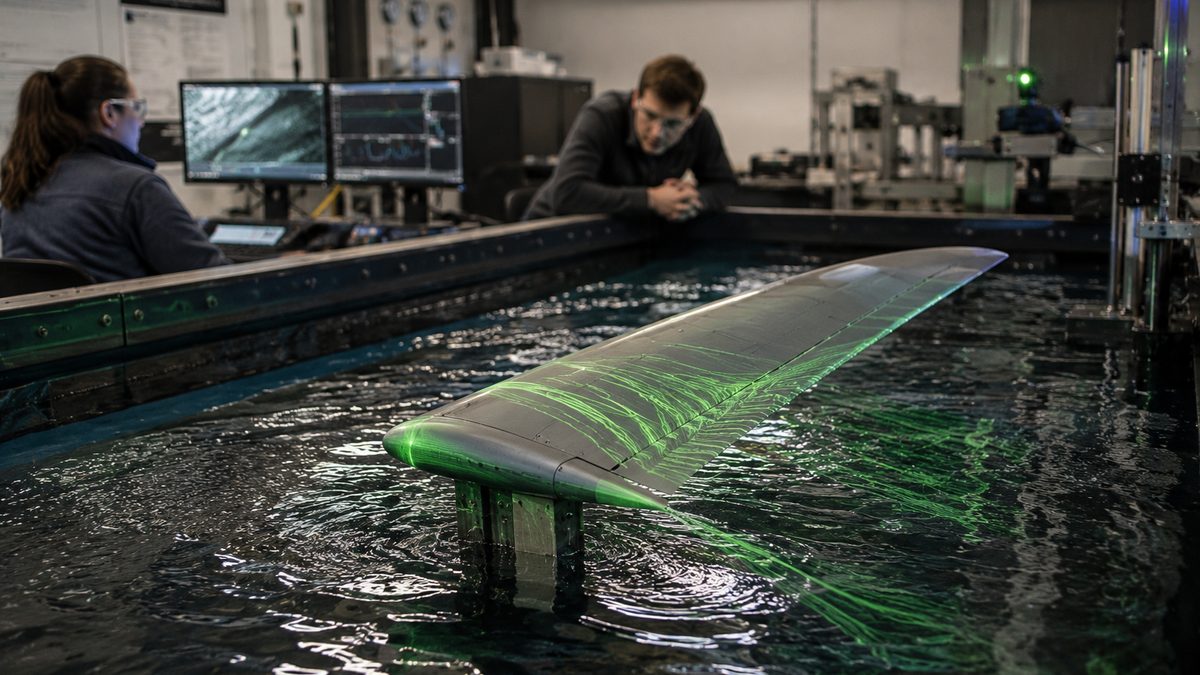
Researchers are studying how wing shapes behave as future amphibious drones move from water into air. Editorial illustration by TheDailyGlobe.
Key Facts
- University of Central Florida researchers are studying how wing shape and motion affect the transition from water to air.
- The transition is known in aerospace research as egress.
- Researchers are using water tanks and 3D-printed wings to study forces acting on wings as they leave the water.
- The work examines effects including surface deformation, wave formation, and vortex shedding.
- Early findings were presented at the 2026 American Institute of Aeronautics and Astronautics SciTech Forum.
A seabird can dive into the ocean, chase a fish, and launch back into the air in seconds. Some rays can even burst from the water and glide briefly above the surface. Nature makes the transition look effortless.
For drones, however, moving from water into flight is far more complicated. The moment a wing breaks through the surface, it encounters rapidly changing forces that can affect balance, lift, and stability. A vehicle that flies smoothly in the air may behave very differently when it first emerges from the water.
Researchers at the University of Central Florida are studying that transition in hopes of helping engineers design future amphibious drones capable of operating in coastal environments, monitoring oceans, or potentially assisting during disaster-response missions.
The Challenge Happens in a Split Second
The problem begins at the boundary between water and air. Water is far denser than air, which means forces acting on a wing can change dramatically within moments as the wing crosses the surface.
Engineers refer to this transition as egress. During egress, a wing may experience sudden changes in lift and drag. Water can cling to surfaces, waves can form around the wing, and swirling currents can develop behind it.
For a small drone, those changes can matter. A brief imbalance during takeoff could reduce efficiency, make control more difficult, or potentially disrupt flight altogether. Understanding those forces is one reason researchers are focusing on the problem before attempting larger real-world deployments.
What Researchers Are Testing
The UCF team is using controlled water-tank experiments to examine how different wing designs behave as they leave the water. Rather than testing complete aircraft, researchers are studying individual wing shapes and movements to isolate the factors that influence performance.
The experiments use 3D-printed wings and specialized measurement systems that allow researchers to observe what happens around the wing during the transition. The goal is to identify patterns that could eventually help engineers design more stable amphibious aircraft.
One area of interest is a phenomenon sometimes called lift overshoot. In simple terms, a wing may briefly generate more lift than expected as it leaves the water. While that might sound helpful, sudden changes can also create stability problems if designers do not understand how and when they occur.
Researchers are also examining vortex shedding, which occurs when swirling patterns form behind a moving object. Those vortices can influence how forces develop around a wing during the critical moment when it moves from one environment to another.
Why the Research Matters
Most drones today are designed to operate either in the air or on the ground. Vehicles that can move directly between water and air remain a more difficult engineering challenge.
If engineers eventually solve those challenges, amphibious drones could potentially reach areas that are difficult for traditional aircraft or boats. Researchers have pointed to possible future uses such as ocean monitoring, coastal surveys, environmental research, and support during search-and-rescue operations.
Those possibilities remain prospective applications rather than proven capabilities. The current research focuses on understanding the physics that would make such systems possible in the first place.
Questions the Lab Cannot Yet Answer
The findings so far come from controlled experiments rather than open-water operations. That means many practical questions remain unresolved.
Researchers do not yet know which wing designs will perform best in rough ocean conditions. Saltwater, wind, waves, payload weight, battery limitations, and repeated launches could all affect real-world performance.
It also remains unclear how easily laboratory findings will translate into complete drone systems. A successful wing design is only one part of a functioning aircraft. Engineers must also consider propulsion, navigation, durability, maintenance, and autonomous control systems.
What Readers Should Watch Next
The next milestone will likely be the development of more advanced prototypes that incorporate lessons learned from the wing experiments. Researchers will be looking to see whether the principles identified in water tanks can improve stability during actual water-to-air launches.
Open-water testing will provide a more demanding environment and may reveal challenges that do not appear in laboratory conditions. Those tests could help determine whether amphibious drones can move beyond research projects and become practical tools.
For now, the research offers a reminder that some of nature's simplest-looking movements involve surprisingly complicated physics. A bird leaving the water may appear effortless, but for engineers trying to build a drone that can do the same thing, there is still much to learn.
Reporting note: Reporting draws on university research materials, aerospace engineering reporting, conference presentations, and reviewed background materials. This article was produced with AI-assisted research and reviewed by an editor before publication.