Why Underwater Robots Need More Than Cameras to See Where They're Going
Researchers say a new mapping system combines sonar and cameras to help underwater robots build detailed 3D maps even when sediment and cloudy water block visibility.
Save Article
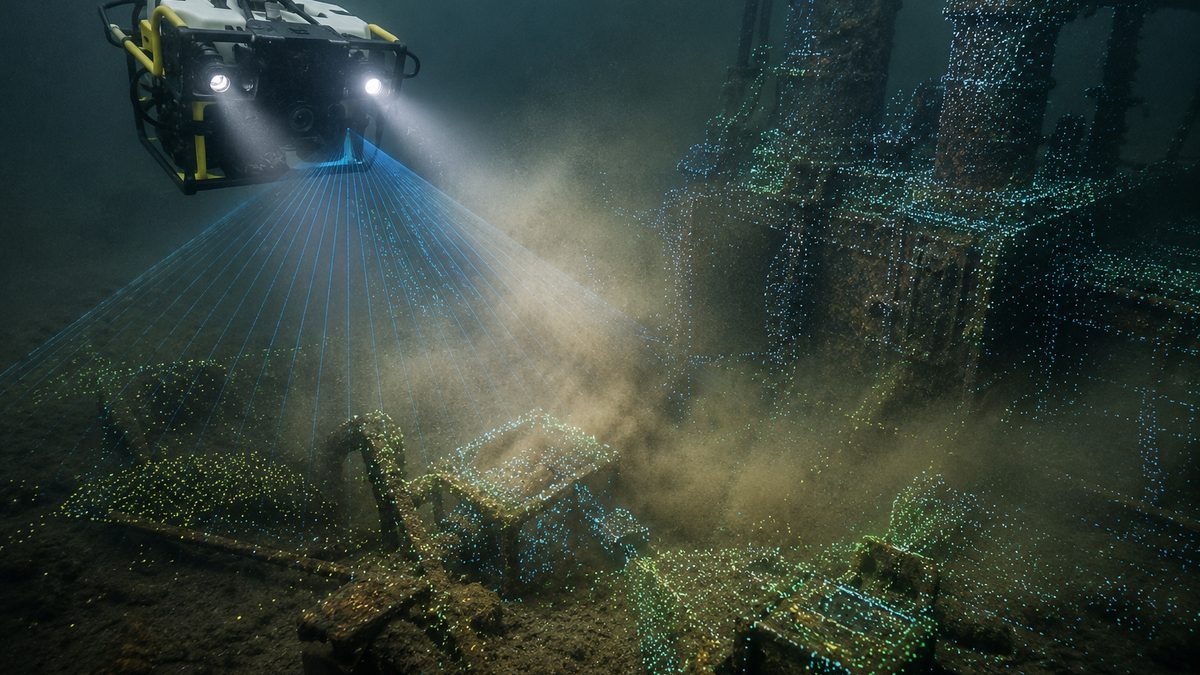
Researchers are combining sonar and camera data to help underwater robots navigate when visibility drops. Editorial illustration by TheDailyGlobe.
Key Facts
- Researchers reported that Sonar-MASt3R combines sonar and camera data to create real-time 3D maps in murky water.
- The system was tested in controlled tank experiments rather than open-water deployments.
- MIT said the technology was able to map environments and identify centimeter-scale object details in cloudy conditions.
- The research was presented at the IEEE International Conference on Robotics and Automation.
- The project received support from organizations including NASA and the National Science Foundation.
Anyone who has ever kicked up mud while walking through a pond has experienced the same problem facing many underwater robots: visibility can disappear almost instantly.
That challenge becomes especially difficult for robotic vehicles that rely on cameras to inspect structures, explore underwater environments, or navigate around obstacles. A robot can stir up sediment with its own movement and suddenly lose sight of the area it is trying to map.
Researchers from MIT and the Woods Hole Oceanographic Institution say they have developed a system designed to address that problem by combining sonar and camera data into a single real-time mapping process. The technology, called Sonar-MASt3R, aims to help underwater robots continue building detailed three-dimensional maps even when the water becomes cloudy.
Why Cameras and Sonar Have Opposite Strengths
The engineering challenge is relatively easy to understand. Cameras can capture fine details when visibility is good, making them useful for identifying objects and creating detailed images of underwater environments.
The problem is that cameras depend on light. Sediment, algae, turbulence, and other conditions can quickly reduce what they can see. In some situations, visibility can drop from several feet to almost nothing.
Sonar works differently. By using sound waves instead of light, it can detect objects and surfaces through water that appears opaque to a camera. However, sonar generally provides less visual detail than a camera image.
The research team's approach attempts to combine the strengths of both systems. Sonar supplies information about the surrounding environment when visibility deteriorates, while camera data helps provide finer detail where conditions allow.
What the Experiments Demonstrated
According to MIT, researchers tested the system in a controlled tank environment where visibility conditions could be managed and measured. The goal was to determine whether combining sonar and camera information could create more reliable maps than either system alone.
The reported results showed that the technology could build three-dimensional representations of the environment even when water conditions became cloudy. Researchers also reported being able to visualize object details at approximately centimeter scale during testing.
Those findings are noteworthy because underwater mapping often requires balancing detail and reliability. A system that maintains awareness of its surroundings while preserving useful detail could help robotic operators work in environments where cameras alone struggle.
Where Researchers Think It Could Be Useful
The research team has suggested that better underwater perception could eventually support a range of activities, including scientific exploration, infrastructure inspection, maintenance work, and recovery operations.
Many underwater tasks require robots to operate near structures, equipment, or seafloor environments where sediment can easily be disturbed. Maintaining an accurate map of the surrounding area becomes increasingly important as visibility worsens.
Researchers see sensor fusion—the process of combining information from multiple types of sensors—as one way to improve how autonomous and remotely operated underwater vehicles understand their surroundings.
What Remains Unproven
Despite the promising results, the research remains in an early stage. The reported testing took place in a controlled tank environment rather than in oceans, lakes, rivers, or other natural settings.
That distinction matters because real underwater environments introduce additional challenges, including currents, varying water chemistry, biological activity, changing lighting conditions, and unpredictable terrain.
It remains unclear how easily the system can be integrated into existing underwater vehicles, whether real-time performance will remain consistent during longer missions, or how well it will perform under a wide range of field conditions.
What Readers Should Watch Next
The next important step is not another laboratory demonstration but testing in natural underwater environments. Field trials will help determine whether the technology performs as well outside controlled conditions as it does inside them.
Researchers may also provide future updates on vehicle integration, software releases, or additional performance data. Those developments will offer a clearer picture of whether sonar-camera fusion becomes a practical tool for underwater robotics or remains primarily a promising research project.
For now, the work highlights a straightforward engineering idea: when one sensor struggles to see through the murk, combining it with another sensor may help underwater robots build a clearer picture of the world around them.
Reporting note: Reporting draws on university research materials, a published research paper, science and technology reporting, and reviewed background materials. This article was produced with AI-assisted research and reviewed by an editor before publication.