Why Researchers Think One-Nanometer Membranes Could Help Industry Reuse More Water
A newly developed membrane uses highly uniform one-nanometer pores to sort molecules more precisely, a step researchers believe could improve industrial water reuse if the technology succeeds outside the laboratory.
Save Article
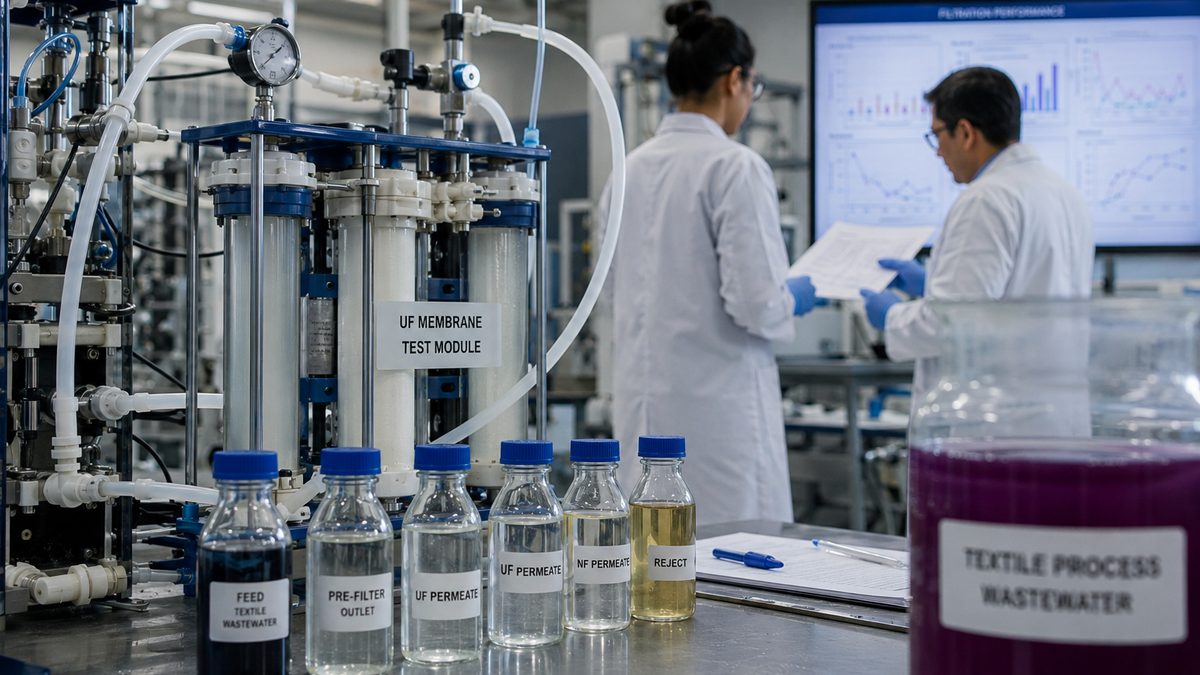
Researchers are studying ultra-precise membranes that could make industrial water reuse more efficient. Editorial illustration by TheDailyGlobe.
Key Facts
- Researchers developed filtration membranes known as POMbranes with highly uniform one-nanometer pores.
- The research was published in the Journal of the American Chemical Society.
- The project involved researchers from CSIR-CSMCRI, IIT Gandhinagar, Nanyang Technological University, and the S N Bose National Centre for Basic Sciences.
- Potential applications discussed in reporting include textile wastewater treatment, pharmaceutical purification, and food processing.
- The technology remains in the research stage and has not been proven in large-scale commercial deployment.
Many industrial processes depend on a task most people rarely think about: separating useful molecules from unwanted material. Whether a factory is treating wastewater, refining pharmaceutical ingredients, or processing food products, that sorting work often requires large amounts of energy, equipment, and water.
Researchers from several institutions in India and Singapore say they have developed a new type of filtration membrane that could make some of those separation steps more precise. The technology, known as a POMbrane, uses highly uniform pores measuring about one nanometer across. While still at the research stage, the work has attracted attention because it addresses a longstanding challenge in industrial filtration: creating membranes that consistently allow some molecules through while blocking others.
Why Pore Size Matters
A nanometer is one-billionth of a meter. At that scale, even tiny differences in pore size can affect which molecules pass through a membrane and which are blocked. Many existing filtration systems contain pores that vary slightly in size, which can reduce precision during separation.
According to research reports describing the project, the new membranes were designed with unusually consistent one-nanometer openings. That uniformity could allow more controlled molecular sorting, potentially improving the efficiency of certain industrial processes that rely on filtration.
Potential Uses Beyond the Laboratory
The research team and related reporting point to several possible applications. Textile manufacturing, for example, often generates wastewater containing dyes and chemical compounds that can be difficult to separate. Pharmaceutical production frequently requires purification steps that isolate specific molecules from complex mixtures. Food processing operations also depend on filtration systems for various separation tasks.
Researchers argue that more precise membranes could help industries recover useful materials while reducing the amount of water that must be discarded or heavily treated. Reporting on the project also notes the possibility of lowering some energy demands associated with industrial separation processes. However, those benefits remain projections rather than demonstrated commercial outcomes.
What the Research Does Not Yet Prove
The excitement around the technology comes with important limits. The published work demonstrates a scientific advance in membrane design, but it does not establish that the membranes can be manufactured economically at industrial scale.
Several practical questions remain unanswered. Researchers still need to determine how the membranes perform when exposed to real industrial wastewater streams, which are often far more complex than controlled laboratory samples. Long-term durability is another open question, as filtration systems can degrade over time when exposed to harsh operating conditions.
Engineers will also need to evaluate fouling resistance, a common problem in which contaminants accumulate on membrane surfaces and reduce performance. Even promising laboratory technologies can struggle if maintenance costs become too high in commercial settings.
What Readers Should Watch Next
For now, the most important takeaway is not that industry has a new water-treatment solution ready for deployment. Instead, researchers have demonstrated a new approach to building highly precise filtration membranes that could eventually prove useful in several industries.
The next phase to watch will be pilot-scale testing and industry trials. Those efforts could reveal whether the membranes maintain their performance outside the laboratory, how long they last, and whether they can compete with existing technologies on cost and maintenance.
If future testing confirms the early promise, the technology could become part of a broader push to make industrial water use and chemical separation more efficient. Until then, the research represents an intriguing engineering development rather than a proven commercial breakthrough.
Reporting note: Reporting draws on published research, scientific institution materials, science reporting, and reviewed background materials. This article was produced with AI-assisted research and reviewed by an editor before publication.