Origami-Inspired 3D Printing Could Build Lightweight Structures Without Molds
Researchers at Oak Ridge National Laboratory are testing a manufacturing approach that combines 3D printing, flexible materials, and origami-inspired folding to create lightweight structures without traditional molds.
Save Article
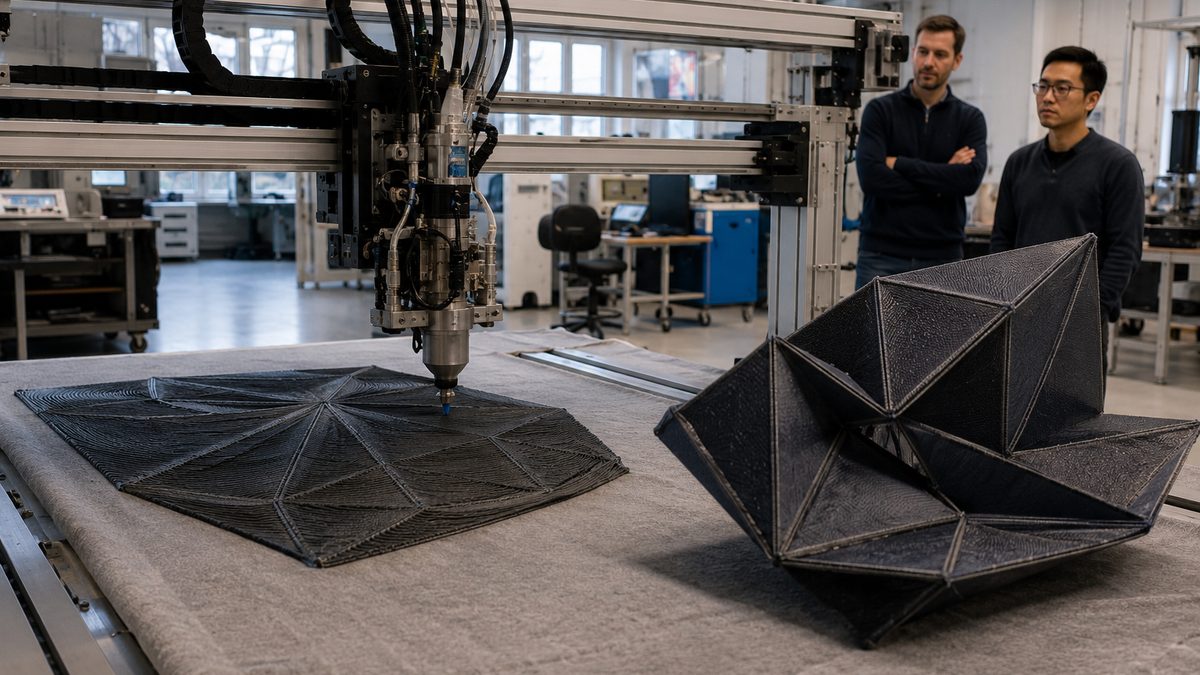
Origami-inspired 3D printing could help engineers build lightweight structures without traditional molds. Editorial illustration by TheDailyGlobe.
Key Facts
- ORNL researchers reported a manufacturing method that combines origami-inspired design with additive manufacturing and hybrid composites.
- The work was conducted through the Department of Energy's Manufacturing Demonstration Facility.
- The process deposits an integration layer and composite material directly onto flexible nylon fabric.
- The resulting structures can be printed flat and later folded into three-dimensional forms.
- ORNL and supporting coverage described the method as offering faster build times and greater design flexibility than some traditional approaches.
Making strong, lightweight parts is often more complicated than it looks. Many composite structures require custom molds, specialized tooling, and manufacturing steps that can add time, cost, and design limitations before a finished product ever leaves the factory floor.
Engineers have spent years searching for ways to simplify that process while maintaining strength and flexibility. One idea now being explored borrows inspiration from an unlikely source: origami.
Researchers at Oak Ridge National Laboratory, or ORNL, recently described a manufacturing approach that combines 3D printing with foldable composite materials. The goal is not to create paper-like art projects, but to develop practical engineering structures that can be printed flat and then folded into useful shapes.
Why Molds Matter in Manufacturing
Many composite parts begin with a mold that determines the final shape of the product. Molds can work well for high-volume manufacturing, but they also require time, materials, and upfront investment. Creating a new design often means creating a new mold as well.
That process can slow experimentation and make customized production more difficult. For industries that rely on lightweight structures, including transportation, aerospace, and industrial equipment, engineers are constantly looking for ways to reduce those constraints.
The ORNL approach attempts to address part of that challenge by removing the need for certain molds altogether.
How the Folding Process Works
According to ORNL, the manufacturing method deposits an integration layer and composite material directly onto flexible nylon fabric. Instead of producing a rigid part in its final shape, the process creates a flat structure that can later be folded into a three-dimensional form.
The folding patterns are inspired by principles used in origami, the practice of creating complex shapes through carefully planned folds. In this case, however, the goal is engineering performance rather than artistic expression.
By combining flexible materials with printed composite elements, researchers can design structures that change shape after manufacturing while still maintaining strength and functionality.
Where the Technology Could Be Useful
One reason the research has attracted attention is its potential versatility. Lightweight structures are valuable in many fields because reducing weight can improve efficiency, simplify transport, and expand design options.
A structure that can be manufactured flat and assembled later may offer advantages in situations where storage space or transportation volume matters. Researchers have pointed to design flexibility as one possible benefit of the approach.
Potential future applications could include transportation systems, aerospace hardware, emergency shelters, field equipment, or custom-built industrial components. At this stage, however, those possibilities remain examples of where the concept might be useful rather than confirmed deployment plans.
Questions That Still Need Answers
As with many engineering developments, promising laboratory results do not automatically translate into widespread industrial use. Several important questions remain unresolved.
Researchers still need to understand how these folded structures perform under long-term stress, repeated use, harsh weather conditions, and other real-world environments. Durability often determines whether a manufacturing technique succeeds beyond research settings.
Economic questions also remain. It is not yet clear how the process compares with conventional composite manufacturing when scaled for larger production runs. Manufacturing systems that work well in research facilities sometimes face new challenges when companies attempt to use them at industrial volumes.
What Readers Should Watch Next
The next phase of development will likely focus on testing, validation, and practical demonstrations. Engineers will be looking for opportunities to evaluate how the structures perform outside controlled research environments.
Industries that depend on lightweight materials may provide some of the earliest opportunities to test the concept in real-world conditions. Transportation, aerospace, emergency response equipment, and specialized manufacturing are among the areas where foldable composite structures could eventually attract attention.
For now, the research offers a glimpse of how manufacturing techniques continue to evolve. Instead of building every structure around fixed molds and rigid production steps, engineers are exploring whether materials can be printed flat, folded later, and still deliver the performance required for demanding applications. Whether the approach gains broader adoption remains uncertain, but it highlights how ideas borrowed from unexpected places can sometimes influence the future of manufacturing.
Reporting note: Reporting draws on national laboratory research materials, engineering publications, technical reporting, and reviewed background materials. This article was produced with AI-assisted research and reviewed by an editor before publication.