Why Fire Departments Are Testing Robot Dogs for Dangerous Emergency Scenes
A four-legged detection robot is being developed to enter hazardous areas before firefighters, gathering information that could help emergency crews make safer decisions.
Save Article
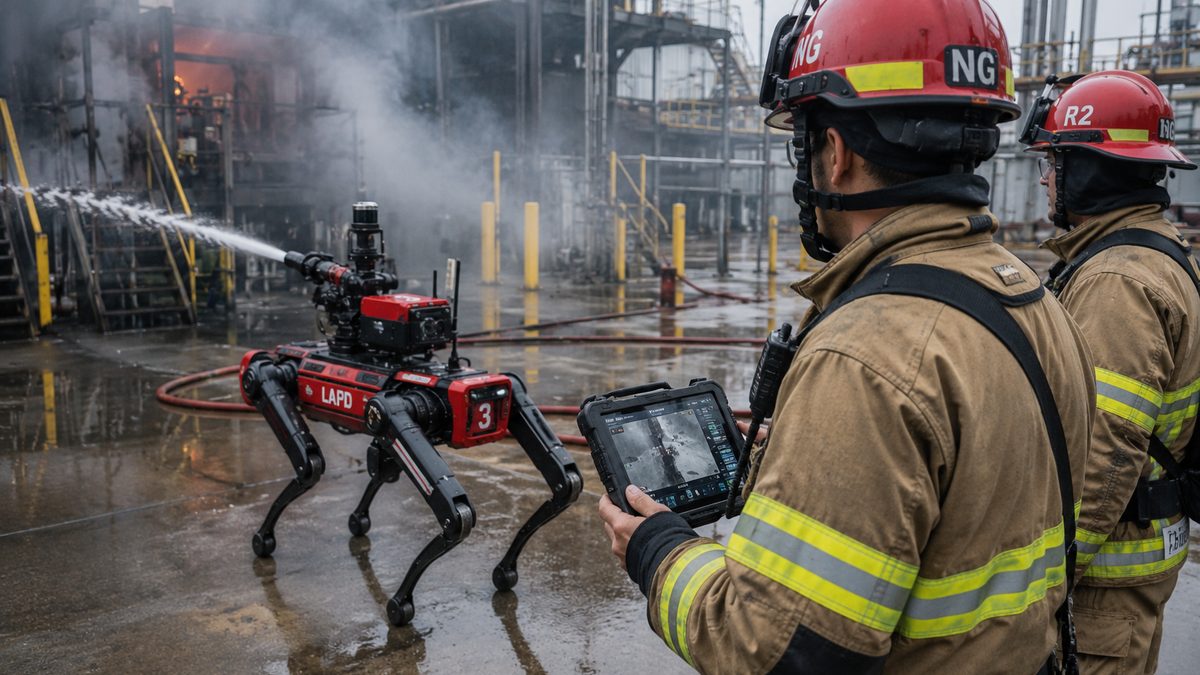
Robots designed for hazardous scenes could help firefighters gather information before people enter dangerous areas. Editorial illustration by TheDailyGlobe.
Key Facts
- TU Graz described a four-legged detection robot designed for firefighting and hazardous-materials situations.
- The robot is intended to enter dangerous areas before emergency responders.
- The system can measure pollutant concentrations in hazardous environments.
- Collected data can be transmitted back to emergency personnel.
- The robot is described as a support tool for responders rather than a replacement for firefighters.
One of the hardest decisions firefighters face is whether it is safe to enter a burning building, chemical spill, or hazardous-materials scene. In many emergencies, responders must make those decisions with limited information while facing smoke, toxic substances, unstable structures, or other dangers that can threaten lives within seconds.
Researchers at Graz University of Technology, known as TU Graz, are working on a possible solution: a four-legged detection robot designed to enter dangerous areas before people do. The machine is intended to collect information from hazardous environments and transmit that data back to emergency crews, helping them better understand conditions before committing personnel to a risky operation.
Gathering Information Before People Enter
The central purpose of the robot is straightforward: gather information from places that may be too dangerous for immediate human entry. A hazardous-materials release, industrial accident, warehouse fire, or smoke-filled structure can contain risks that are difficult to evaluate from outside.
According to descriptions of the system, the robot can move into those environments and collect measurements, including pollutant concentrations. That information can then be sent back to responders, giving incident commanders a clearer picture of what conditions exist inside an affected area.
In emergency response, even a small amount of additional information can influence critical decisions. Knowing where hazardous substances are concentrated or identifying areas that appear especially dangerous could help crews determine entry routes, protective equipment requirements, or whether conditions are too risky for immediate operations.
Why Four Legs Matter
Unlike wheeled robots that can struggle with debris, uneven surfaces, or obstacles, four-legged machines are designed to navigate more complex terrain. That mobility has made robot dogs a growing area of research for inspection work, industrial monitoring, and public-safety applications.
Emergency scenes are rarely neat or predictable. Stairs, rubble, damaged flooring, hoses, equipment, and low visibility can create challenges for robotic systems. Developers hope legged designs may be better suited to environments where traditional robotic platforms have limitations.
A Tool for Firefighters, Not a Replacement
The technology is often described in headlines as a robotic firefighter, but that label can be misleading. The current focus is not replacing emergency crews. Instead, the robot is intended to act as a reconnaissance and detection platform that helps human responders make better-informed decisions.
Firefighters still perform the work that requires human judgment, training, communication, rescue skills, and operational decision-making. The robot's role is to reduce uncertainty by providing information from locations that may be unsafe for immediate human access.
What Still Needs to Be Proven
Several important questions remain unanswered. Public descriptions of the system establish its intended purpose, but they do not yet demonstrate widespread real-world deployment. It remains unclear how extensively the robot has been tested outside controlled demonstrations or research environments.
Cost is another open question. Fire departments and emergency agencies often operate under tight budgets, and new technology must justify both purchase and maintenance expenses. Training requirements, software support, repairs, and replacement parts can all influence adoption decisions.
Researchers and emergency agencies will also need to determine how the robot performs under realistic emergency conditions. Smoke, heat, water, debris, unstable structures, and communications challenges can all affect robotic systems in ways that are difficult to fully replicate during demonstrations.
What Comes Next
The next development to watch is whether fire departments begin evaluating these systems in training exercises and hazardous-materials response programs. Those tests could provide valuable evidence about reliability, durability, and operational usefulness.
For now, the technology represents an effort to solve a practical problem rather than showcase a futuristic gadget. Emergency crews often need better information before entering dangerous environments. If robotic detection systems can safely provide that information, they may become another tool that helps responders protect both the public and themselves.
Reporting note: Reporting draws on university research materials, technology reporting, engineering publications, and reviewed background materials. This article was produced with AI-assisted research and reviewed by an editor before publication.