What Rice Can Teach Engineers About Building Smarter Materials
Researchers found an unusual behavior in packed rice grains and used it to design a material that reacts differently to slow pressure and sudden impacts without electronics.
Save Article
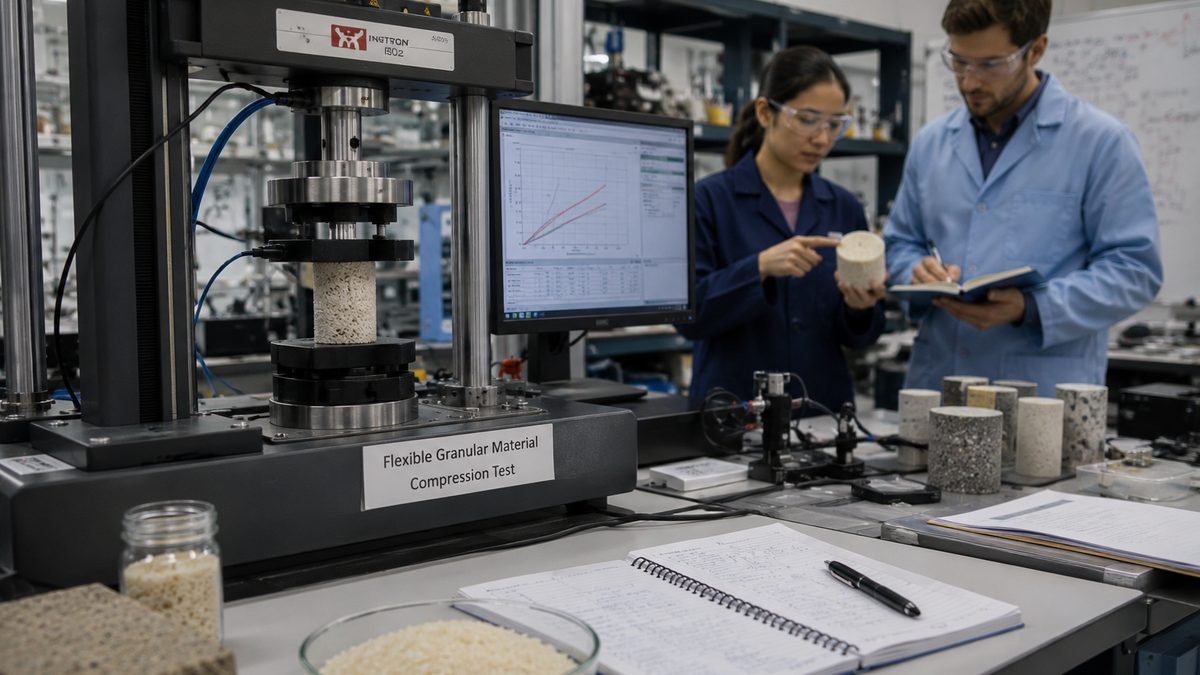
A strange property in packed rice grains is helping researchers design materials that respond differently to slow pressure and sudden impact. Editorial illustration by TheDailyGlobe.
Key Facts
- Researchers found that packed rice grains weaken under rapid compression while remaining stronger under slower pressure.
- The behavior is known as rate softening.
- The team used the effect to design a granular metamaterial.
- The material can respond differently to slow movement and sudden impact without electronics, sensors, or active controls.
- The research was published in the journal Matter.
Rice is one of the most familiar foods in the world. It is not something most people would expect to influence the design of future robots or advanced safety equipment. Yet researchers studying how packed rice grains behave under pressure say they found a surprising physical effect that could help engineers create materials that respond automatically to different kinds of force.
The finding centers on what happens when rice grains are compressed. Researchers reported that tightly packed rice weakens when squeezed quickly but remains stronger when pressure is applied more slowly. They used that behavior as the basis for a new engineered material designed to respond differently depending on how force arrives.
A Material That Reacts Without Electronics
Most smart technologies rely on sensors, software, batteries, or electronic controls to detect changes and respond. The material described in this research works in a different way. Its response comes from its physical structure.
Researchers describe the design as a granular metamaterial. Metamaterials are engineered structures whose behavior comes from how their parts are arranged. In this case, the arrangement allows the material to react one way when force is applied slowly and another way when force arrives suddenly.
That distinction could matter in systems where a material needs to stay flexible during ordinary movement but respond differently during an impact. The idea is especially interesting because it suggests some adaptive behavior can be built into the material itself rather than added through electronics.
Why Engineers Are Paying Attention
One possible use is soft robotics. Unlike traditional industrial robots built around rigid parts, soft robots are designed to bend, stretch, and move in ways that are closer to living systems. Materials that naturally react to different forces could eventually help those robots move safely around people or fragile objects.
Researchers and reporting on the work have also pointed to possible uses in protective equipment. A material that behaves differently during normal motion and sudden impact could be relevant to padding, helmets, cushioning, or other safety gear. Those uses remain possibilities, not finished products.
What Has Not Been Proven Yet
The research does not mean rice itself will become robot parts or consumer safety gear. The value is in the behavior researchers observed and the design principle they built from it.
Several practical questions remain. Researchers still need to show how the material performs after repeated impacts and long-term use. It is also unclear whether the design can be manufactured into practical robot components or protective products at useful scale.
Another open question is how the material compares with existing impact-absorbing materials. A laboratory result can be promising without being ready for real-world products, especially when durability, cost, manufacturing, and maintenance still have to be tested.
What Comes Next
The next stage to watch is prototype testing. Engineers will need to see whether the material keeps its unusual behavior after repeated stress and whether it can be shaped into useful parts for robotics or safety equipment.
Future tests may focus on robot joints, padding, helmets, and other gear where the difference between slow movement and sudden impact matters. Those applications are not established yet, but they show why the research is more than a curiosity.
For now, the main lesson is simple: an ordinary grain of rice helped researchers notice a behavior that could guide a new class of passive smart materials. If later testing holds up, that insight could help engineers build materials that react to the world around them without needing an electronic brain.
Reporting note: Reporting draws on published research, scientific institution materials, science reporting, and reviewed background materials. This article was produced with AI-assisted research and reviewed by an editor before publication.