A New NASA Satellite Is Revealing How Air Pollution Changes Hour by Hour
NASA's TEMPO mission is providing a closer look at how pollution moves and changes throughout the day, offering researchers a level of detail that older satellites could not provide.
Save Article
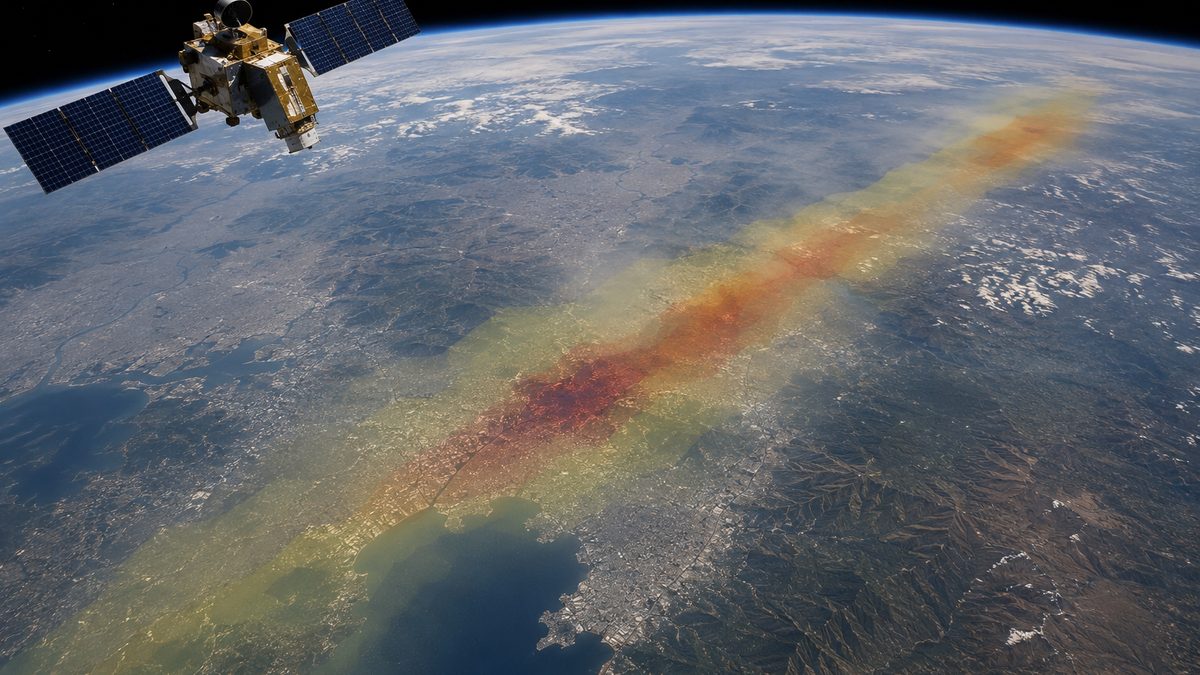
Hourly satellite observations are giving researchers a clearer view of how air pollution changes through the day. Editorial illustration by TheDailyGlobe.
Key Facts
- NASA reported that TEMPO tracked morning nitrogen dioxide that contributed to afternoon ozone formation along the New York-Washington corridor.
- NASA observed high nitrogen dioxide concentrations during the morning commute on May 18, 2026, and lower concentrations later in the afternoon.
- More than 35 million people live along the New York-Washington corridor, according to NASA.
- Older polar-orbiting satellites typically collected pollution observations over New York about once per day.
- TEMPO provides hourly daytime observations after being placed into operation.
Most people only think about air pollution when they see an air-quality alert on their phone or hear a forecast mention ozone levels. What is usually invisible is how those conditions change from hour to hour as traffic increases, sunlight intensifies, and pollutants move across a region.
NASA's TEMPO mission is offering a much closer look at that daily cycle. New observations released by NASA show how pollution evolved across the densely populated New York-Washington corridor during a May 2026 air-quality episode, giving researchers a detailed view of changes that older satellites could not capture as frequently.
The result is not a new public warning system or a replacement for existing air-quality monitoring. Instead, it is a new source of information that could help researchers and agencies better understand how pollution develops throughout the day.
What TEMPO Observed Over the Northeast
According to NASA, TEMPO tracked elevated nitrogen dioxide concentrations during the morning commute on May 18. By later in the day, those levels had decreased while ozone concentrations increased across parts of the corridor stretching between New York and Washington.
That pattern matters because nitrogen dioxide is one of the ingredients involved in the formation of ground-level ozone. Sunlight and atmospheric conditions can help convert pollution from vehicles and other sources into ozone as the day progresses.
The observations provided a visual example of a process that scientists have long understood but have not always been able to monitor with hourly regional coverage from space.
Why Hourly Data Is Different
Before TEMPO, many pollution-monitoring satellites followed polar orbits around Earth. Those systems could provide valuable observations, but they often captured conditions over a location only once during a day.
TEMPO takes a different approach. Positioned in geostationary orbit, it continuously watches the same broad region and can collect observations throughout daylight hours. That allows researchers to see how pollution changes between morning, midday, and afternoon rather than relying on a single daily snapshot.
For researchers studying urban pollution, transportation emissions, weather interactions, and ozone formation, that additional detail can reveal patterns that would otherwise be difficult to observe from space.
What the Technology Can and Cannot Do
The mission's capabilities come with important limitations. NASA noted that some of the data products highlighted in the recent observations remain provisional, while the ozone mapping used beta data that has not yet been optimized for operational use.
That means the images and measurements should not be viewed as a finished public forecasting product. They are part of an evolving scientific system that continues to be evaluated and refined.
NASA also does not present TEMPO as a replacement for ground monitoring networks. Ground sensors remain an important part of measuring local conditions and supporting official air-quality reporting.
How the Information Could Be Used
NASA says one potential benefit of the mission is helping researchers improve atmospheric models and air-quality forecasting systems. The idea is straightforward: better information about how pollution moves and changes could eventually support better understanding of future pollution events.
What remains unclear is how quickly those benefits will become part of routine operational forecasting. Public agencies, researchers, and forecasting systems typically require time to evaluate new data sources and determine how best to incorporate them.
The available reporting does not establish that TEMPO has already transformed forecasting. It does show that researchers now have access to a level of daytime observation that was previously unavailable from older satellite systems.
What Readers Should Watch Next
Summer often brings conditions that can contribute to ozone formation, and wildfire smoke events have become a growing concern in parts of North America. Those situations may provide some of the clearest examples of how hourly satellite observations can be used in practice.
In the coming months, researchers and public agencies will continue evaluating how TEMPO data fits alongside existing monitoring networks and forecasting tools. The satellite is already showing pollution's daily rhythm in greater detail. The next question is how that information will be integrated into the systems people rely on to understand the air around them.
Reporting note: Reporting draws on NASA Earth Observatory materials, scientific reporting, mission documentation, and reviewed background materials. This article was produced with AI-assisted research and reviewed by an editor before publication.