NASA Is About to Try a Robotic Rescue of a Fading Space Telescope
NASA and a private spacecraft company are preparing an unusual mission that could give a two-decade-old science telescope more time in orbit while testing a new approach to satellite maintenance.
Save Article
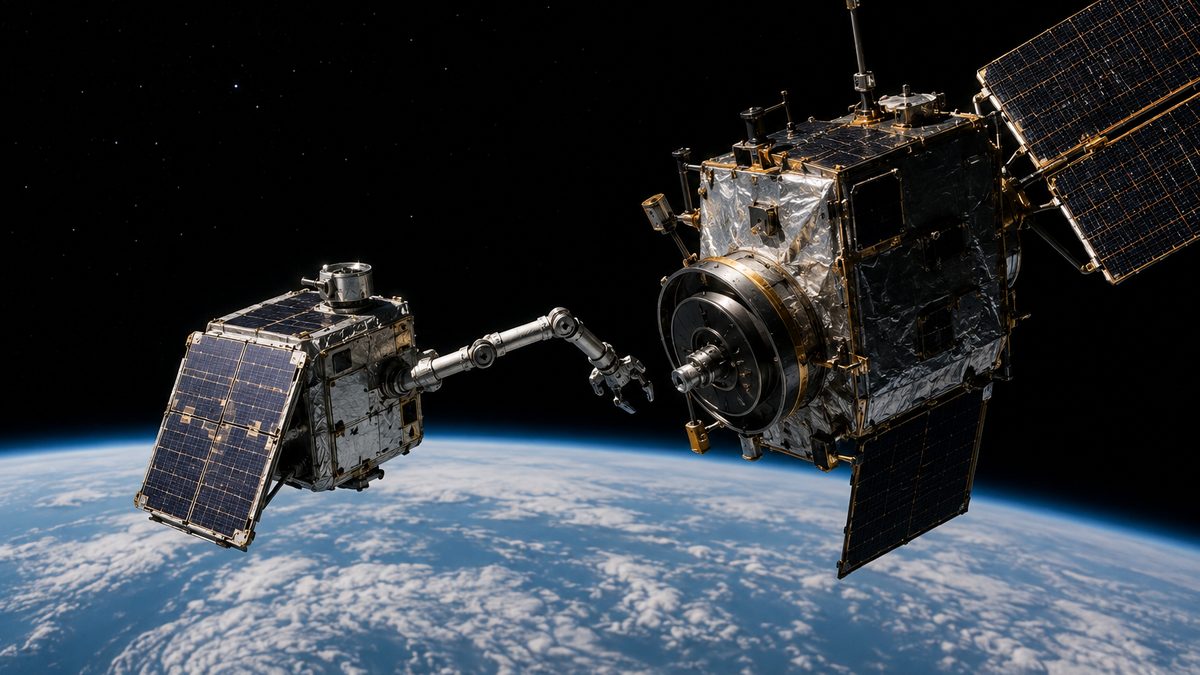
A planned NASA-backed mission would test whether a robotic spacecraft can raise the orbit of an aging science satellite. Editorial illustration by TheDailyGlobe.
Key Facts
- NASA says Katalyst Space's LINK spacecraft will attempt to rendezvous with Swift and raise its orbit.
- Swift launched in 2004 and studies high-energy events such as gamma-ray bursts.
- NASA reports that Swift's orbit has been decaying more quickly because of increased solar activity.
- Katalyst says the LINK spacecraft has completed environmental testing ahead of the planned mission.
- The mission remains an upcoming attempt and has not yet been completed.
Most machines eventually need maintenance. Cars get new parts, aircraft undergo inspections, and buildings require repairs. Spacecraft are no different. The challenge is that a satellite orbiting Earth cannot simply be brought into a repair shop.
NASA is preparing an unusual mission that aims to solve part of that problem. Working with Katalyst Space, the agency plans to test whether a robotic spacecraft can locate an aging science telescope already in orbit and give it a boost that could help keep it operating longer.
The target is NASA's Swift observatory, a spacecraft launched in 2004 that has spent more than two decades studying some of the universe's most energetic events, including gamma-ray bursts. According to NASA, Swift's orbit has been decaying more rapidly because of increased solar activity, creating pressure to find a way to preserve the mission.
Why Swift Needs Help
Satellites in low Earth orbit are not permanently fixed in space. Even hundreds of miles above the planet, traces of Earth's atmosphere create drag that gradually slows spacecraft and pulls them closer to Earth over time.
Solar activity can make that process happen faster. When the Sun becomes more active, Earth's upper atmosphere can expand, increasing the drag experienced by satellites. NASA says Swift has been experiencing that effect, causing its orbit to decay more rapidly than expected.
For a spacecraft that has already exceeded its original mission expectations, maintaining altitude can become one of the biggest challenges to continued operations.
A Different Kind of Space Mission
Rather than launching a replacement telescope, NASA's plan involves sending Katalyst Space's LINK spacecraft to find Swift, rendezvous with it and raise its altitude.
That may sound straightforward, but orbital rendezvous is one of the more demanding tasks in spaceflight. Both spacecraft are moving at thousands of miles per hour around Earth. The servicing vehicle must accurately locate its target, match its orbit and complete operations without damaging either spacecraft.
Katalyst recently announced that LINK completed environmental testing, an important milestone intended to verify that the spacecraft can withstand the conditions of launch and space operations. Passing those tests does not guarantee mission success, but it moves the project closer to an actual flight attempt.
What Makes This Important Beyond One Telescope
The mission is attracting attention not only because of Swift itself but because it could provide a real-world demonstration of satellite servicing. For decades, most satellites have been designed with a simple lifecycle: launch, operate and eventually retire.
If spacecraft can safely receive orbital boosts or other forms of maintenance, operators may gain additional options before replacing expensive hardware. That could be useful for scientific missions, communications satellites and other spacecraft whose instruments remain functional even as their orbits change.
Advocates of satellite servicing see that possibility as part of the future of space operations. However, the broader commercial market for such services remains largely unproven. Whether routine servicing becomes common will depend on both technical success and economic practicality.
The Hardest Parts Are Still Ahead
The mission has generated interest because the concept is easy to understand: save a useful spacecraft instead of losing it. But the most difficult steps have not happened yet.
The spacecraft still must launch successfully, locate Swift, complete a rendezvous and execute the orbital boost. Any one of those stages can present technical challenges. Available mission information also does not establish exactly how much additional operating life Swift could gain if the effort succeeds.
NASA and Katalyst have described the mission as an attempt, not a completed rescue.
What Readers Should Watch Next
The next major developments will be mission briefings, launch timing announcements and updates on LINK's progress toward orbit. After launch, attention will shift to whether the spacecraft can successfully find and approach Swift.
If the orbital boost works, the mission could provide a useful test case for extending the life of aging spacecraft. If it falls short, engineers will still gain information about what it takes to service satellites already operating in orbit. Either way, the effort offers a glimpse into a future where maintaining spacecraft may become almost as important as launching them.
Reporting note: Reporting draws on NASA mission materials, company technical updates, independent space reporting, and reviewed background materials. This article was produced with AI-assisted research and reviewed by an editor before publication.