NASA’s Quiet Supersonic Jet Has Finally Broken the Sound Barrier
NASA's X-59 has completed its first supersonic flight, but the real test is whether it can make high-speed flight quiet enough for communities below.
Save Article
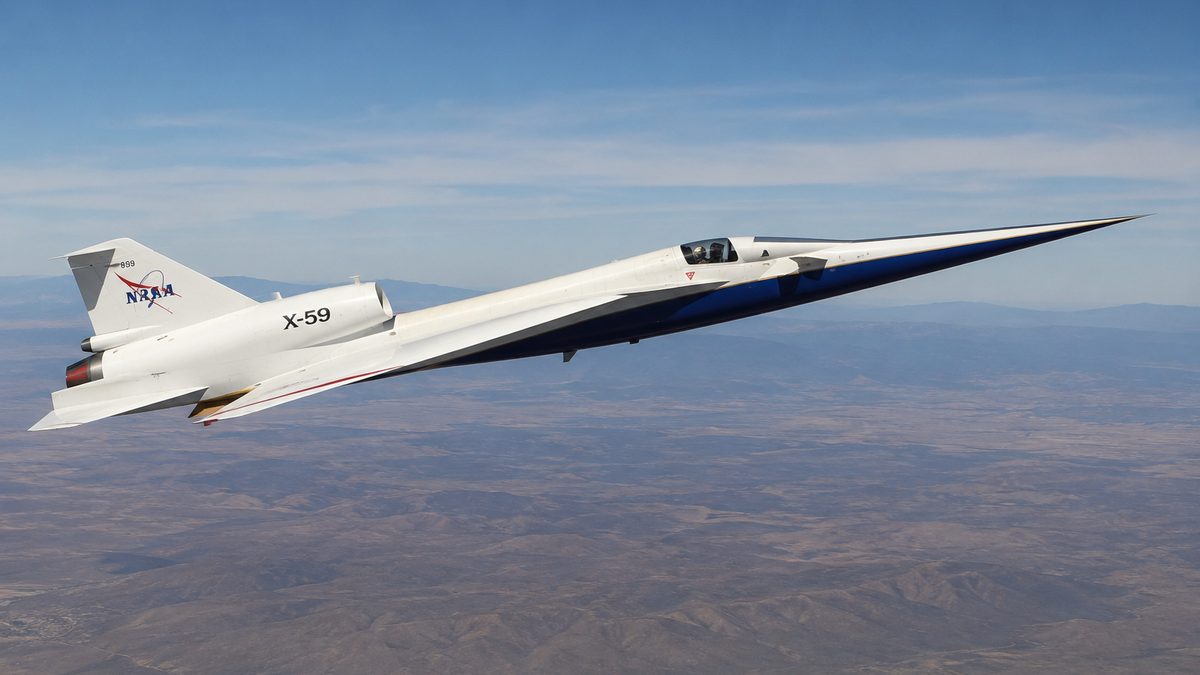
NASA’s X-59 has begun the supersonic phase of a test program focused on quieter high-speed flight. Editorial illustration by TheDailyGlobe.
Key Facts
- NASA reported that the X-59 completed its first supersonic flight on June 5, 2026.
- The aircraft reached approximately Mach 1.1 during an 81-minute test flight.
- The X-59 is part of NASA's Quesst mission focused on quieter supersonic flight.
- Future testing will gather data on how people respond to the aircraft's sound profile.
- The flight was a research milestone, not a commercial aviation launch.
For decades, one problem has stood in the way of widespread supersonic travel over land: noise. Flying faster than sound is technically possible, but the loud sonic booms created by aircraft have long made routine overland supersonic flights impractical in many places.
That is the challenge NASA is trying to address with the X-59, an experimental aircraft designed not simply to fly fast, but to fly fast while producing a much quieter sound signature than traditional supersonic aircraft.
NASA announced that the X-59 completed its first supersonic flight on June 5, reaching approximately Mach 1.1 during an 81-minute test flight. The milestone marks a new phase in the agency's effort to study whether aircraft design can reduce the disruptive boom that has limited supersonic travel for decades.
Why Speed Is Not the Main Challenge
The ability to exceed the speed of sound is not new. Military aircraft have done it for decades, and the Concorde carried passengers across oceans at supersonic speeds before retiring in 2003.
The bigger challenge has been the sonic boom. When an aircraft travels faster than sound, pressure waves combine into a loud shockwave that can be heard on the ground. The noise can be startling and disruptive, which led regulators in many countries to restrict routine civilian supersonic flights over land.
NASA's X-59 was designed with an unusually long, narrow shape intended to spread those pressure waves differently. The goal is not to eliminate sound entirely but to transform a sharp boom into something closer to a softer thump.
What the Flight Actually Proved
The first supersonic flight answered an important engineering question: the aircraft can successfully exceed the speed of sound in flight. That alone is a significant checkpoint for a research aircraft built around an unconventional design.
However, the flight did not prove that quiet supersonic travel is ready for widespread use. NASA still needs to collect extensive data on how the aircraft performs under mission conditions and how its sound is perceived by people on the ground.
In other words, the speed milestone was necessary, but it was never the final goal of the program.
The Next Step Happens on the Ground
The most important tests may ultimately involve people who never step onto the aircraft. NASA's broader mission includes gathering information from communities that experience the aircraft's sound during future test flights.
Researchers want to understand whether the modified sound profile is noticeably less disruptive than a traditional sonic boom. Those findings could eventually help regulators evaluate future rules governing supersonic flight, though no regulatory changes have been announced.
The agency's work is aimed at producing evidence, not policy. Any future decisions about commercial operations would depend on regulators reviewing data that has not yet been collected.
Questions That Still Need Answers
Several major uncertainties remain. NASA still needs to determine how the aircraft performs during additional testing, how quiet its sound signature actually is under operational conditions, and how communities respond to repeated overflights.
Even if the noise goals are achieved, other hurdles remain outside the scope of the X-59 program. Commercial aircraft design, airline economics, certification requirements, and regulatory approvals would all play a role in determining whether future passenger aircraft adopt similar technology.
The current research does not establish when, or whether, travelers will someday board a commercial version of a quiet supersonic aircraft.
What Readers Should Watch Next
The next milestones will be less dramatic than breaking the sound barrier, but potentially more important. NASA plans to continue mission-condition flights and collect data about how the aircraft's sound is experienced on the ground.
Those results will help determine whether the X-59's unusual design can solve the noise problem that has limited supersonic travel for generations. The aircraft has now proven it can fly faster than sound. What remains to be seen is whether it can do so quietly enough to change how future aviation is regulated and designed.
Reporting note: Reporting draws on NASA materials, independent science reporting, aerospace coverage, and reviewed background materials. This article was produced with AI-assisted research and reviewed by an editor before publication.