Why Smaller Gas Sensors Could Change How Leaks Are Detected
Researchers are developing compact sensors that use light and sound to detect trace gases, a technology that could eventually make environmental monitoring and industrial leak detection easier to deploy.
Save Article
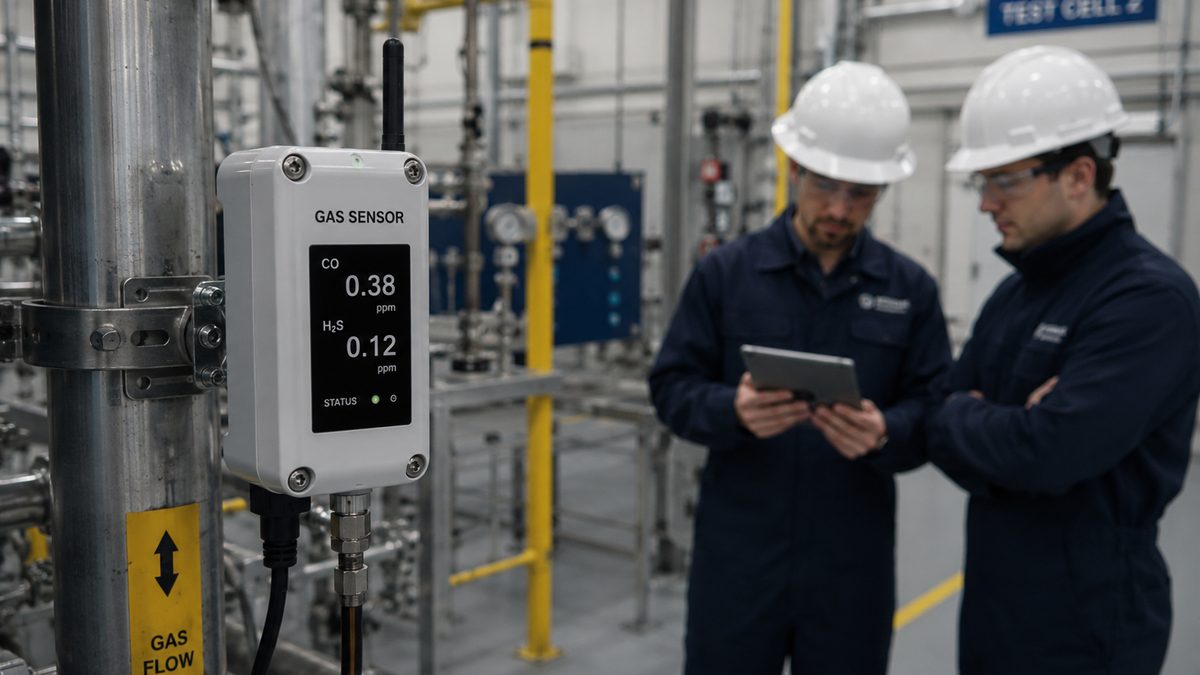
Compact trace-gas sensors could make it easier to monitor leaks and pollutants close to the source. Editorial illustration by TheDailyGlobe.
Key Facts
- Fraunhofer researchers described a compact sensor system for detecting trace gases.
- The technology uses resonant photoacoustics to identify gases.
- The method works by exposing gas to pulsed light and measuring resulting sound waves.
- Fraunhofer says the approach is designed to be compact and robust.
- Potential applications include environmental monitoring, industrial safety, and process control.
Many gases become a problem long before people can see, smell, or otherwise notice them. Small leaks can go undetected for extended periods, and trace pollutants can be difficult to measure without specialized equipment. That challenge has led researchers to look for faster and more practical ways to monitor air quality and industrial systems.
Researchers at Germany's Fraunhofer Institute say they are developing a compact sensing approach that could make trace-gas detection easier to deploy in a variety of settings. The technology uses a technique known as resonant photoacoustics, which combines pulses of light with highly sensitive sound detection to identify tiny amounts of gas.
How Light Can Reveal Invisible Gases
The science behind the technology sounds complicated, but the basic idea is relatively straightforward. Certain gases absorb specific wavelengths of light. When pulsed light shines through a gas sample, some of that energy is absorbed and converted into tiny pressure changes.
Those pressure changes create extremely small sound waves. Sensitive instruments can detect those sounds and use them to identify the presence of particular gases. Because different gases absorb light differently, researchers can use the resulting signals to determine what may be present in the air.
The Fraunhofer project focuses on making this type of sensing system smaller and potentially more practical than some larger laboratory-grade equipment traditionally used for similar measurements.
Why Size Matters
Detecting trace gases is often easier in a controlled laboratory than in the field. Large instruments can provide highly accurate measurements, but they may be expensive, difficult to move, or impractical to place near every location where monitoring would be useful.
Researchers argue that smaller sensors could allow monitoring systems to be placed closer to the point where leaks or emissions might occur. Instead of relying on a limited number of centralized measurement systems, future networks could potentially use multiple sensors distributed across larger areas.
That possibility is one reason engineers continue to explore compact sensing technologies. The goal is not simply to shrink equipment but to make monitoring easier to deploy in places where larger systems may be difficult to use.
Where the Technology Could Be Useful
Coverage of the research points to several possible applications. Environmental monitoring systems could use compact sensors to track pollutants or emissions. Industrial facilities may be interested in technologies that help identify trace gases during manufacturing processes or infrastructure monitoring.
Process-control systems are another potential area of interest. In some industries, knowing the concentration of specific gases can help operators monitor how equipment or chemical processes are performing.
These possibilities remain potential applications rather than established commercial deployments. The current work focuses on the sensing technology itself, not on a broad rollout across industries.
Questions Still Waiting for Answers
Several important questions remain unresolved. Public descriptions of the technology explain how the sensing method works, but they do not establish how it will perform across every environment where gas monitoring might be needed.
Temperature changes, humidity, contamination, vibration, and other real-world conditions can affect sensor performance. Researchers will need to demonstrate reliability under those circumstances and show how often calibration or maintenance may be required.
Cost is another uncertainty. Fraunhofer and supporting coverage describe the approach as potentially lower-cost, but large-scale manufacturing and deployment can introduce challenges that are difficult to predict during research and development.
What to Watch Next
The next step will likely involve testing the sensors in more realistic operating environments. Pilot projects in industrial facilities, environmental monitoring systems, or infrastructure networks could provide a clearer picture of how the technology performs outside the laboratory.
For now, the research represents an effort to make gas detection more practical and accessible. Whether the approach ultimately gains widespread adoption will depend on how well it handles real-world conditions, how much it costs to deploy, and whether it delivers reliable measurements where they matter most.
Reporting note: Reporting draws on scientific institution materials, engineering research, technology reporting, and reviewed background materials. This article was produced with AI-assisted research and reviewed by an editor before publication.