A Brain Implant That Adjusts With Each Step Could Help Parkinson’s Patients Walk More Safely
Researchers at UC San Francisco tested a brain implant system that responds to walking-related brain signals in real time, offering an early look at how future medical devices may adapt to a patient’s movements.
Save Article
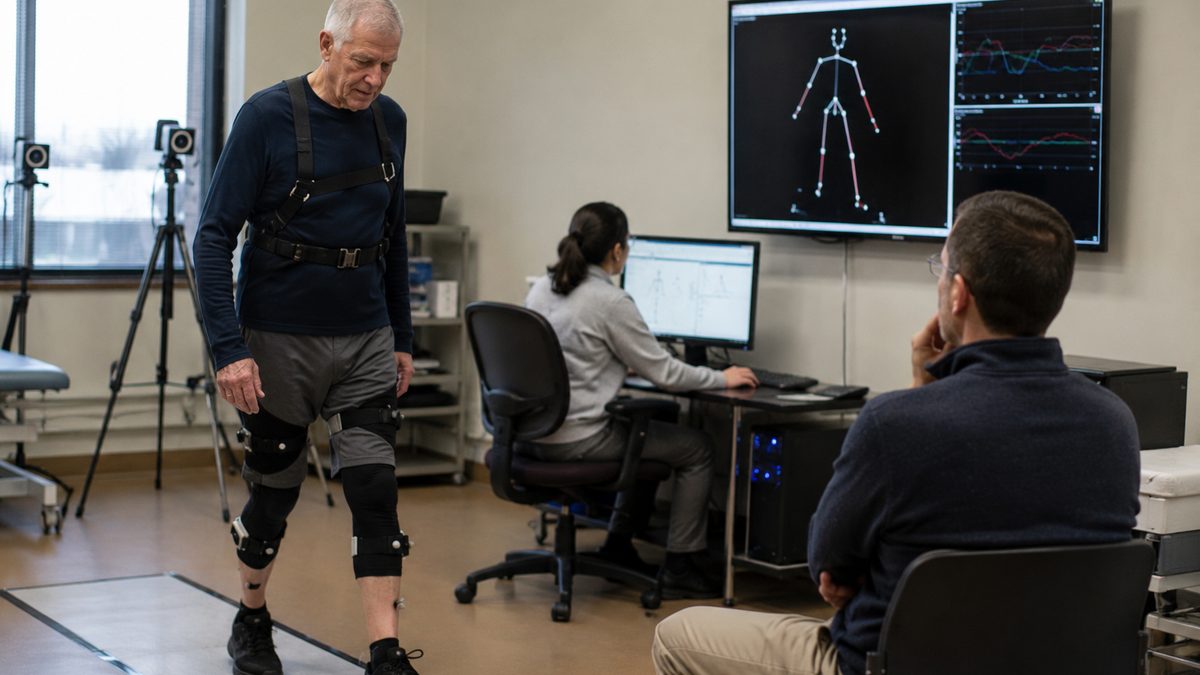
Adaptive brain stimulation research is exploring whether implanted devices can respond to movement in real time. Editorial illustration by TheDailyGlobe.
Key Facts
- UC San Francisco researchers tested an adaptive deep brain stimulation system for people with Parkinson’s disease.
- The study was published in Nature Medicine.
- The system detected step-related neural signals and adjusted stimulation within fractions of a second.
- Five people with Parkinson’s disease participated in the feasibility study.
- Researchers reported improvements in gait measures and fewer falls during active-use periods, with no serious adverse events reported in source coverage.
For many people living with Parkinson’s disease, walking can become one of the condition’s most frustrating and dangerous challenges. Balance problems, freezing episodes, and unexpected falls can make everyday activities difficult, even when other symptoms are being managed.
Researchers at UC San Francisco have reported early results from an experimental brain stimulation system designed to address that problem in a new way. Instead of delivering a constant stream of electrical stimulation throughout the day, the system adjusts its activity in real time based on signals associated with a person’s steps.
The research offers an early glimpse of a broader idea that could influence future medical devices: treatments that adapt to what the body is doing moment by moment rather than operating with a fixed setting.
How the System Differs From Traditional Stimulation
Deep brain stimulation, often called DBS, is already used to help some Parkinson’s patients manage symptoms. The treatment involves implanted electrodes that deliver electrical signals to specific parts of the brain.
Traditional DBS systems generally operate using settings programmed by clinicians. While those settings can be adjusted over time, the stimulation itself remains relatively constant during daily use.
The adaptive system tested by UCSF researchers takes a different approach. It monitors neural activity linked to walking and then modifies stimulation almost instantly as movement occurs. In simple terms, the implant attempts to respond to what the patient is doing instead of treating every moment the same way.
What the Small Study Found
The study involved five participants who had already undergone deep brain stimulation surgery. Researchers evaluated whether the adaptive approach could improve mobility compared with more conventional stimulation methods.
According to the reported findings, the system was able to identify signals associated with individual steps and adjust stimulation within fractions of a second. Researchers reported improvements in gait-related measures and observed fewer falls during periods when the adaptive system was active.
Equally important, source coverage of the study reported no serious adverse events during the testing period. That does not establish long-term safety or effectiveness, but it provided researchers with evidence that the concept could be studied further.
Why Researchers Are Interested in Adaptive Devices
One challenge in treating neurological conditions is that symptoms can change from moment to moment. A therapy that works well while someone is sitting may not be ideal while they are walking, turning, or performing another activity.
Adaptive systems aim to address that problem by responding to changing conditions. Rather than relying entirely on pre-programmed settings, they use real-time information from the body to guide treatment decisions.
Researchers have suggested that similar approaches could eventually be explored in other neurological applications. However, those possibilities remain future research questions rather than established medical uses.
What Remains Unproven
The findings should be viewed as early clinical research rather than evidence of a new standard treatment. The study involved only five participants, making it far too small to answer many of the questions patients and clinicians would reasonably ask.
It remains unclear whether the same results would appear in larger and more diverse patient populations. Researchers also have more work to do to determine how long benefits may last, whether the technology can be simplified for routine clinical use, and what regulatory reviews would be required before broader deployment.
The study also does not mean that people with Parkinson’s disease can expect access to this technology anytime soon. Investigational systems often undergo years of additional testing before they become widely available, if they do at all.
What Readers Should Watch Next
The most important next step will be larger clinical studies designed to confirm whether the benefits seen in this feasibility trial hold up across more patients and longer periods of use.
Researchers will also be looking closely at real-world mobility outcomes, including whether adaptive stimulation can consistently reduce falls and improve daily independence outside controlled research settings.
For now, the study offers something more modest but still meaningful: evidence that brain implants may eventually become more responsive to the activities people are performing. Whether that approach becomes a practical treatment remains uncertain, but the research suggests that future medical devices may be able to adapt alongside the people using them.
Reporting note: Reporting draws on peer-reviewed research, scientific institution materials, university reporting, and reviewed background materials. This article was produced with AI-assisted research and reviewed by an editor before publication.