AMD's 2nm Server Chip Ramp Shows How AI Is Reshaping Computing Infrastructure
AMD's EPYC Venice production ramp shows why the AI boom depends not only on GPUs and models, but also on server CPUs, fabs and supply chains.
Save Article
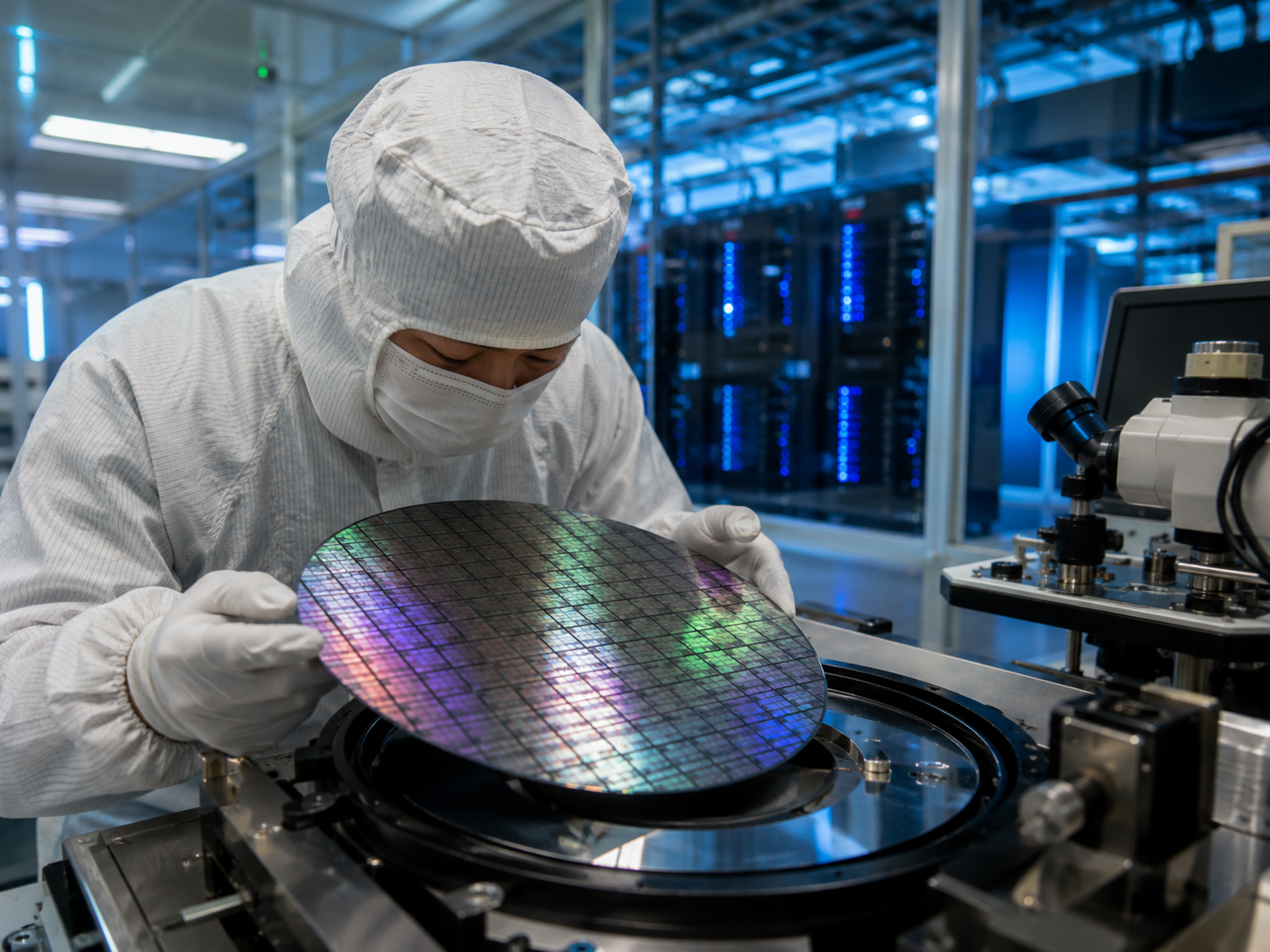
AMD's EPYC Venice production ramp shows why the AI boom depends not only on GPUs and models, but also on server CPUs, fabs and supply chains. Editorial illustration by TheDailyGlobe.
Key Facts
- AMD announced that its next-generation EPYC processor, codenamed Venice, is ramping production in Taiwan on TSMC's advanced 2nm process technology.
- AMD said Venice is the first high-performance computing product in the industry to achieve production ramp on TSMC advanced 2nm technology.
- AMD said agentic AI workloads are driving demand for accelerated AI infrastructure deployments.
- AMD said it plans future production ramp at TSMC's Arizona fabrication facility.
- Tom's Hardware and Wall Street Journal reporting placed the ramp within broader AI infrastructure and semiconductor competition.
AMD's next server-chip milestone is a reminder that the AI boom is not built only on flashy models or graphics processors. It also depends on the less visible hardware that runs data centers.
AMD announced that its next-generation EPYC processor, codenamed Venice, is ramping production in Taiwan on TSMC's advanced 2nm process technology. The company said Venice is the first high-performance computing product in the industry to achieve production ramp on TSMC's advanced 2nm technology.
For readers, the practical point is this: AI needs physical infrastructure. That includes server CPUs, GPUs, memory, networking, power, cooling, advanced manufacturing and the factories that can actually make the chips.
Why Server CPUs Still Matter
AI coverage often focuses on GPUs because they handle much of the heavy parallel computing used to train and run large AI systems. But a data center is not just a wall of GPUs.
Server CPUs still coordinate work, run operating systems, manage data, support storage and networking, and handle many tasks that surround accelerated computing. If GPUs are the engines for certain AI workloads, CPUs are part of the control system that keeps the rest of the machine useful.
That is why AMD's EPYC line matters in the AI infrastructure story. The company is not simply announcing another chip. It is trying to position server processors for data centers where AI workloads are changing how computing is planned, purchased and deployed.
What 2nm Means and Does Not Mean
The 2nm label is an industry process-node designation. Readers should not treat it as a simple literal measurement of every transistor. Modern chip-node names are partly technical and partly industry shorthand for a generation of manufacturing improvements.
Still, process nodes matter because they can affect performance, power efficiency and chip density. In data centers, power efficiency is not a small detail. AI systems can require large amounts of electricity, and better chips can help determine how much computing can fit inside real-world power, cooling and cost limits.
The production ramp should also be read carefully. It does not mean broad server availability begins immediately everywhere. It means AMD has entered a production-ramp phase for the chip on TSMC's advanced process.
Why Taiwan and Arizona Matter
AMD said Venice is ramping production in Taiwan, where TSMC remains one of the world's most important advanced chip manufacturers. That location matters because Taiwan sits at the center of global semiconductor supply chains.
AMD also said it plans future production ramp at TSMC's Arizona fabrication facility. That detail connects the chip announcement to a larger U.S. technology goal: bringing more advanced semiconductor manufacturing capacity closer to home.
This does not erase supply-chain risk or make advanced manufacturing simple. Building and scaling leading-edge chip production is difficult, expensive and slow. But the Taiwan-Arizona connection shows how AI infrastructure has become a manufacturing geography story as much as a software story.
The AI Infrastructure Shift
AMD said agentic AI workloads are driving demand for accelerated AI infrastructure deployments. That is a company claim and should be read as such, but it fits the broader direction of the market: companies are trying to build systems that can run more AI work reliably and efficiently.
Agentic AI usually refers to systems designed to carry out multi-step tasks with more autonomy than a basic chatbot. Whether those systems deliver lasting business value remains a separate question. What is already clear is that more AI experimentation creates more demand for compute.
That demand puts pressure on chips, data centers, electricity, cooling and cloud infrastructure. A faster model demo may get the public's attention. The harder question is whether the underlying infrastructure can scale without becoming too expensive, too power-hungry or too dependent on fragile supply chains.
What Remains Unclear
AMD's announcement does not settle how Venice will perform in real deployments, how quickly customers will adopt it, or how it will compare with competing chips once systems are available.
It also does not prove that every AI workload needs the newest process node or that every company should rebuild infrastructure around the latest hardware. Some organizations may benefit from new chips. Others may get more value from better software, cloud planning, memory capacity, power management or workload design.
For readers, the clean takeaway is that AI is becoming a physical infrastructure story. Behind the apps and models are server trays, processors, wafers, fabs and supply chains. AMD's Venice ramp is one more sign that the next phase of AI competition will be shaped not only by what software can do, but by who can build the hardware to run it.
Reporting note: Reporting draws on AMD company materials, semiconductor industry reporting, TSMC context, data-center technology reporting, and reviewed AI infrastructure background. This article was produced with AI-assisted research and reviewed by an editor before publication.