3D-Printed Nozzles Could Help Make Future Medicines More Consistent
MIT researchers demonstrated 3D-printed devices that create precise layered microdroplets, a manufacturing technique that could support future drug-delivery systems and advanced materials.
Save Article
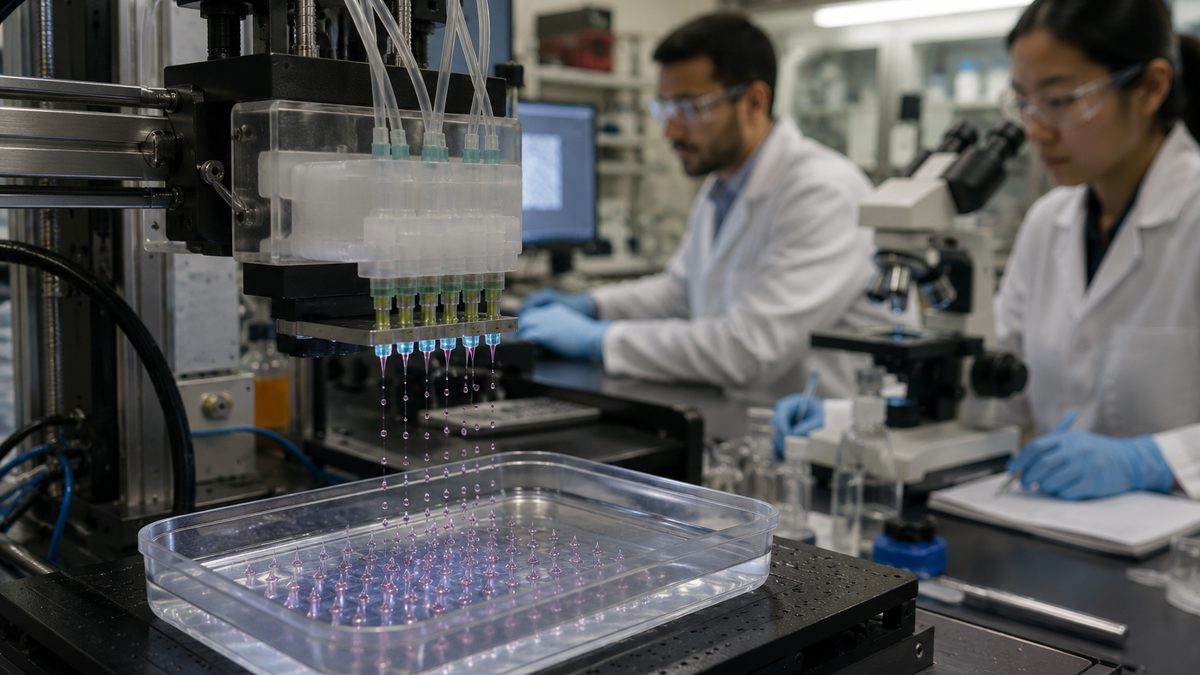
New 3D-printed nozzle designs could help researchers manufacture layered particles for future medicines and materials. Editorial illustration by TheDailyGlobe.
Key Facts
- MIT researchers demonstrated 3D-printed triaxial electrospray emitters.
- The devices can generate precise three-layer microdroplets.
- Researchers said the technique could support future manufacturing of time-release drug-delivery particles and self-healing materials.
- The devices can be produced in hours using 3D printing.
- The reported approach avoids some fabrication steps traditionally associated with cleanroom manufacturing.
Many modern medicines depend on precise timing. Some drugs are designed to release quickly, while others work best when their ingredients are delivered gradually over hours, days, or even longer. Creating those controlled-release systems often requires manufacturing tiny particles with multiple layers, each performing a different job.
Making those microscopic structures consistently can be difficult and expensive. Researchers have spent years looking for ways to produce complex particles more efficiently while maintaining the precision needed for medical and scientific applications.
Researchers at MIT recently demonstrated a new approach using 3D-printed devices that create highly structured microdroplets. The work focuses on manufacturing technology rather than a new treatment, but researchers say the method could eventually support the production of advanced drug-delivery particles and other engineered materials.
A Different Way to Build Tiny Particles
The technology centers on devices known as triaxial electrospray emitters. While the name sounds technical, the basic idea is easier to understand. The emitters act like extremely precise nozzles that create microscopic droplets made of multiple layers.
Instead of producing a simple particle with one uniform structure, the system can generate droplets containing three distinct layers. Researchers can potentially use those layers to control how a particle behaves, including how substances are released over time or how materials respond to damage.
The MIT team reported that the emitters were created through 3D printing, allowing researchers to manufacture the devices more quickly than some traditional fabrication methods. The ability to rapidly produce specialized tools could make experimentation easier for laboratories exploring new materials and manufacturing techniques.
Why Manufacturing Matters
When people think about medical breakthroughs, they often focus on a new drug or therapy. Manufacturing technology receives less attention, even though it can determine whether an idea remains in a laboratory or becomes practical to produce at larger scale.
The significance of the MIT work lies in the tool itself. Researchers are not claiming to have created a new medicine. Instead, they demonstrated a way to make highly structured microscopic particles that could potentially be useful in future drug-delivery systems.
The same manufacturing approach could also have applications outside medicine. Research coverage highlighted possible future uses involving self-healing materials, biosensors, artificial-cell research, and other advanced material systems that depend on carefully engineered microscopic structures.
What the Research Demonstrated
According to MIT and related science reporting, the 3D-printed emitters successfully produced three-layer microdroplets under laboratory conditions. The demonstration showed that the devices could generate particles with a level of structural precision that researchers view as important for future applications.
Another practical advantage involves production speed. Researchers reported that the devices can be created within hours and avoid some of the cleanroom fabrication requirements associated with more traditional approaches. That could lower barriers for research teams experimenting with complex particle designs.
For scientists developing new materials or delivery systems, faster access to manufacturing tools can shorten development cycles and allow more rapid testing of ideas.
Questions Still Waiting for Answers
The research remains firmly in the demonstration stage. Several important questions must be answered before the technology could play a role in commercial manufacturing.
One uncertainty is scale. Producing precise particles in a laboratory is different from producing them consistently in the large volumes required for industrial manufacturing. Researchers have not yet established how the process performs under full-scale production conditions.
Quality control is another challenge. Pharmaceutical manufacturing operates under strict standards, and any future use would need to meet regulatory requirements designed to ensure consistency and safety. Available reporting does not establish whether the current process can satisfy those requirements.
It also remains unclear which applications might reach practical use first. Drug delivery, self-healing materials, biosensors, and other concepts have been discussed as potential future directions, but no specific commercial products have been announced.
What Readers Should Watch Next
The next milestone will likely involve testing beyond the initial laboratory demonstration. Researchers and manufacturers will want to see whether the process can maintain precision at larger scales and under real production conditions.
Potential collaborations with pharmaceutical companies, materials manufacturers, or industrial research groups could provide additional insight into where the technology fits and whether it offers advantages over existing manufacturing methods.
For now, the MIT work highlights a side of innovation that often stays out of the spotlight. The future of medicine may depend not only on discovering new treatments but also on developing better tools to build them. This research suggests that 3D printing could play a role in creating those tools, even if practical applications remain several steps away.
Reporting note: Reporting draws on university research materials, engineering research coverage, scientific reporting, and reviewed background materials. This article was produced with AI-assisted research and reviewed by an editor before publication.