Why NASA Put One of the Coldest Laboratories Ever Built Into Orbit
NASA has activated an upgraded version of its Cold Atom Lab aboard the International Space Station, giving researchers new ways to study matter at temperatures just above absolute zero and explore questions at the edge of quantum physics.
Save Article
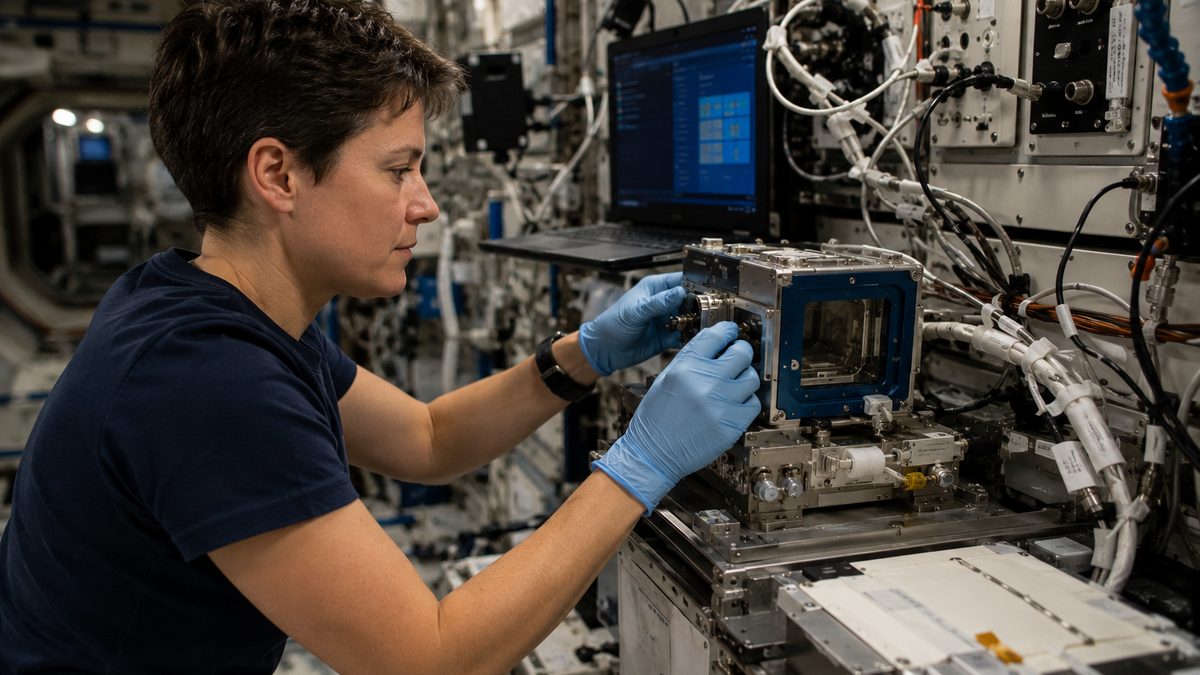
The Cold Atom Lab lets researchers study ultracold matter in microgravity. Editorial illustration by TheDailyGlobe.
Key Facts
- NASA announced the Cold Atom Lab upgrade on June 16, 2026.
- Astronauts activated the upgraded laboratory aboard the International Space Station.
- The facility cools atoms to temperatures just above absolute zero.
- NASA says the upgrade enables new categories of quantum experiments.
- Cold Atom Lab has been operating aboard the space station since 2018.
Imagine cooling atoms so much that they stop behaving the way we expect. Instead of acting like tiny particles bouncing around, they begin displaying strange quantum properties that can make matter behave more like a wave.
Those conditions are almost impossible to experience in everyday life, but scientists can create them inside specialized laboratories. One of the most unusual of those laboratories is not on Earth at all. It is orbiting roughly 250 miles above the planet aboard the International Space Station.
This week, NASA announced that astronauts had switched on an upgraded version of the Cold Atom Lab, a facility designed to chill atoms to temperatures just above absolute zero and give researchers new opportunities to study quantum matter in microgravity.
What Changed Inside the Orbiting Laboratory
The Cold Atom Lab was already one of the most unusual research facilities ever built. Its purpose is not to test spacecraft hardware or observe distant galaxies. Instead, it focuses on the behavior of ultracold atoms.
According to NASA, the newly activated upgrade expands the laboratory's scientific capabilities and allows researchers to perform experiments that were not previously possible. The agency says scientists from multiple research teams will be able to explore new questions involving quantum matter and the behavior of atoms under conditions that are difficult to create on Earth.
The upgrade itself is a research tool rather than a scientific result. The experiments made possible by the changes will generate findings in the future, but those findings have not yet been produced.
Why Space Is Useful for Quantum Physics
At first glance, space may seem like an unusual place to study ultracold atoms. The reason has less to do with distance from Earth and more to do with gravity.
On Earth, gravity quickly pulls cooled atoms downward. Scientists can still conduct remarkable experiments in ground-based laboratories, but the effects of gravity limit how long some quantum states can be observed.
Inside the International Space Station, researchers can work in a microgravity environment. The atoms can remain suspended for longer periods, allowing scientists to observe delicate quantum behavior that would otherwise be more difficult to study. Longer observation times can provide more opportunities to measure and compare how these systems behave.
How Atoms Become Almost Unimaginably Cold
The temperatures involved are difficult to grasp. Absolute zero, the theoretical point at which atomic motion reaches its minimum possible level, is minus 459.67 degrees Fahrenheit, or minus 273.15 degrees Celsius.
Cold Atom Lab cools atoms to temperatures just above that limit. Researchers accomplish this using carefully controlled laser systems and magnetic fields that slow atomic motion dramatically.
Under those conditions, atoms can form what physicists call a Bose-Einstein condensate. In simple terms, large numbers of atoms begin behaving as a single quantum system. Scientists sometimes describe the result as a form of matter that allows quantum effects to become visible on scales that are easier to study.
These experiments help researchers investigate some of the most fundamental questions in physics, including how matter behaves under extreme conditions and how quantum systems evolve over time.
What the Upgrade Does Not Prove
Quantum research often attracts attention because of its potential future applications. Researchers have explored how quantum science could eventually contribute to more sensitive measurements, advanced navigation systems, and other technologies.
The Cold Atom Lab upgrade does not demonstrate those applications today. NASA's announcement focused on expanding research capability rather than unveiling a commercial product or near-term technology for consumers.
The most immediate outcome is simply that scientists now have a more capable laboratory in which to conduct experiments. Any practical applications that emerge would likely depend on years of additional research and testing.
The Questions Scientists Are Still Chasing
Several important uncertainties remain. NASA has not identified which upgraded experiments will produce the first major scientific results, and researchers do not yet know which studies may prove most influential.
It also remains unclear how quickly discoveries made in orbit could contribute to future sensing, timing, navigation, or measurement technologies. Quantum research often advances through incremental discoveries rather than dramatic breakthroughs.
For now, the activation of the upgraded Cold Atom Lab represents something simpler but still remarkable: a chance to study one of nature's strangest regimes in a place uniquely suited to the task. As new experiments begin aboard the station, scientists will be watching to see what the coldest laboratory in orbit reveals next about the quantum world.
Reporting note: Reporting draws on NASA and Jet Propulsion Laboratory materials, International Space Station research resources, and reviewed background materials. This article was produced with AI-assisted research and reviewed by an editor before publication.