Why Physicists Are Watching a Giant Underground Detector for Clues About Neutrinos
Early results from one of the world's largest neutrino experiments show improved measurement precision and offer a glimpse into a long-running mystery in particle physics.
Save Article
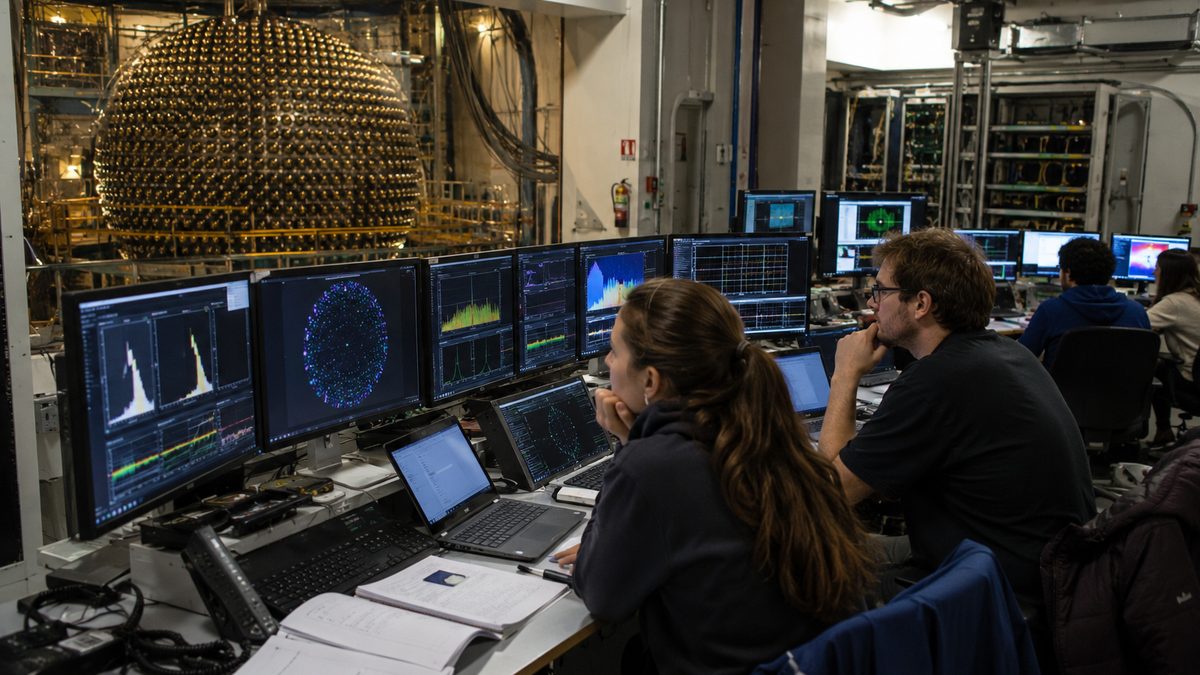
Large underground detectors help physicists measure particles that rarely interact with ordinary matter. Editorial illustration by TheDailyGlobe.
Key Facts
- Nature published JUNO's first-data results on June 10, 2026.
- The analysis used the detector's first 59.1 days of observations after completion.
- Researchers reported a precision improvement of about 1.6 times compared with previous combined measurements.
- The experiment studies neutrino oscillation using particles produced by nuclear reactors.
- JUNO has not yet determined neutrino mass ordering, one of its primary scientific goals.
At this moment, trillions of neutrinos are passing through your body. They stream through buildings, mountains, and even the Earth itself with almost no interaction. Most go completely unnoticed, which is why physicists sometimes describe them as ghostly particles.
Catching even a tiny fraction of those particles requires enormous instruments. That is where the Jiangmen Underground Neutrino Observatory, known as JUNO, comes in. Buried underground and designed to make extremely precise measurements, the detector has now released its first scientific results, giving researchers an early look at what the facility may be able to accomplish.
A Detector Built for a Difficult Job
Neutrinos are among the most abundant particles in the universe, yet they are notoriously difficult to study because they interact so weakly with matter. Physicists have spent decades building larger and more sensitive detectors to observe them.
JUNO was designed specifically for precision. The facility uses a massive volume of liquid scintillator, a material that produces tiny flashes of light when particles interact with it. By capturing and analyzing those flashes, researchers can reconstruct information about neutrinos that would otherwise pass unnoticed.
The detector's location underground helps reduce interference from cosmic rays and other sources of background noise, allowing scientists to focus on rare neutrino signals.
What the First Results Show
The newly published results come from the first 59.1 days of data collected after the detector became operational. Even with that relatively short observation period, researchers reported improved precision in measurements of reactor neutrino oscillations.
Neutrino oscillation refers to a phenomenon in which neutrinos appear to change between different forms, or flavors, as they travel. The discovery of oscillation was one of the major findings in modern particle physics because it showed neutrinos have mass, something earlier theories did not predict.
According to the paper, JUNO's early measurements improved precision by a factor of 1.6 compared with previous combined measurements. For physicists, greater precision means a clearer understanding of how neutrinos behave and whether existing theories continue to match observations.
The Bigger Question Behind the Experiment
The first results are important, but they are not the experiment's ultimate objective. One of JUNO's main goals is to determine neutrino mass ordering, a question that has remained unresolved despite years of research around the world.
Scientists know neutrinos have mass, but they do not yet know the exact arrangement of those masses. Determining that ordering would help researchers refine models of particle physics and better understand how neutrinos fit into the structure of the universe.
The new study does not answer that question. Instead, it shows that the detector is operating successfully and producing measurements with the precision needed to pursue the larger goal.
What Scientists Still Do Not Know
Several uncertainties remain. Researchers have not yet said when JUNO will collect enough data to determine neutrino mass ordering. The timeline depends on future observations and the quality of the measurements gathered over the coming years.
There is also a broader scientific question. If future measurements reveal results that do not fit neatly within the current three-flavor framework used to describe neutrinos, physicists may need to rethink parts of their understanding of these particles. At this stage, however, the first data do not establish such a finding.
What Comes Next for JUNO
For now, the most important development is that the detector has begun doing exactly what it was built to do: collect high-quality neutrino data. Every additional month of observations will add to the experiment's statistical power and help refine future measurements.
The mystery of neutrino mass ordering remains unsolved. But after its first 59.1 days of operation, JUNO has given physicists reason to believe it may become one of the most important tools yet in the effort to answer that question.
Reporting note: Reporting draws on peer-reviewed research, scientific journal materials, physics research publications, and reviewed background materials. This article was produced with AI-assisted research and reviewed by an editor before publication.