The August 2026 Solar Eclipse Could Turn Sunset Into One of the Sky's Rarest Sights
A total solar eclipse will cross parts of the Northern Hemisphere on August 12, 2026, creating an unusual opportunity for some observers to see totality as the Sun sits low near the horizon.
Save Article
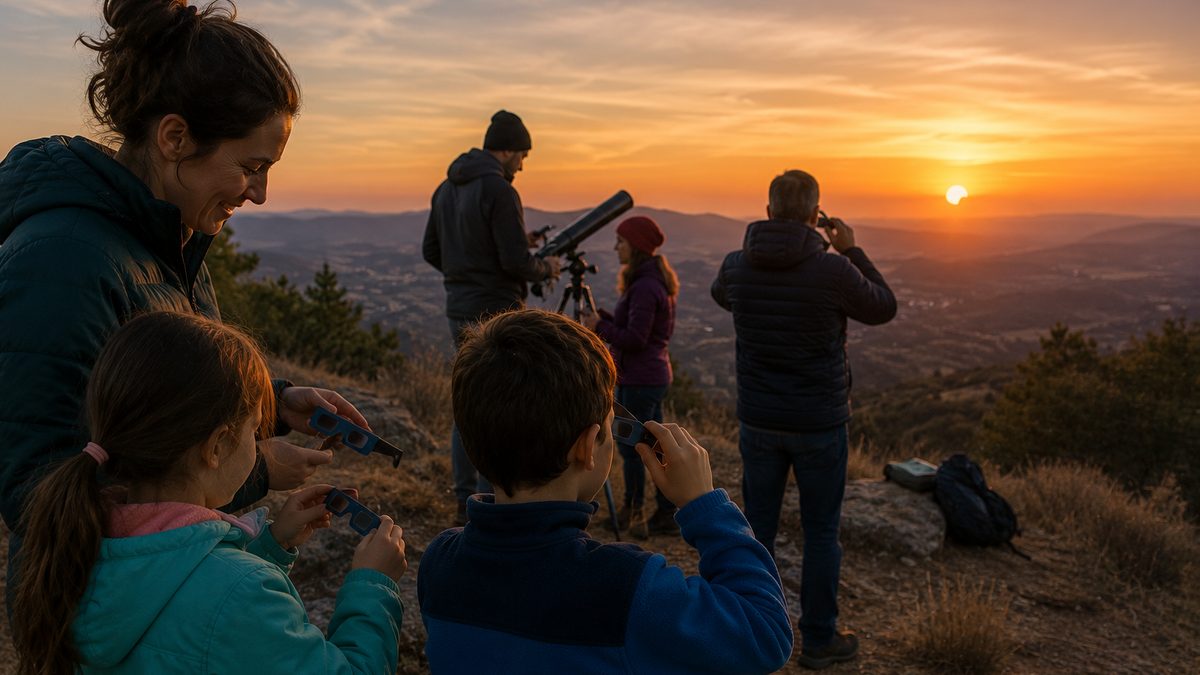
Safe viewing and location matter for solar eclipses, especially when the Sun is low near the horizon. Editorial illustration by TheDailyGlobe.
Key Facts
- NASA says the total solar eclipse will occur on August 12, 2026.
- The path of totality crosses Greenland, Iceland, northern Russia, the Atlantic Ocean, Spain, and a small portion of Portugal.
- Many other locations across the Northern Hemisphere will experience a partial solar eclipse.
- NASA has published detailed eclipse maps showing timing and visibility zones.
- Weather and local viewing conditions will play a major role in what observers actually see.
Most sunsets are predictable. The Sun slowly sinks below the horizon, colors spread across the sky, and daylight fades into evening. On August 12, 2026, some people may witness something far less ordinary: the Moon briefly covering the Sun as it approaches the horizon, creating a rare sunset eclipse experience.
The total solar eclipse is still weeks away, but it is now close enough that travelers, educators, astronomy enthusiasts, and curious families are beginning to look at viewing plans. NASA has published detailed information about the eclipse path, showing where totality will occur and where millions of others may see a partial eclipse.
Unlike many science stories that remain confined to laboratories or observatories, this is an event that people can potentially step outside and experience for themselves—provided they are in the right location and weather conditions cooperate.
What Makes This Eclipse Different
Total solar eclipses occur somewhere on Earth every few years, but no two are exactly alike. The August 2026 event stands out because of where and when totality occurs.
For portions of Spain and nearby regions, the eclipse will take place late in the day as the Sun sits relatively low in the sky. That timing creates the possibility of a dramatic visual experience as daylight fades and the eclipsed Sun approaches the horizon.
The low angle may also make the event feel different from midday eclipses. Landscapes, buildings, coastlines, and distant terrain can become part of the visual experience in ways that are not always possible when the Sun is high overhead.
Where the Eclipse Will Be Visible
According to NASA's eclipse calculations, the path of totality will sweep across Greenland, Iceland, northern Russia, parts of the Atlantic Ocean, Spain, and a small corner of Portugal.
People located directly within that path will have the opportunity to experience totality, the brief period when the Moon completely blocks the visible face of the Sun. During totality, daylight dims dramatically and the Sun's outer atmosphere, known as the corona, can become visible.
Outside the path of totality, many locations across the Northern Hemisphere will still experience a partial eclipse. In those areas, the Moon will cover only part of the Sun.
How Scientists Know Where It Will Happen
Predicting eclipses is one of astronomy's most reliable calculations. Scientists can accurately determine the positions and movements of Earth, the Moon, and the Sun years in advance.
Using those calculations, NASA produces detailed maps showing exactly where the Moon's shadow will travel across Earth's surface. Small differences in location can have a major effect on what observers see, which is why eclipse maps often include precise timing and path information.
The underlying science is straightforward. A total solar eclipse happens when the Moon passes directly between Earth and the Sun and casts its shadow onto a narrow portion of the planet's surface.
What the Event Does Not Guarantee
Even the most accurate eclipse calculations cannot guarantee a perfect viewing experience. The path of totality is known with great precision, but local conditions remain unpredictable.
Cloud cover is often the biggest uncertainty. A location positioned perfectly within the eclipse path could still have a poor view if skies are overcast on eclipse day. Local terrain can also matter, especially when the Sun is near the horizon.
Observers should also remember that looking directly at the Sun without proper eye protection can cause serious eye damage. Safe solar viewing requires eclipse glasses or other approved solar filters whenever any portion of the bright solar surface remains visible.
What to Watch as August Approaches
Over the coming weeks, astronomers and skywatchers will continue refining local viewing guidance while weather forecasts gradually become more useful. NASA and astronomy organizations are expected to provide additional public information as the date draws closer.
For now, the most important takeaway is simple. The August 12 eclipse offers a chance to witness one of nature's most remarkable alignments, and for some observers it may unfold against the backdrop of a setting Sun. Whether skies are clear enough to fully enjoy the moment remains uncertain, but the celestial geometry behind the event is already set in motion.
Reporting note: Reporting draws on NASA eclipse materials, NASA eclipse mapping data, astronomy resources, and reviewed background materials. This article was produced with AI-assisted research and reviewed by an editor before publication.