A 5-Million-Year-Old Whale Graveyard Reveals How the Deep Ocean Remembers Life
Researchers reported a vast whale necropolis stretching across the Indian Ocean seafloor, offering a rare look at how whale remains can support life and preserve ecological history for millions of years.
Save Article
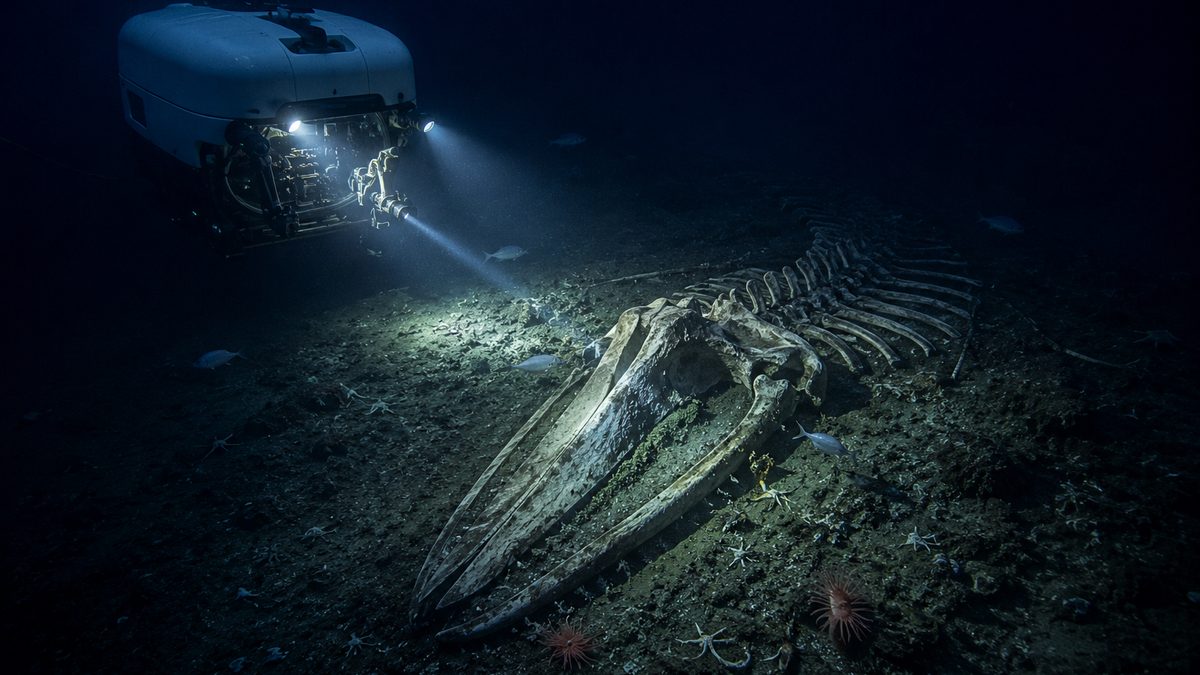
Whale remains on the seafloor can become habitats for deep-ocean life and records of ancient ecosystems. Editorial illustration by TheDailyGlobe.
Key Facts
- Nature published research describing a whale necropolis in the Diamantina Zone of the Indian Ocean.
- Researchers reported the site extends about 1,200 kilometers along the seafloor.
- The survey identified five modern whale-fall communities.
- Scientists documented hundreds of fossil cetacean remains.
- The discovery links present-day deep-sea ecosystems with a fossil record spanning millions of years.
Far below the ocean's surface, where sunlight never reaches and temperatures hover near freezing, whale bones can become islands of life. Long after a whale dies and sinks to the seafloor, its remains can feed communities of organisms that survive in one of Earth's most challenging environments.
Researchers now report finding evidence of this process on a remarkable scale. A study published in Nature describes a vast whale necropolis, or whale graveyard, in the Indian Ocean's Diamantina Zone. The site stretches roughly 1,200 kilometers across the seafloor and contains both modern whale-fall communities and hundreds of fossil whale remains dating back millions of years.
Where Death Becomes Habitat
When a whale sinks after death, it can create what scientists call a whale fall. The carcass becomes a concentrated source of nutrients in an environment where food is often scarce. Over time, a variety of organisms may colonize the remains, creating a localized ecosystem around the bones.
The newly described site appears to preserve multiple examples of that process. Researchers reported finding both active whale-fall communities and ancient fossil remains in the same broad region. That combination allows scientists to compare modern deep-sea ecosystems with evidence preserved over geological timescales.
For researchers, the discovery offers a rare opportunity to study how these biological communities may have developed and changed across millions of years.
How Scientists Mapped the Site
The findings were based on deep-sea surveys that combined mapping, direct observations, and analysis of fossil remains. Researchers used exploration tools capable of operating in extreme ocean depths where human access is limited.
According to the study, scientists documented hundreds of fossil cetaceans, the group of marine mammals that includes whales, dolphins, and porpoises. They also identified five modern whale-fall communities that continue to support deep-sea organisms today.
Together, those observations helped reveal a much larger ecological story than researchers expected when exploring the region.
Why the Discovery Matters
The finding is notable not only because of its size but because it connects living ecosystems with ancient biological history. Whale bones can serve as both habitat and archive, preserving clues about species, ocean conditions, and ecological relationships that existed long ago.
The discovery also highlights how much of the deep ocean remains unexplored. Large portions of the seafloor have received far less attention than many regions on land, leaving open the possibility that similar sites exist elsewhere but have not yet been documented.
For readers, the story offers a reminder that some of Earth's most complex ecosystems exist far from view. What appears to be a graveyard can also function as a thriving biological community.
What the Research Does Not Prove
Researchers have been careful not to overstate the broader implications of the site. The discovery does not automatically explain how every whale-fall ecosystem develops, nor does it provide a complete history of whale evolution or migration patterns.
Some species identifications may be refined as additional analysis continues. Scientists are also still working to understand the full ecological history represented by the fossil record found in the region.
As with many major discoveries, the first publication answers some questions while opening many others.
What Comes Next
Researchers hope continued exploration will reveal more about the organisms associated with the site and the environmental conditions that allowed such an extensive concentration of whale remains to accumulate over time.
One of the biggest unanswered questions is whether comparable whale-fall graveyards exist elsewhere in the world's oceans. Future expeditions could help determine whether the Diamantina Zone is unusual or part of a larger pattern that scientists have only begun to recognize.
For now, the discovery provides a striking glimpse into a hidden world where the remains of giant marine mammals continue shaping life on the seafloor long after those animals disappeared from the surface ocean. Millions of years later, the deep sea is still preserving their story.
Reporting note: Reporting draws on peer-reviewed research, scientific publications, field observations, and reviewed background materials. This article was produced with AI-assisted research and reviewed by an editor before publication.