What Trump’s New AI Order Does and Does Not Do
A new executive order creates a federal framework for advanced AI security, but much of its practical impact may depend on whether major technology companies choose to participate.
Save Article

AI oversight is becoming a national-security question as powerful models move faster than old rules. Editorial illustration by TheDailyGlobe.
Key Facts
- The White House announced an executive order focused on advanced artificial intelligence innovation and security.
- The order creates federal coordination around cybersecurity and national-security concerns tied to advanced AI systems.
- Federal Register publication confirms the executive order and its policy framework.
- Associated Press reported that the order invites review of top AI models for national-security risks.
- The framework relies heavily on voluntary participation rather than direct mandatory regulation.
Artificial intelligence is advancing quickly enough that many people encounter its effects before they fully understand how the technology works. Government officials increasingly argue that the same systems helping businesses write code, analyze data, and automate tasks could also create cybersecurity or national-security risks if they become powerful enough.
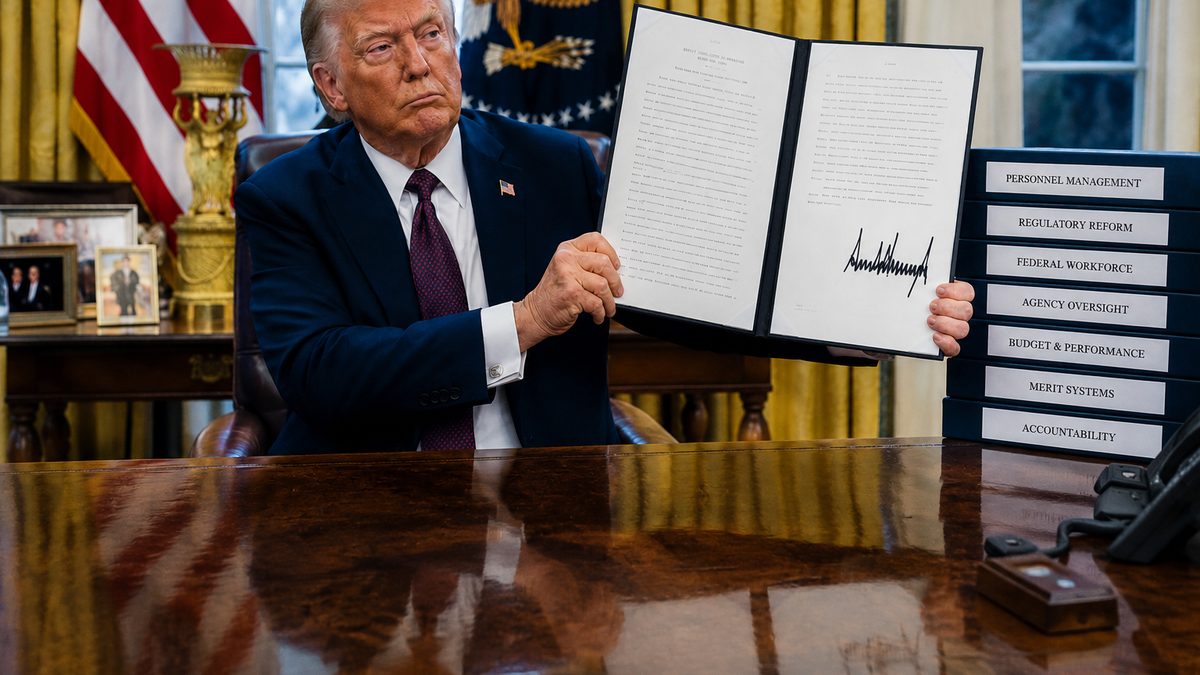
That concern is at the center of a new executive order from President Donald Trump. The order establishes a federal framework focused on advanced AI innovation and security, while encouraging review of some of the most capable AI systems before they are widely deployed.
What Changed
The executive order signals that the administration views advanced AI as both an economic opportunity and a potential security challenge. According to White House materials and the published order, federal agencies are directed to coordinate efforts related to AI security, cybersecurity preparedness, and national-security concerns involving advanced models.
The administration argues that the approach can strengthen American leadership in AI while addressing risks that could emerge as systems become more capable. The order places particular attention on models that may have implications beyond ordinary consumer use.
For readers, the key takeaway is straightforward: the federal government is creating a more organized process for thinking about AI-related security risks rather than treating the technology solely as a commercial or research issue.
Why Voluntary Review Matters
One of the most notable features of the order is what it does not do. The framework is not described as a broad mandatory licensing system for AI companies, nor does it establish sweeping new federal regulation covering all artificial intelligence development.
Instead, reporting reviewed by TheDailyGlobe indicates that the administration is pursuing a model that encourages security review and cooperation. That approach gives companies significant flexibility while still creating a pathway for government involvement when officials believe national-security concerns may be present.
Supporters of this approach argue that a rapidly evolving technology may be difficult to regulate through traditional rulemaking. A voluntary framework can potentially adapt more quickly while avoiding some of the burdens associated with formal regulation.
Critics and policy analysts, however, have questioned whether voluntary participation alone can address the most serious concerns if companies choose not to cooperate or disagree with government assessments.
The Accountability Question
The policy also raises a broader question about executive power and technology oversight. The administration is publicly acknowledging that advanced AI may create risks involving cybersecurity and national security. At the same time, it is relying heavily on cooperation rather than direct enforcement.
That creates a tension that may shape future debates in Washington. If voluntary reviews work as intended, supporters may argue that additional regulation is unnecessary. If major disputes emerge between government officials and AI developers, pressure could grow for Congress or regulators to pursue stronger oversight tools.
For now, the order establishes a framework for coordination and review rather than a system of mandatory federal control.
What Remains Unclear
Several important questions remain unanswered. The administration has not yet established how many AI companies will participate in the review process or how consistently participation will occur across the industry.
It is also unclear whether voluntary review could evolve into a practical expectation for companies developing the most advanced models. Available reporting does not establish how disagreements between government officials and AI developers would be resolved if security concerns arise.
Implementation details are still developing, and some agencies may issue additional guidance as the framework takes shape.
What Readers Should Watch Next
The next phase of the story will likely be less about the executive order itself and more about how companies respond to it. Agency guidance, participation decisions by major AI developers, and any public disputes over model reviews could reveal how much influence the framework ultimately carries.
The order clearly establishes that AI security has become a federal policy priority. What remains uncertain is whether voluntary cooperation will provide enough leverage to shape the behavior of the companies building the most powerful systems.
Reporting note: Reporting draws on White House materials, Federal Register publications, Associated Press reporting, policy analysis, and reviewed background materials. This article was produced with AI-assisted research and reviewed by an editor before publication.