Trump’s Civil Service Order Reopens a Debate About Who Should Control Federal Agencies
A new executive order affecting senior federal positions has renewed a long-running debate over accountability, expertise, and political influence inside government agencies.
Save Article
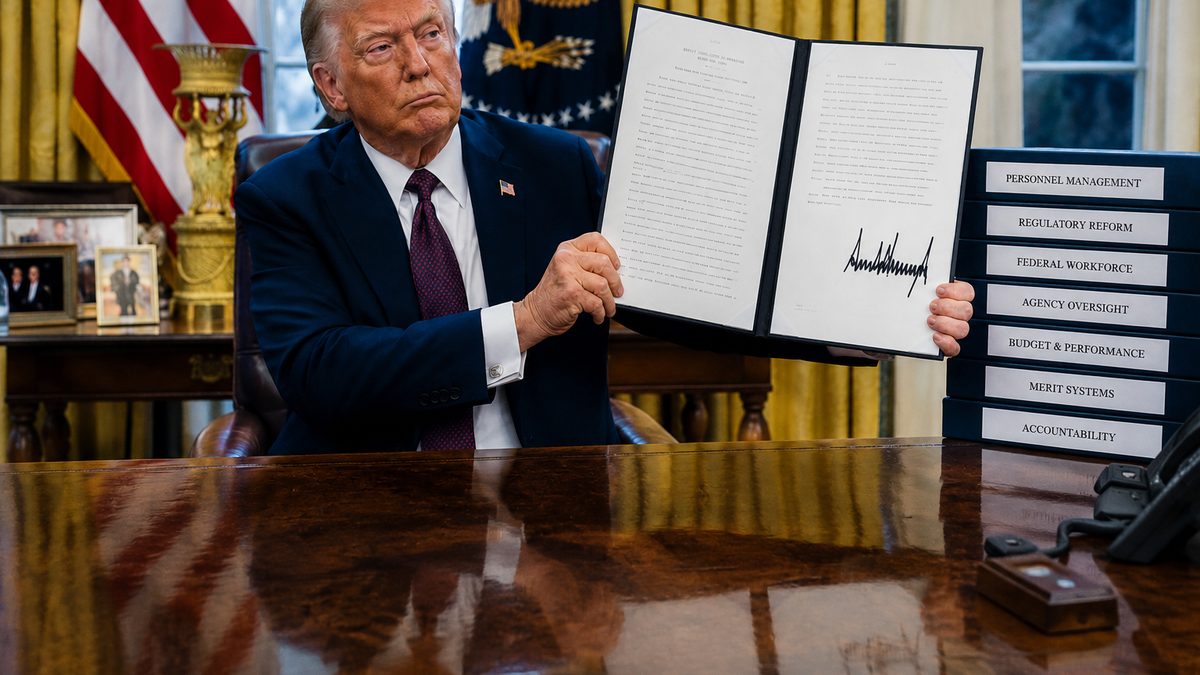
Changes to civil-service rules can reshape how power moves through government. Editorial illustration by TheDailyGlobe.
Key Facts
- The White House announced an executive order affecting certain senior federal positions involved in policy work.
- The administration says the change is intended to increase accountability in the federal workforce.
- Specialized workforce reporting indicates thousands of positions could eventually be affected.
- Critics argue the changes could weaken traditional civil-service independence.
- The final scope of implementation remains unclear.
Most people interact with government through services rather than politics. Tax returns are processed, benefits are administered, regulations are enforced, and public records are maintained by career employees whose jobs typically continue from one administration to the next.
That structure is why changes to civil-service rules often generate debate far beyond federal workplaces. Supporters see such changes as a way to make government more accountable to elected leaders. Critics see them as a test of whether professional government positions can remain insulated from political pressure.
A new executive order announced by the Trump administration has placed that debate back at the center of Washington. The order targets senior federal positions involved in shaping or influencing policy and could affect thousands of government employees, according to specialized federal workforce reporting.
What the Executive Order Changes
The order focuses on federal employees whose work influences policy decisions. According to administration materials, those positions should be more directly accountable to elected leadership because their responsibilities help shape how government policies are developed and carried out.
The White House argues that presidents are elected to implement policy agendas and should have greater authority over senior officials who play a role in that process. Administration materials describe the move as an effort to increase accountability throughout the federal workforce.
Reporting by Government Executive and Federal News Network indicates that thousands of positions may ultimately be affected, although agencies will still need to determine which jobs fall within the new classification framework.
Why Civil-Service Protections Exist
Modern civil-service protections were developed to create a professional workforce that continues functioning regardless of which party controls the White House. Career employees are generally hired through established procedures and are protected from being removed solely because of political disagreements.
Supporters of those protections argue they help preserve expertise, continuity, and impartial administration of government programs. They contend that agencies perform best when technical specialists and career professionals can provide advice and carry out responsibilities without worrying about political loyalty tests.
At the same time, critics of the existing system have long argued that removing underperforming employees can be difficult and that elected leaders should have greater authority over officials who influence major policy decisions.
The Central Disagreement
The debate surrounding the order largely comes down to competing views of accountability.
The administration's position is straightforward: officials who help shape policy should be answerable to elected leadership and easier to remove when they do not support an administration's direction. From that perspective, the change strengthens democratic accountability because voters elect presidents to guide the executive branch.
Critics view the issue differently. They argue that making senior career positions easier to replace could encourage political considerations to play a larger role in jobs traditionally viewed as professional rather than partisan. Their concern is not simply who occupies those positions today, but how future administrations of either party might use similar authority.
What Remains Unclear
Several important questions remain unanswered. Agencies have not yet completed the process of identifying which positions will ultimately be reclassified. As a result, the precise scope of the change remains uncertain.
It is also unclear how labor unions, affected employees, Congress, or the courts may respond. Previous efforts involving similar workforce classifications generated legal and political disputes, and observers will be watching to see whether similar challenges emerge again.
The long-term effect on agency operations is also disputed. Supporters and critics offer different predictions, but those claims remain arguments rather than established outcomes.
What Readers Should Watch Next
The next phase of the story will happen inside federal agencies as officials determine which positions fall under the new framework and how the order is implemented in practice.
Legal challenges, congressional oversight efforts, and agency guidance could all shape the final result. For now, the executive order has reopened a long-running debate about where the balance should sit between political accountability and an independent professional civil service. The answer will affect not only federal employees but also the institutions responsible for delivering government services to the public.
Reporting note: Reporting draws on White House materials, executive-order documents, federal workforce reporting, and reviewed background materials. This article was produced with AI-assisted research and reviewed by an editor before publication.