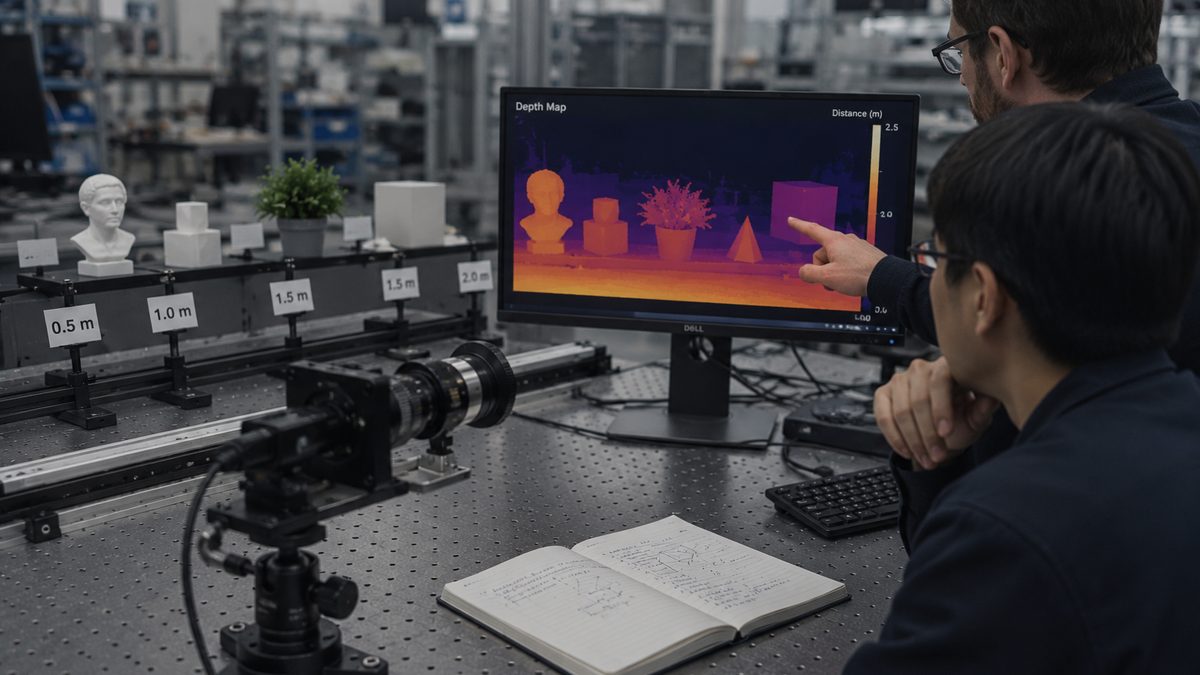
Cooling AI Chips From the Inside Could Cut a Major Data-Center Bottleneck
Researchers at KAIST have developed a chip-cooling design that routes water through microscopic channels inside silicon, targeting one of the biggest physical limits facing advanced computing systems.
Save Article
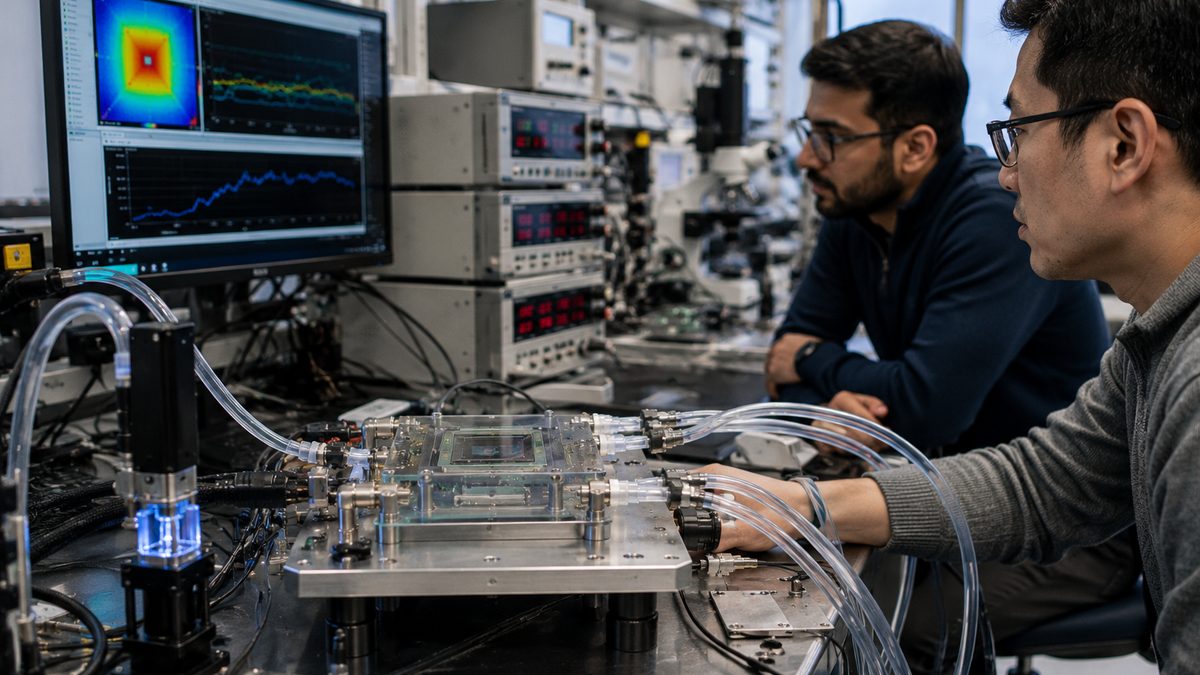
As AI chips grow more powerful, cooling technology is becoming a major engineering challenge. Editorial illustration by TheDailyGlobe.
Key Facts
- KAIST researchers developed a liquid-cooling design that embeds microscopic cooling channels directly inside a silicon chip.
- The system uses room-temperature water flowing through internal microchannels.
- Researchers reported maintaining chip temperatures below 100 degrees Celsius under heat-generation conditions exceeding 2,000 watts per square centimeter.
- The research was described as a CMOS-compatible manifold microchannel cooling design.
- The findings were published in the journal Energy Conversion and Management.
Much of the public conversation around artificial intelligence focuses on software models, training data, and computing power. Behind the scenes, however, another challenge continues to grow: heat.
Modern AI chips perform enormous numbers of calculations every second. Those calculations require electricity, and much of that energy eventually becomes heat that must be removed. If temperatures climb too high, performance can suffer and hardware can be damaged.
Researchers at the Korea Advanced Institute of Science and Technology, or KAIST, recently reported a cooling approach designed to tackle that problem from inside the chip itself rather than relying solely on external cooling systems.
Why Heat Is Becoming a Bigger Problem
As computing hardware becomes more powerful, engineers often face a simple reality: more performance typically creates more heat. AI accelerators, graphics processors, and high-performance computing chips can generate intense thermal loads in very small spaces.
Traditional cooling methods usually move heat away from a chip's surface through heat spreaders, cooling plates, fans, or liquid-cooling equipment attached outside the semiconductor package. Those approaches remain effective in many situations, but engineers continue searching for ways to handle increasingly concentrated heat.
The challenge is not unique to AI. Advanced computing systems used in scientific research, engineering simulations, and other high-performance workloads face similar thermal constraints.
How the New Cooling Design Works
The KAIST team took a different approach by placing tiny cooling channels directly inside the silicon structure. Water flows through those microscopic pathways and removes heat closer to where it is generated.
Researchers described the system as a manifold microchannel cooler. While the terminology is technical, the basic idea is straightforward: bring cooling fluid closer to the hottest parts of the chip instead of relying entirely on heat to travel outward before being removed.
According to summaries of the research, the design uses room-temperature water and achieved cooling performance that exceeded previous reported benchmarks under specific testing conditions. Researchers said the system kept temperatures below 100 degrees Celsius even while handling extremely high heat-generation levels.
Why Researchers Believe It Matters
Cooling has become an increasingly important part of modern computing infrastructure. Data centers invest heavily in systems that move heat away from servers, while chip designers continually look for ways to increase performance without creating unmanageable thermal problems.
If embedded cooling methods eventually prove practical, they could provide engineers with another option for managing heat in future generations of processors. Researchers and industry observers have pointed to potential applications in advanced computing hardware, high-performance processors, power electronics, and complex chip packaging technologies.
Those possibilities remain prospective rather than proven. The reported results apply to a research demonstration and should not be interpreted as evidence that commercial AI infrastructure is about to adopt the technology at scale.
What the Research Does Not Prove
Several important questions remain unanswered. The reported results focus on chip-level cooling performance rather than complete servers or data centers. That distinction matters because cooling a single semiconductor device is different from cooling thousands of interconnected systems operating continuously.
Researchers have not yet demonstrated how the design would perform across years of commercial operation. Manufacturing costs, reliability, maintenance requirements, packaging challenges, and large-scale deployment all remain open questions.
It is also unclear how easily the technology could be integrated into existing production environments. Some reports suggest compatibility with established semiconductor manufacturing processes, but widespread adoption would require additional testing and industry validation.
What Readers Should Watch Next
The next stage will likely involve moving beyond laboratory measurements and demonstrating how embedded cooling performs in more complete computing systems. Engineers will be watching for tests involving chip packages, processor assemblies, and eventually larger computing platforms.
Industry partnerships could provide clues about whether manufacturers view the technology as commercially promising. Future demonstrations may also reveal how well the cooling approach works when integrated with the many other components that make modern computing hardware function.
For now, the research highlights a reality that often receives less attention than AI software itself. Building faster computing systems is not only a question of better algorithms. It is also a question of managing the heat those systems create, and that challenge may become increasingly important as computing demands continue to grow.
Reporting note: Reporting draws on university research materials, semiconductor engineering reporting, technical publications, and reviewed background materials. This article was produced with AI-assisted research and reviewed by an editor before publication.