Why Waiting Rooms Reveal More About Society Than We Think
In an era when many public spaces have become more private, waiting rooms remain one of the few places where strangers still regularly share time together.
Save Article
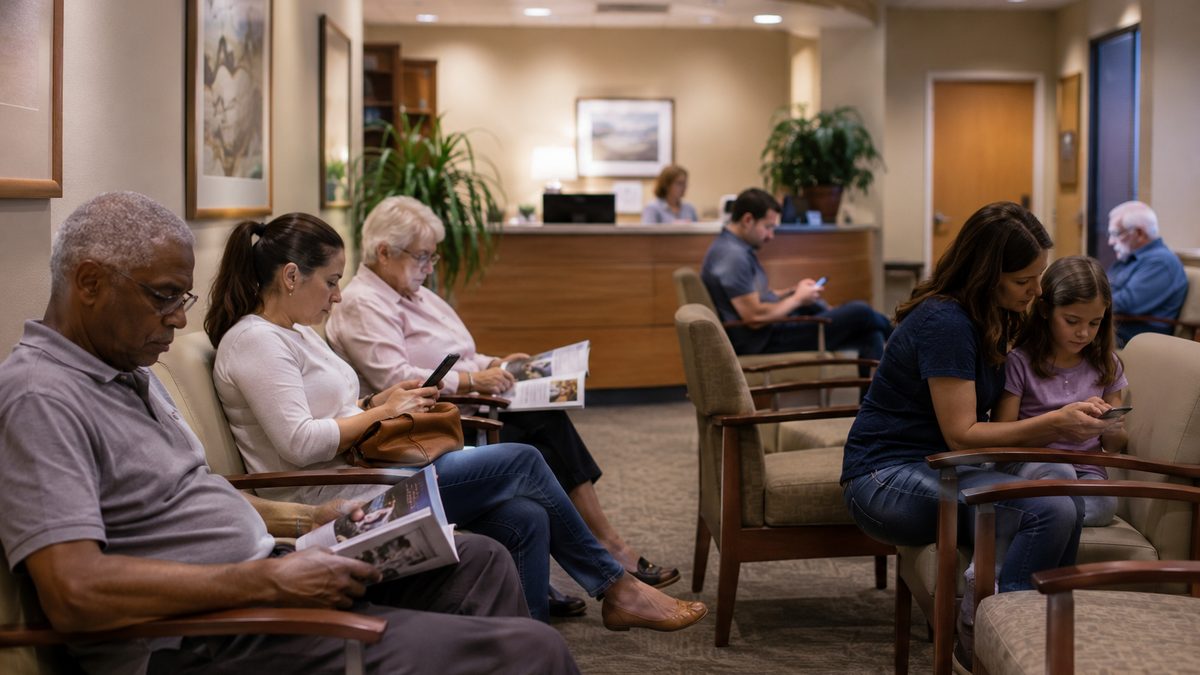
Waiting rooms remain one of the few places where strangers regularly share time and space without planning to meet. Editorial illustration by TheDailyGlobe.
Key Facts
- Americans spend substantial time waiting for appointments and services.
- Waiting rooms regularly bring together people from different backgrounds and age groups.
- Many traditional public gathering places have become less central to daily life.
- Social connection researchers have documented declines in some forms of in-person interaction.
- Waiting rooms remain common in health care, government services, and many businesses.
Most people do not think much about waiting rooms. They are places to get through rather than places to notice. Whether at a doctor's office, auto repair shop, government agency, or service center, the goal is usually the same: wait your turn and move on.
Yet waiting rooms occupy a surprisingly unusual place in modern life. At a time when many activities have become personalized, digital, or private, waiting rooms remain one of the few spaces where strangers routinely spend time together without choosing who will be there.
That makes them an overlooked window into how people interact, how communities function, and how public life has changed over the past few decades.
A Shared Space Few People Choose
Unlike coffee shops, parks, or restaurants, waiting rooms are not destinations. People arrive because they need something. That simple fact changes the atmosphere.
Everyone in the room is there for a different reason. One person may be waiting for a medical appointment. Another may be renewing paperwork. Someone else may be picking up a family member. Their lives may have little in common, yet they briefly share the same space.
In many ways, waiting rooms create a small cross-section of a community. People of different ages, incomes, professions, and backgrounds sit side by side for a few minutes or a few hours. Few other places still bring together such a random mix of people on a regular basis.
What Changed About Public Life
Several generations ago, people often encountered strangers in a wider range of everyday settings. Neighborhood stores, community organizations, local gathering spots, and civic groups created opportunities for casual interaction.
Many of those experiences still exist, but some have become less common. Shopping can happen online. Entertainment can happen at home. Work can happen remotely. Social interaction increasingly takes place through screens rather than shared physical spaces.
As those changes accumulated, the number of places where strangers regularly cross paths narrowed. Waiting rooms remain one of the exceptions because they are difficult to replace entirely with technology.
The Quiet Rules Everyone Understands
Waiting rooms also reveal something interesting about social behavior. Most people understand the unwritten rules without anyone explaining them.
People usually keep a respectful distance when seats are available. Conversations tend to stay quiet. Eye contact is brief. Phones, magazines, books, and laptops often serve as personal boundaries. At the same time, many people will still help someone who needs assistance or exchange a few friendly words when the moment feels appropriate.
The result is a form of coexistence that is neither fully social nor fully isolated. People acknowledge one another's presence while largely respecting each other's privacy.
What Phones Have Changed
Anyone comparing today's waiting rooms to those of twenty years ago would probably notice one obvious difference. Smartphones have transformed how people spend their time while waiting.
A room that once might have featured newspapers, magazines, and occasional conversation is now often filled with glowing screens. People answer emails, scroll through news, watch videos, or communicate with friends while they wait.
That shift has made waiting feel more productive or entertaining for many people. It may also mean fewer spontaneous conversations between strangers. The waiting room still gathers people together physically, but technology allows them to remain connected elsewhere at the same time.
Why Waiting Rooms Still Matter
For all their ordinary appearance, waiting rooms highlight something important about modern society. They remind us that public life has not disappeared completely. Even in a highly personalized world, there are still places where people share time with others they did not choose and may never see again.
Those moments are rarely memorable. Most waiting-room experiences fade from memory almost immediately. Yet together they represent a small but persistent form of civic life—one built not on friendship or agreement, but on the simple reality of sharing space with other people.
As more parts of daily life move online, that may be one reason waiting rooms remain quietly interesting. They continue to reveal how people behave when strangers gather in the same room, even when nobody came there to socialize in the first place.
Reporting note: Reporting draws on health-care access reporting, public-space sociology research, social connection research, and reviewed background materials. This article was produced with AI-assisted research and reviewed by an editor before publication.