County Fairs Still Explain a Lot About American Summer Culture
Beyond rides and fried food, county fairs remain one of the few places where agriculture, youth programs, local businesses, crafts, and community traditions come together in the same space.
Save Article
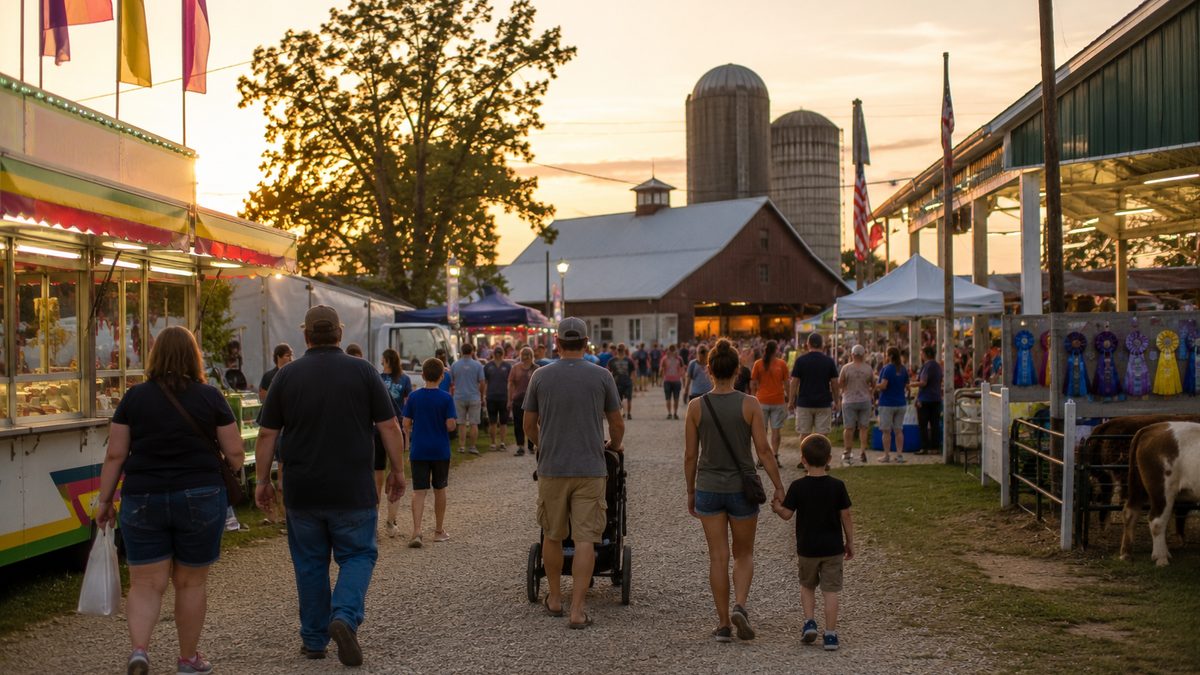
County fairs remain summer gathering places where food, agriculture, youth projects, and local tradition meet. Editorial illustration by TheDailyGlobe.
Key Facts
- The International Association of Fairs and Expositions represents fairs and expositions across North America and beyond.
- 4-H programs connect young people with agriculture, learning opportunities, and community projects.
- USDA's National Institute of Food and Agriculture describes 4-H as a youth development program linked to land-grant universities and cooperative extension systems.
- County fairs often include livestock exhibitions, agricultural displays, food vendors, crafts, competitions, and entertainment.
- Available information does not establish a national attendance trend for county fairs in 2026.
The first thing many people notice at a county fair is the mix of everything happening at once. The smell of food drifts across the grounds. Children tug parents toward rides. Livestock barns buzz with activity. Craft displays sit beside agricultural exhibits. A local band plays somewhere in the distance while families wander from one attraction to the next.
At first glance, it can feel like a collection of unrelated activities. Spend a little time there, though, and county fairs begin to reveal something larger. They remain one of the few public spaces where agriculture, food, youth programs, small businesses, crafts, and community traditions all meet in the same place.
More Than Rides And Fried Food
County fairs are often remembered for giant turkey legs, carnival games, and midway attractions. Those elements remain part of the experience, but they only tell part of the story.
Many fairs continue to serve as showcases for local agriculture and community achievement. Visitors may see livestock raised by students, gardening projects, baking competitions, woodworking displays, photography exhibits, and other entries created by people who spent months preparing for the event.
That combination makes fairs different from most entertainment venues. They are not simply places where people consume experiences. They are also places where community members display what they have built, grown, learned, or created.
The Role Of 4-H And Youth Programs
One of the most visible examples of that community connection is 4-H. For generations, county fairs have provided a public stage for many youth projects tied to agriculture, leadership, science, crafts, and practical skills.
According to USDA's National Institute of Food and Agriculture, 4-H operates through a youth development model connected to land-grant universities and cooperative extension programs. While many people associate 4-H primarily with livestock, the organization encompasses a much broader range of learning experiences.
At fairs, visitors often see the results of those efforts firsthand. A livestock competition may be happening in one building while photography entries, robotics projects, cooking displays, or educational exhibits are being judged nearby. The fair becomes a public reminder that youth development can happen outside traditional classrooms.
A Snapshot Of Local Identity
County fairs also provide a glimpse into what makes individual communities unique. The foods, exhibits, competitions, and traditions often reflect local history and regional priorities.
An agricultural county may emphasize livestock and farming displays. Another community might place more attention on crafts, horticulture, local foods, or cultural traditions. Even when fairs share similar attractions, the details often reflect the people who organize and participate in them.
That local character helps explain why county fairs continue to attract interest even as entertainment options have expanded dramatically. Visitors are not simply attending an event. They are seeing a community present itself to neighbors and guests.
Questions That Do Not Have Clear Answers Yet
Not every aspect of the county fair story is easy to measure. Available information does not provide a clear national picture of attendance trends for 2026. It is also unclear how factors such as weather, travel costs, inflation, or local economic conditions may be affecting individual fairs this year.
Some communities may be seeing strong participation while others face challenges. Conditions can vary considerably depending on location, population, and local support.
Without consistent national data, broad claims about the future of county fairs should be approached carefully.
Why The Tradition Still Matters
County fairs persist because they continue to serve practical purposes. They create opportunities for learning, competition, business promotion, social connection, and community celebration. They give young people a place to present their work and offer visitors a chance to better understand the region where they live.
That does not mean every fair is identical or that every community experiences these events in the same way. What remains consistent is the fair's ability to bring together parts of community life that are often separated during the rest of the year.
For readers walking through fairgrounds this summer, the attractions may seem familiar. Yet beneath the rides, food stands, and entertainment is something more enduring: a gathering place where local identity, practical skills, agriculture, and community traditions continue to meet face-to-face in an increasingly digital world.
Reporting note: Reporting draws on materials from the International Association of Fairs and Expositions, 4-H programs, USDA National Institute of Food and Agriculture resources, and reviewed background materials. This article was produced with AI-assisted research and reviewed by an editor before publication.