The Fix-First Mindset Is Turning Repair Into Everyday Culture
Repair cafés, right-to-repair debates and household cost pressure are making fixing things feel less fringe and more practical.
Save Article
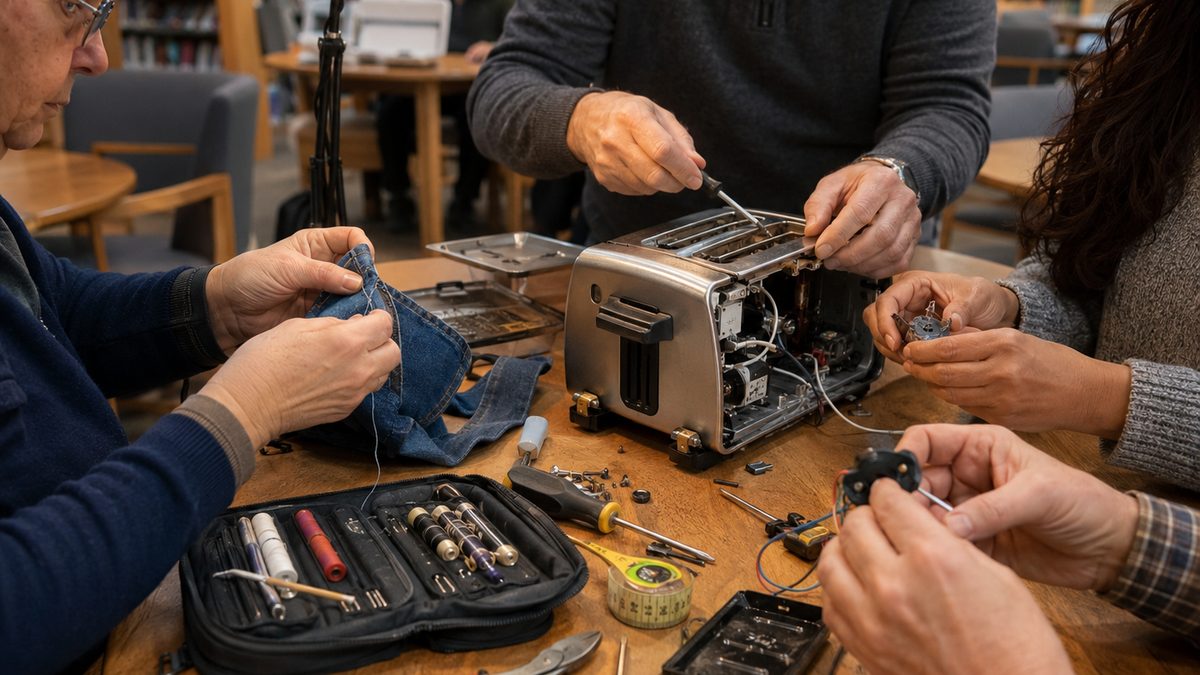
Repair cafés and tool-sharing programs turn fixing household items into a practical community skill. Editorial illustration by TheDailyGlobe.
Key Facts
- Repair cafés are community spaces where volunteers help people repair broken or malfunctioning items.
- The Repair Association tracks right-to-repair activity across states and should be understood as an advocacy source.
- Recent reporting has described a broader fix-first mindset tied to affordability, waste reduction and consumer control.
- Repair culture overlaps with home economics, community skill-sharing and policy debates.
- Participation, access and repair options vary widely by community.
A broken lamp, a loose chair leg, a jammed zipper or a toaster that suddenly quits does not automatically have to mean a trip to the trash.
For a long time, replacement has often felt like the default. New products are easy to buy, hard-to-open devices can be difficult to repair, and many people were never taught how to fix ordinary household items. But repair is becoming more visible again, not only as a way to save money, but as a practical culture built around skills, ownership and community help.
Repair cafés, right-to-repair debates and everyday cost pressure are all part of that larger shift. The evidence does not prove that repair is suddenly available everywhere or always cheaper than replacement. It does show that fixing things has moved beyond a niche hobby and into a wider conversation about household value.
Why Fixing Things Feels Different Now
Repair has always existed. People have patched clothes, sharpened tools, glued furniture, replaced cords and kept old machines running for generations. What feels different now is the visibility. Repair cafés and similar events give the habit a public place. Right-to-repair debates give it a policy frame. Rising household costs give many people a practical reason to ask whether something can be fixed before it is replaced.
That does not mean every broken item deserves a second life. Some repairs cost more than a replacement. Some items are unsafe to fix without proper training. Some products are built in ways that make repair difficult. A realistic repair culture starts there: fixing things is useful, but it is not magic.
Still, the basic instinct is easy to understand. If a lamp can be rewired, a jacket zipper can be replaced or a chair can be tightened, the household saves money and keeps something useful in circulation. The value is not only financial. People also learn what things are made of, how they fail and what can be done before buying new.
Repair Cafés Turn Skill Into Community
Repair cafés are one of the clearest examples of the fix-first idea. They are usually community events where volunteers help people repair small household items, clothing, electronics, furniture or other belongings. The exact setup varies, but the shared idea is straightforward: bring something broken, sit with someone who knows more than you do, and try to fix it together.
That model matters because many people do not have a garage full of tools, a relative who can sew or solder, or the confidence to take apart a small appliance alone. A repair event can make the first step less intimidating. It also turns repair into a social activity instead of a private frustration.
The limits are important. Repair cafés are not available in every community, and volunteer events cannot solve every repair problem. Some items need professional service, replacement parts or safety checks. But as a cultural signal, they show that repair is not just about saving one object. It is also about passing along practical knowledge.
The Policy Fight Behind the Household Habit
The right-to-repair movement adds another layer. The Repair Association, an advocacy organization, tracks state activity related to repair laws. Its work connects household frustration to a larger consumer question: when people buy something, how much control should they have over fixing it?
That debate can involve electronics, appliances, farm equipment and other products that may require tools, parts, manuals or software access. Supporters argue that repair access can save consumers money and reduce waste. Manufacturers and industry groups have often raised concerns about safety, intellectual property, cybersecurity, warranties or product reliability. The details vary by product and state.
For readers, the policy fight can seem distant until something breaks. Then the issue becomes practical: Can a local repair shop get the part? Can the owner open the product without damaging it? Is repair possible without paying nearly the price of a new item?
What Repair Cannot Promise
The fix-first mindset should not be turned into a lecture. Repair is not always cheaper. It is not always accessible. It is not always safe. Some households have more time, tools, transportation and local options than others. A respectful repair culture has to recognize those limits instead of making people feel guilty for replacing something when repair is unrealistic.
The available reporting and advocacy tracking also do not prove exactly how widespread repair cafés are across every U.S. region or how much of the repair trend is driven by budgets, environmental concerns, policy debates or simple nostalgia for more durable goods.
What to Watch Locally
The most useful place to watch is close to home. Local libraries, community centers, neighborhood groups and sustainability organizations may host repair cafés, mending events, tool libraries or skill-sharing workshops. State right-to-repair bills are another place to watch, especially for readers interested in whether repair access becomes easier over time.
For now, the practical takeaway is modest but useful: before something goes out the door, it may be worth asking whether it can be fixed, who nearby knows how, and whether the repair is safe and realistic. That question alone marks a cultural change.
Repair is not about pretending every old thing can be saved. It is about remembering that some useful things still can be.
Reporting note: Reporting draws on established reporting, repair-café context, right-to-repair policy tracking, advocacy materials, and reviewed background context. This article was produced with AI-assisted research and reviewed by an editor before publication.