Serbia’s China Deals Put Its EU Path Under New Pressure
Serbia signed more than 20 cooperation agreements with China while facing protests at home, raising a practical question for Europe: how far Belgrade can deepen Beijing ties while still pursuing EU membership.
Save Article
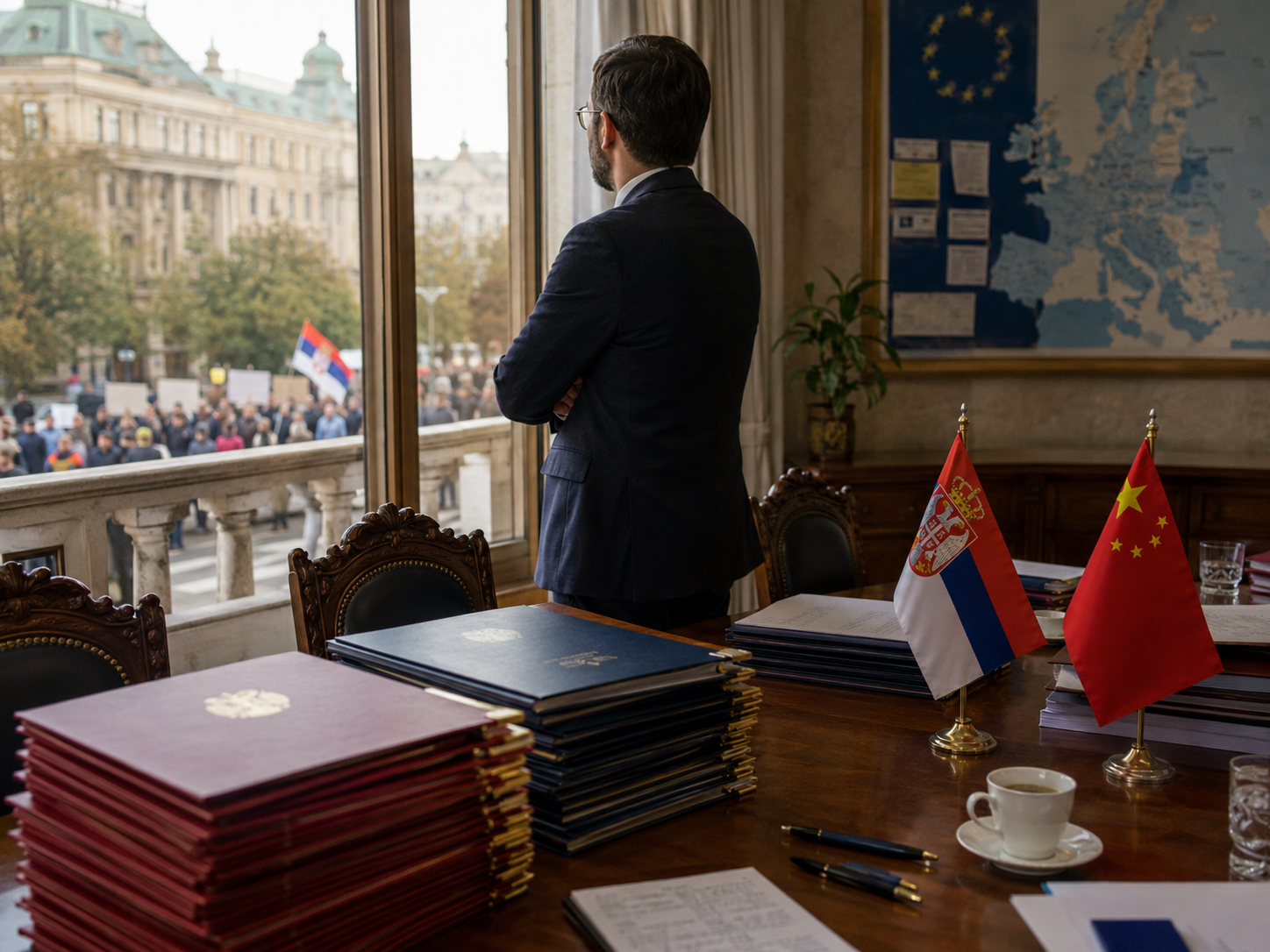
Serbia signed more than 20 cooperation agreements with China while facing protests at home, raising a practical question for Europe: how far Belgrade can deepen Beijing ties while still pursuing EU membership. Editorial illustration by TheDailyGlobe.
Key Facts
- AP reported Serbian President Aleksandar Vučić met Chinese President Xi Jinping in Beijing on May 25, 2026.
- AP reported the leaders witnessed the signing of more than 20 cooperation agreements covering politics, trade, technology and education.
- AP reported Xi awarded Vučić China’s Friendship Medal.
- AP reported Vučić’s China visit came as Serbia faced major anti-government protests at home.
- Serbian and Chinese official materials show the two governments had already elevated ties through a comprehensive strategic partnership and a “shared future” framework.
Serbia’s president deepened ties with China on Monday while facing pressure from a protest movement at home, putting Belgrade’s balancing act with Europe back in focus.
AP reported that Serbian President Aleksandar Vučić met Chinese President Xi Jinping in Beijing on May 25, 2026. The leaders witnessed the signing of more than 20 cooperation agreements covering politics, trade, technology and education, and Xi awarded Vučić China’s Friendship Medal, according to AP.
For readers, the issue is not whether Serbia held another diplomatic meeting. It is whether a country formally seeking European Union membership can keep moving toward Brussels while building deeper political and economic ties with Beijing, especially while domestic critics are questioning transparency, corruption and democratic standards.
Why Serbia’s China Ties Matter
Serbia is not an EU member, but it is an EU candidate. That makes its foreign policy choices especially important to Europe. Brussels is not only watching whether Serbia signs agreements with China. It is watching whether Serbia’s laws, institutions, procurement practices, foreign policy alignment and democratic standards move closer to EU expectations.
Chinese and Serbian official statements describe the relationship in positive terms. The two governments had already elevated ties through a comprehensive strategic partnership and a “shared future” framework. The new agreements in Beijing build on that direction rather than starting from scratch.
That does not mean Serbia has abandoned Europe. The source material does not support that conclusion. It does mean Vučić’s government is continuing to cultivate China as a major partner while Serbia’s EU path remains unfinished.
That balance matters because China’s role in Europe is no longer limited to trade. Infrastructure, technology, education, finance and diplomatic support can all shape how governments make decisions and how much influence outside powers have inside Europe’s borders or near them.
The Domestic Pressure Behind the Visit
Vučić’s trip came as Serbia faced major anti-government protests at home, according to AP. Those protests have continued since a deadly 2024 train station collapse that critics connected to corruption and lack of transparency.
Those are protester and critic claims and should be treated as such. Vučić and pro-government voices reject the protest movement’s framing. The important point for the article is not to decide the entire domestic dispute from outside. It is to show that Serbia’s foreign policy is unfolding while its government faces public pressure over accountability and trust.
That timing gives the China visit a second layer. International agreements can project stability and partnership abroad. Protests at home can point to a different problem: whether citizens believe major decisions, public works and government institutions are being handled transparently.
The train station collapse remains part of that domestic backdrop because infrastructure has become one of the symbols of Serbia’s political argument. Critics have linked the disaster to corruption and weak oversight. Government supporters dispute the protest movement’s broader claims. The legal and political consequences remain unsettled.
Infrastructure Is Part of the Bigger Question
The source material does not show the full text or implementation details of every new Serbia-China agreement. AP reported they covered politics, trade, technology and education. That means the practical effects will depend on which agreements become real projects, funding arrangements, policies or institutional partnerships.
Infrastructure is especially sensitive in Serbia because it sits at the intersection of economic development, foreign investment and public accountability. Roads, rail lines, stations and other projects are visible signs of progress, but they also raise questions about contracts, oversight, safety and debt when the public does not trust the process.
That is where the China relationship can become politically complicated. Beijing can offer financing, construction capacity and diplomatic support. European institutions usually attach their own standards around procurement, governance, transparency and regulatory alignment. Serbia’s challenge is that it cannot easily satisfy every partner’s expectations at once.
For ordinary Serbians, this is not just foreign policy. It can affect what gets built, who pays for it, how transparent the contracts are, whether public institutions are trusted and whether the country’s future feels closer to the EU, China, Russia or some mix of all three.
Europe’s Balkan Problem
Serbia matters beyond its borders because the Balkans remain one of Europe’s most politically sensitive regions. EU enlargement, Chinese influence, Russian ties, unresolved regional disputes and domestic democratic standards overlap there.
For the EU, Serbia’s path is a test of credibility. If candidate countries believe EU membership is too distant or too uncertain, they may look harder for other partners. If they deepen other ties too far, Brussels may question whether they are still moving toward EU standards.
That tension does not have to produce a clean break. Countries often work with multiple partners. But Serbia’s case is more sensitive because it is formally seeking EU membership while also maintaining close relationships with powers that Europe views with caution.
China’s role is different from Russia’s, and the two should not be treated as interchangeable. China’s influence is often built through investment, trade, infrastructure, technology and diplomacy. Russia’s role in the Balkans has its own history, security meaning and political networks. Serbia’s position is shaped by both, but not in the same way.
What the New Agreements Do Not Yet Tell Us
The signing ceremony shows political intent. It does not, by itself, show how much of the cooperation will become concrete investment, enforceable policy or long-term institutional change.
That distinction matters. Diplomatic agreements can range from broad statements of friendship to specific projects with money, deadlines and legal commitments. The available source material confirms the number and general categories of the agreements, but not every practical consequence.
It also remains unclear whether the Beijing agreements will slow, complicate or reshape Serbia’s EU accession path. They may sharpen European concern, but the article should not state as fact that the EU path has been derailed unless EU officials or accession documents support that conclusion.
The same caution applies to Serbia’s protests. The protest movement has shown public pressure, but it remains unclear whether it can force early elections, governance changes or a shift in how Vučić manages foreign partnerships.
The Reader Takeaway
Serbia is a European swing-state story in practical terms. It is not in the EU, but it wants to join. It works closely with China. It has maintained ties that make Western governments uneasy. It is facing domestic protests over accountability and transparency. And it sits in a region where outside influence matters.
That is why Monday’s meeting in Beijing deserves attention. The new agreements are not just ceremonial background. They are part of Serbia’s attempt to keep multiple doors open while pressure builds at home and Europe watches how Belgrade defines its future.
The clearest reading is careful, not dramatic. Serbia has not been shown to have chosen China over Europe. But its deeper China relationship adds pressure to an EU path that already depends on trust, institutions, alignment and public accountability.
Reporting note: Reporting draws on AP reporting, Serbian foreign ministry materials, Chinese foreign ministry background, official bilateral statements, and reviewed Balkan regional context. This article was produced with AI-assisted research and reviewed by an editor before publication.