NVIDIA’s Humanoid Robot Platform Shows AI Moving Into University Labs
NVIDIA’s Isaac GR00T reference humanoid robot is aimed at academic research, not home use, showing how robotics work is becoming more standardized.
Save Article
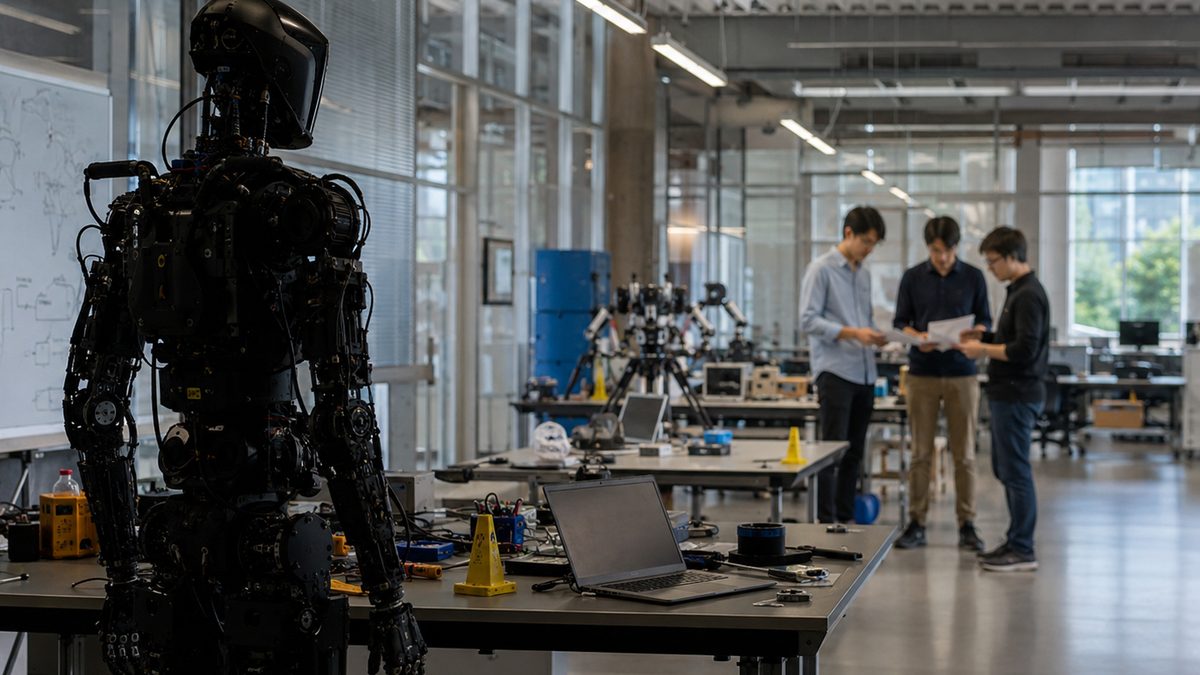
Humanoid robot research is moving toward more standardized platforms, but practical real-world use still depends on testing, safety and reliability. Editorial illustration by TheDailyGlobe.
Key Facts
- NVIDIA announced the Isaac GR00T Reference Humanoid Robot on June 1, 2026.
- NVIDIA describes it as an open humanoid robot reference design built on Jetson Thor and the Isaac GR00T open development platform.
- NVIDIA says the platform is intended to help academic researchers access humanoid robotics hardware and software without building every layer from scratch.
- Technology reporting says the system uses a Unitree humanoid chassis, dexterous hands, onboard compute and NVIDIA robotics software tools.
- Robotics research still faces major questions around reliability, safety, cost, data and real-world deployment.
Humanoid robots are easy to imagine as future helpers in homes, hospitals, warehouses or factories. The harder reality is slower and less cinematic: researchers still have to teach machines how to see, move, balance, manipulate objects, recover from mistakes and operate safely outside tightly controlled demonstrations.
NVIDIA’s latest robotics announcement fits into that less flashy but more important part of the story. On June 1, the company announced the Isaac GR00T Reference Humanoid Robot, a platform aimed at academic researchers studying humanoid robotics.
What NVIDIA Announced
NVIDIA describes the Isaac GR00T Reference Humanoid Robot as an open humanoid robot reference design built on Jetson Thor and the company’s Isaac GR00T open development platform. In plain terms, the company is offering researchers a more complete starting point for studying humanoid robots.
That matters because robotics research can be slowed by the need to assemble many layers at once: hardware, sensors, hands, computing, simulation tools, robot-control software and testing environments. NVIDIA says the platform is meant to help academic researchers work on humanoid robotics without building every layer from scratch.
Technology reporting on the announcement says the system uses a Unitree humanoid chassis, dexterous hands, onboard compute and NVIDIA robotics software tools. Those details help explain why this is not simply a robot body. It is a research setup meant to connect physical hardware with software systems used for learning, testing and simulation.
Why A Reference Platform Matters
A reference platform is not the same thing as a finished consumer product. It is closer to a shared research foundation. If universities can work from similar hardware and software setups, researchers may be able to compare results more clearly and spend more time on the problems they are studying.
For humanoid robots, those problems are still difficult. A machine shaped somewhat like a person has to move through spaces built for people, use tools and objects designed for human hands, and make sense of messy real-world surroundings. Even small tasks can become complicated when lighting changes, objects shift, floors are uneven or people behave unpredictably.
That is where simulation also matters. Related robotics research has focused on scalable, GPU-accelerated simulation, which can let researchers test robot behavior in virtual environments before trying it on hardware. Simulation does not replace real-world testing, but it can help researchers run more experiments and find problems before a physical robot is put through the same task.
What This Does Not Mean
The announcement should not be read as evidence that household humanoid robots are ready for everyday life. NVIDIA is presenting the platform for academic research, not as a robot that consumers can buy to do chores or provide care.
That distinction is important because humanoid robots often attract more hype than the technology can support. A lab platform can help researchers study movement, manipulation, perception and reasoning. It does not automatically solve the practical problems that come with cost, safety, reliability, maintenance, training data and public trust.
Real-world usefulness is the hard test. A robot that performs well in a lab still has to deal with cluttered rooms, unexpected obstacles, fragile objects, people nearby and tasks that do not happen the same way twice. Those are not small details. They are the difference between a promising research system and a machine people can depend on.
Why Universities Are The Right Place To Watch
The most immediate audience for NVIDIA’s platform is not the general public. It is academic labs trying to study humanoid robotics with more complete tools. That makes universities an important place to watch if readers want to understand what is real progress and what is still mostly demonstration.
If researchers adopt platforms like this, the useful signs will not only be flashy videos. They will be better testing methods, clearer comparisons between approaches, safer robot behavior, improved manipulation and stronger links between simulation and physical machines.
Humanoid robots may eventually become more practical in workplaces or homes, but that path still runs through careful research. NVIDIA’s announcement is a reminder that the future of robotics is not built only in product launches. Much of it starts in labs, where the slow work of making machines reliable comes before any promise of everyday use.
Reporting note: Reporting draws on NVIDIA materials, established technology reporting, robotics simulation research, and reviewed background materials. This article was produced with AI-assisted research and reviewed by an editor before publication.