Why the FBI Built a Fake Town to Train for Real-World Cyber Incidents
The FBI's Kinetic Cyber Range looks like a small town, but its purpose is to prepare investigators and responders for cyber incidents that can affect hospitals, utilities, businesses, and other real-world systems.
Save Article
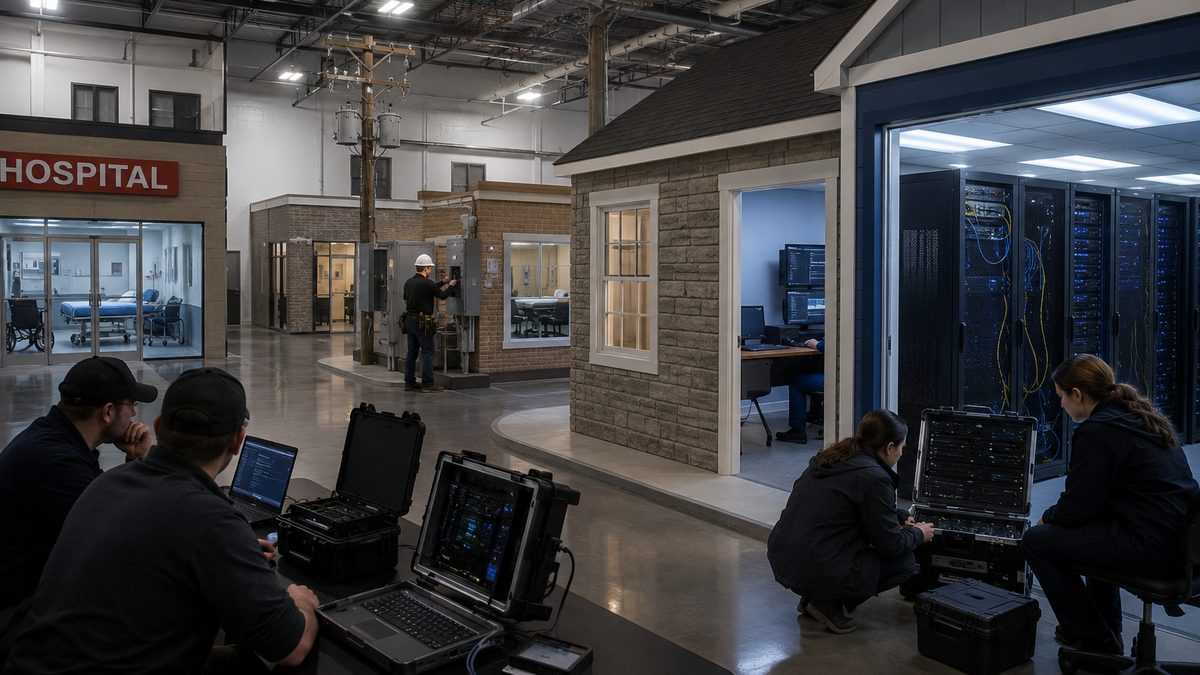
Cyber training increasingly recreates the physical places and systems investigators may encounter during real incidents. Editorial illustration by TheDailyGlobe.
Key Facts
- The FBI says its Kinetic Cyber Range occupies approximately 22,000 square feet.
- The facility includes houses, hotel rooms, a hospital, a gas station, and a power company.
- The range contains functioning networks, devices, and systems designed to behave like real-world environments.
- The FBI says more than 1,400 students have trained at the facility since it opened in February 2025.
- The facility includes a data center with more than 200 servers.
When people hear the term cyberattack, they often picture someone sitting behind a computer screen. But a cyber incident involving a hospital, utility company, vehicle fleet, or public service can quickly become a problem that affects buildings, equipment, workers, and entire communities.
That reality helps explain why the FBI has invested in a training environment that looks less like a traditional classroom and more like a small town. The agency recently highlighted its Kinetic Cyber Range, a large indoor facility in Huntsville, Alabama, designed to give investigators and technical specialists a place to practice responding to realistic cyber incidents before they encounter them in the field.
The facility offers a glimpse into how cybersecurity training is evolving. Instead of focusing only on computer systems, modern training increasingly aims to recreate the physical environments where digital problems can have real-world consequences.
More Than a Computer Lab
According to the FBI, the Kinetic Cyber Range was built to resemble a small community rather than a conventional technical training center. Inside are locations that mirror places investigators might encounter during an actual incident, including homes, businesses, utility facilities, and healthcare settings.
The goal is to allow trainees to work in environments that feel closer to reality. A cyber incident affecting a hospital may involve medical equipment, communications challenges, documentation, and coordination among multiple teams. A disruption involving a utility company may require understanding how digital systems connect to physical infrastructure.
By recreating those environments indoors, the FBI says trainees can practice decision-making in settings that reflect real operational conditions.
Why Realism Matters
The FBI argues that realistic environments help students learn lessons before they are responsible for responding to actual incidents. Training exercises can expose mistakes, communication problems, or technical gaps without creating risks for real organizations or communities.
That approach is not unique to cybersecurity. Pilots use flight simulators. Emergency responders train in mock disaster scenarios. Medical professionals practice procedures before treating patients. Cybersecurity training is increasingly moving in a similar direction as digital systems become more deeply connected to physical infrastructure.
The FBI says every space within the range contains functioning systems, devices, and networks designed to operate as they would outside the training environment. That allows participants to encounter situations that are closer to the conditions they may face in the real world.
What the Public Information Does Not Show
While the FBI has provided substantial detail about the facility itself, public information is more limited when it comes to measuring outcomes. The agency says more than 1,400 students have trained at the range since its opening in February 2025, but the available reporting does not independently establish how much the training improves performance during actual investigations or incident response efforts.
It is also unclear how frequently scenarios are updated, how training effectiveness is measured, or whether similar facilities could be expanded elsewhere. Public reporting has not established how broadly the model may be adopted by state agencies, local governments, or private infrastructure operators.
Those unanswered questions do not diminish the scale of the facility, but they do highlight the difference between describing a training program and proving its results.
Cybersecurity Is Becoming a Physical Infrastructure Issue
One reason the facility stands out is that it helps illustrate how cybersecurity has changed. Digital investigations increasingly involve systems connected to everyday life, including transportation networks, healthcare facilities, utilities, and other services people rely on every day.
That means investigators may need more than technical expertise. They may also need to communicate with affected organizations, preserve evidence, understand operational environments, and make decisions under pressure.
The Kinetic Cyber Range reflects that broader view of cybersecurity. The training is not only about computers. It is also about understanding how technology interacts with the physical world.
What to Watch Next
The most important question going forward is whether other organizations follow a similar path. As critical infrastructure becomes more connected, agencies and operators may increasingly look for hands-on training environments that recreate the systems they are responsible for protecting.
For now, the FBI's indoor town offers a visible example of how cyber training is changing. The public details show a facility designed to make digital threats tangible. What remains to be seen is whether this model becomes a larger part of how governments and infrastructure operators prepare for future incidents.
Reporting note: Reporting draws on FBI materials, technology reporting, official facility information, and reviewed background materials. This article was produced with AI-assisted research and reviewed by an editor before publication.