What an Unusual Star System May Reveal About the Milky Way's Earliest Years
New observations from the James Webb Space Telescope and Hubble Space Telescope suggest that Terzan 5 is more than a typical star cluster. Researchers say it may preserve clues from a much earlier chapter in the Milky Way's formation.
Save Article
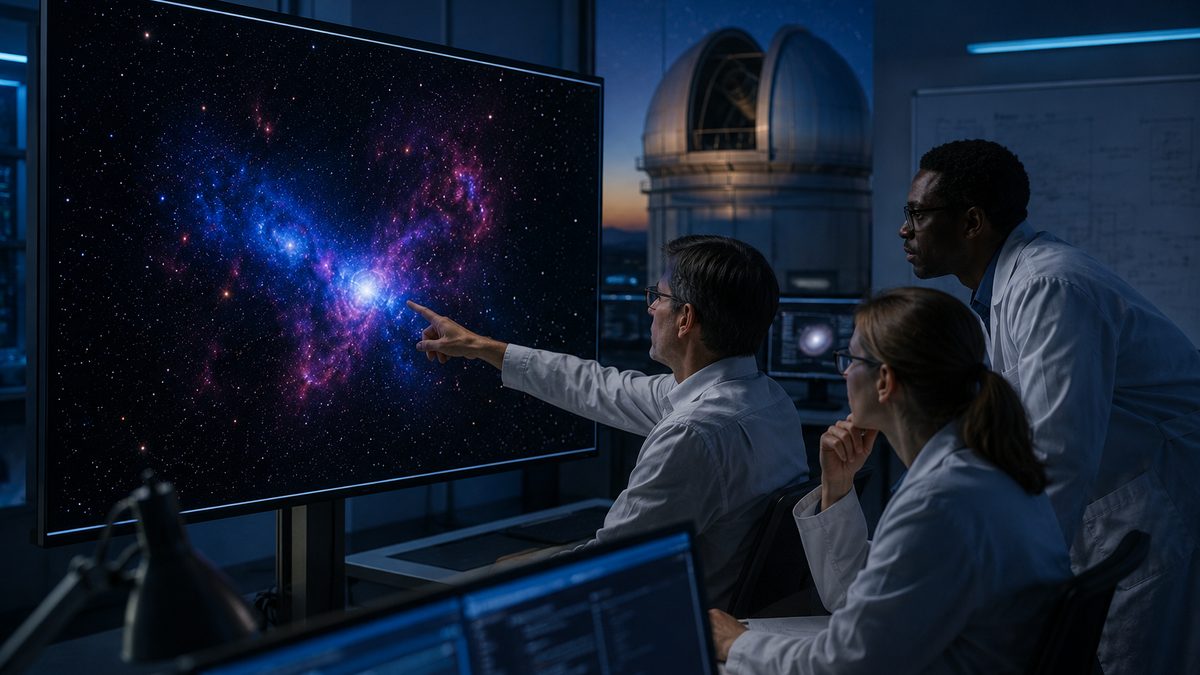
Old star systems can preserve clues about how the Milky Way formed. Editorial illustration by TheDailyGlobe.
Key Facts
- NASA published new findings about Terzan 5 on June 16, 2026.
- Researchers say Terzan 5 is not simply a globular cluster as previously classified.
- Observations indicate the system contains up to four distinct star populations.
- The findings were presented at the 248th meeting of the American Astronomical Society.
- Related research was published in the journal Astronomy & Astrophysics.
Some fossils are buried in rock. Others may be hiding in plain sight among the stars.
Astronomers studying a dense collection of stars known as Terzan 5 believe it could be preserving evidence from one of the earliest chapters in the Milky Way's history. New observations from NASA's James Webb Space Telescope, combined with earlier Hubble Space Telescope data, are strengthening the case that Terzan 5 is something far more unusual than researchers once thought.
Rather than being a typical globular cluster—a common type of tightly packed star cluster—Terzan 5 appears to contain several distinct generations of stars. That discovery could help scientists better understand how the central region of our galaxy formed billions of years ago.
A Star System That Refused to Fit the Mold
For many years, Terzan 5 was grouped with globular clusters, ancient collections of stars that orbit larger galaxies. These systems typically contain stars that formed around the same time, making them useful laboratories for studying stellar evolution.
Terzan 5 never fit that picture perfectly. Located near the crowded central bulge of the Milky Way, it contains an unusually rich mixture of stars. Earlier observations hinted that the system might have a more complicated history than astronomers originally believed.
The latest Webb observations allowed researchers to examine the system with greater precision. According to NASA, the data revealed evidence for as many as four distinct populations of stars, suggesting multiple periods of star formation rather than a single event.
How Scientists Read the History of a Galaxy
Astronomers cannot travel back in time to watch galaxies form. Instead, they reconstruct the past by studying the properties of stars that still exist today.
Different generations of stars often carry different chemical signatures and ages. By identifying those differences, researchers can piece together when stars formed and how a system evolved over billions of years.
Webb's powerful infrared instruments are particularly useful for this work because they can see through dust that obscures parts of the galaxy. Researchers combined Webb observations with archival Hubble data to build a clearer picture of Terzan 5's stellar populations.
The result is a system that appears more complex than a standard star cluster. Some astronomers now view it as a possible surviving remnant from the era when the Milky Way itself was still assembling.
Why the Discovery Matters
The Milky Way's central bulge—the dense region of stars near the galaxy's center—formed very early in galactic history. Exactly how that process unfolded remains an active area of research.
If Terzan 5 truly represents a surviving building block from that period, it offers scientists a rare opportunity to study conditions that existed long before Earth formed. Instead of observing a distant young galaxy, researchers may be able to examine a nearby relic that has carried evidence of those early events through cosmic time.
For readers, the significance is less about a single star system and more about how astronomy works. Large telescopes are not only discovering new objects. They are helping scientists reconstruct stories that unfolded billions of years ago using clues still visible today.
What the Findings Do Not Prove
The new observations do not solve the entire mystery of how the Milky Way formed. Researchers have identified compelling evidence that Terzan 5 is unusually complex, but that does not mean it represents every building block involved in creating the galaxy.
Scientists are also careful not to describe the object as a complete record of galactic formation. The findings provide an important piece of evidence, not a final explanation.
Questions remain about how representative Terzan 5 is and whether other similar systems are still waiting to be identified within the Milky Way.
The Next Questions for Astronomers
Future observations will focus on determining whether Terzan 5 is unique or part of a larger population of ancient relic systems hidden within the galaxy's bulge. Researchers will also continue studying the ages and chemical makeup of its stars to better understand how the system evolved.
The answers may take years to emerge. But the latest Webb and Hubble observations have already transformed Terzan 5 from an unusual star cluster into something potentially more valuable: a surviving record from an era when the Milky Way was still taking shape.
Reporting note: Reporting draws on NASA mission materials, published astronomy research, telescope observations, and reviewed background materials. This article was produced with AI-assisted research and reviewed by an editor before publication.