Astronomers May Have Found the Remains of a Long-Ago Stellar Explosion Near the Milky Way's Center
New X-ray observations suggest astronomers may have identified a supernova remnant hidden near the crowded center of the Milky Way, though the finding remains preliminary.
Save Article
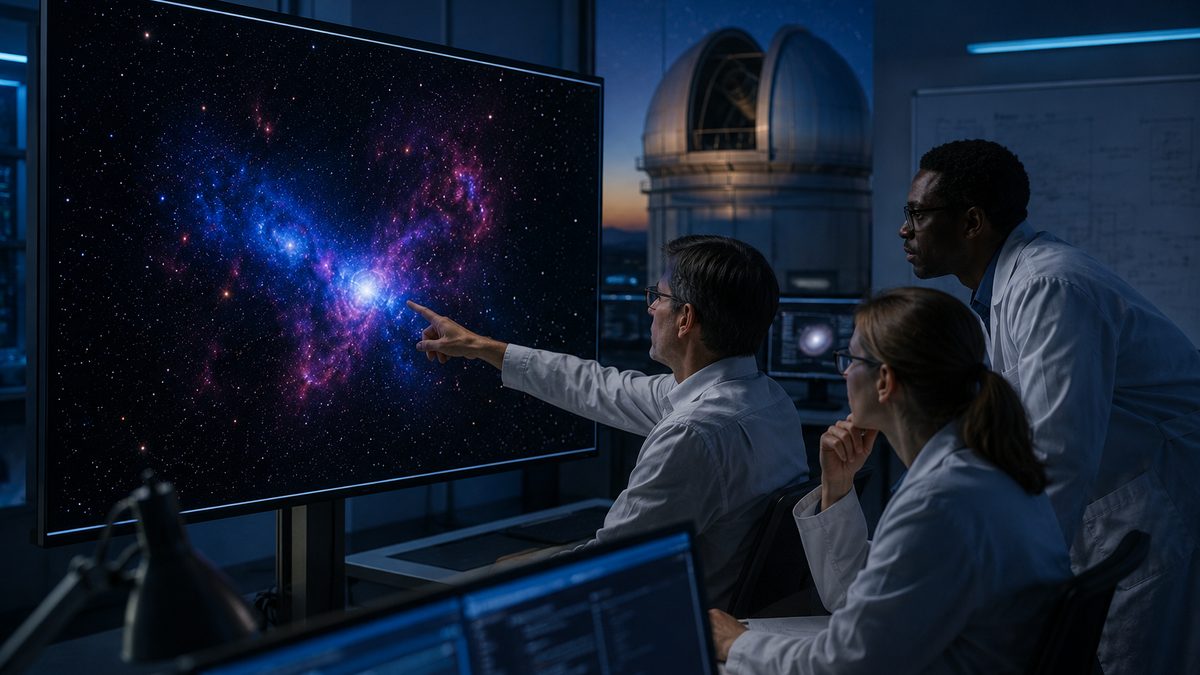
X-ray telescopes can reveal energetic objects hidden in crowded regions of the galaxy. Editorial illustration by TheDailyGlobe.
Key Facts
- Researchers used NASA's Chandra X-ray Observatory and ESA's XMM-Newton telescope to study the Sagittarius C region.
- Scientists identified X-ray emissions located inside a larger bubble of gas.
- The feature may represent a previously unknown supernova remnant.
- Researchers have not yet confirmed the object's exact nature.
- The observations were reported in materials released by the Chandra X-ray Center and NASA.
The center of the Milky Way is one of the busiest and most difficult places in the galaxy to study. Dense clouds of gas and dust, powerful radiation sources, and countless stars crowd together in a region that often hides its secrets from ordinary telescopes.
Now astronomers say they may have uncovered evidence of something dramatic hidden there: the remains of a long-ago stellar explosion. The finding is not yet confirmed, but new observations suggest a possible supernova remnant may be sitting near the galaxy's center, buried within a complicated environment that has challenged researchers for years.
A Hidden Clue in Sagittarius C
The observations focused on Sagittarius C, a region near the center of the Milky Way. While visible-light telescopes struggle to see through the thick material concentrated there, X-ray instruments can reveal energetic processes that would otherwise remain hidden.
Researchers reported finding a source of X-ray emission located within a larger structure of gas. Based on its shape and characteristics, astronomers believe the feature could be the remains of a supernova, the powerful explosion that occurs when certain stars reach the end of their lives.
Supernova remnants are important because they preserve evidence of those explosions long after the original event has faded. Studying them helps astronomers understand how stars evolve, how elements are spread through galaxies, and how energetic events influence their surroundings.
Why X-Rays Matter
Most people think of astronomy as looking at visible stars through a telescope. Modern astronomy, however, depends on observing many different forms of light, including X-rays.
High-energy events such as exploding stars often leave behind material heated to millions of degrees. That hot material can emit X-rays that specialized observatories detect from space. Chandra and XMM-Newton were designed for exactly that purpose.
By combining observations from multiple instruments, researchers can examine regions that appear relatively ordinary in visible light but reveal much more complicated structures when viewed in higher-energy wavelengths.
What the Discovery Could Tell Us
If the feature is ultimately confirmed as a supernova remnant, it could provide another piece of evidence about how stars live and die in one of the most extreme environments in the galaxy.
The galactic center differs from quieter regions of the Milky Way. It contains stronger gravitational influences, denser clouds of material, and a concentration of stars that makes observations more difficult. Finding remnants in such an environment can help researchers better understand how stellar explosions behave under those conditions.
The possible remnant may also help scientists map the history of violent events that occurred near the center of the galaxy over thousands or even tens of thousands of years.
What Scientists Still Do Not Know
Despite the excitement surrounding the observations, researchers have been careful not to overstate the finding. The available evidence suggests the feature could be a supernova remnant, but the identification remains preliminary.
Scientists are still working to determine exactly what they are seeing. The observations do not yet prove the object's origin, and questions remain about how the feature formed and whether another explanation could fit the data.
That uncertainty is a normal part of science. New observations often begin as promising candidates before additional analysis either strengthens or weakens the original interpretation.
What Comes Next
Future observations and continued analysis will help researchers determine whether the object truly represents the remains of a stellar explosion. Additional X-ray studies, along with observations in other wavelengths, may provide clues that are not yet visible in the current data.
For now, astronomers have identified an intriguing feature in one of the most crowded regions of the Milky Way. The possibility of hidden stellar wreckage near the galaxy's center offers a reminder that even in a sky studied for generations, there are still discoveries waiting to be made—and some of them can only be seen when scientists look beyond visible light.
Reporting note: Reporting draws on NASA materials, Chandra X-ray Center findings, scientific mission updates, and reviewed background materials. This article was produced with AI-assisted research and reviewed by an editor before publication.