Webb Observations Show How Galaxy Neighborhoods Shaped Early Growth
Astronomers studying the Loktak Protocluster found evidence that dense early-universe environments were already shaping how galaxies developed.
Save Article
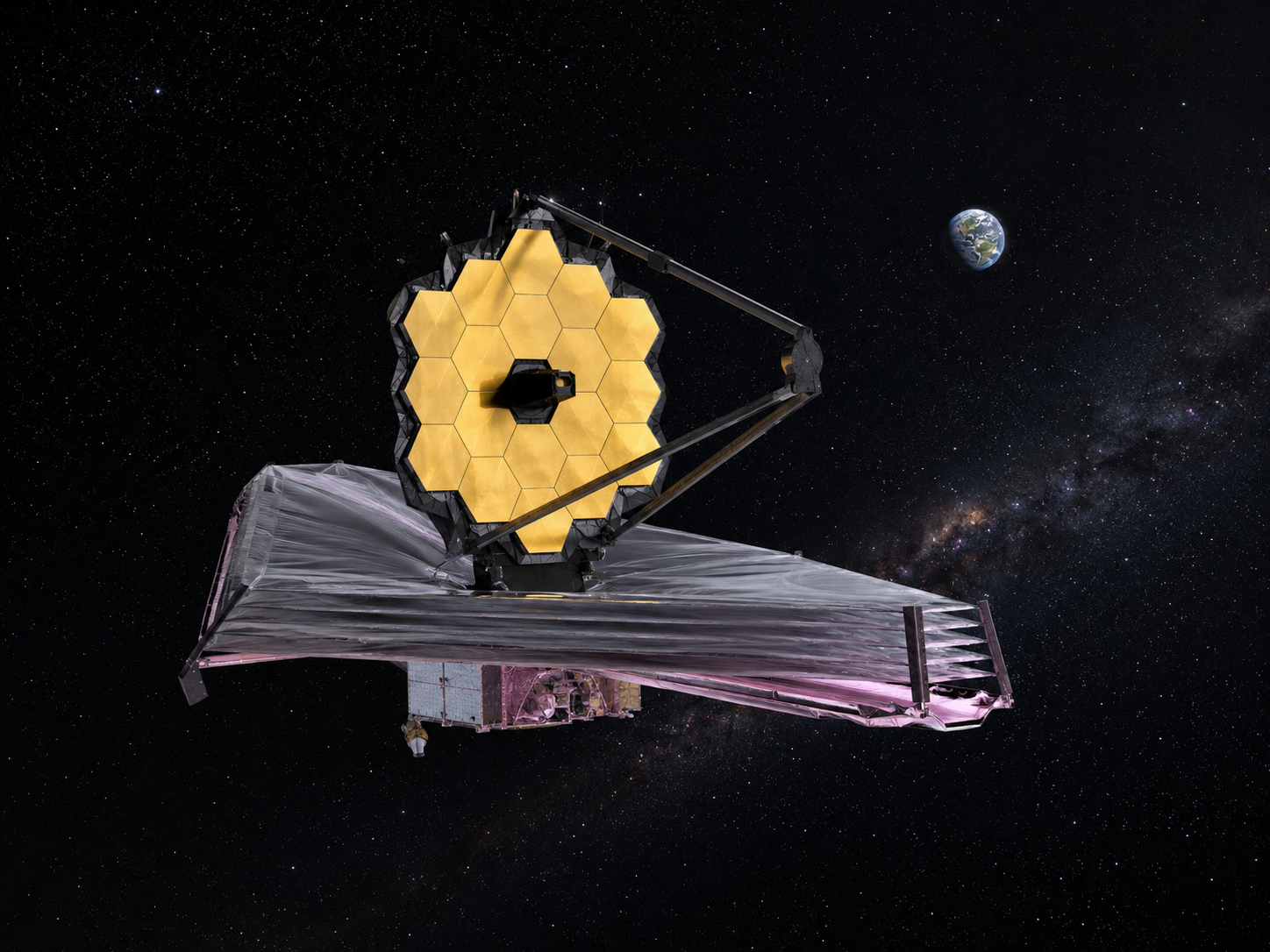
Webb observations are helping astronomers study how early galaxy neighborhoods influenced the growth of galaxies. Editorial illustration by TheDailyGlobe.
Galaxies do not grow in isolation. Like neighborhoods, their surroundings can shape how they develop.
That is the idea behind new observations of the Loktak Protocluster, a large grouping of young galaxies seen as it existed about 12.6 billion years ago, when the universe was roughly 1.2 billion years old. Because its light has taken billions of years to reach Earth, astronomers are looking at the structure as it appeared in the young universe, not as it would look today.
Astronomers used the James Webb Space Telescope to study galaxies in the protocluster, which lies in the direction of the constellation Sextans. The structure was first identified with the Subaru Telescope’s Hyper Suprime-Cam, which helped spot a dense region of young, star-forming galaxies known as Lyman-alpha emitters.
What Webb Helped Scientists Compare
The study compared galaxies inside the dense protocluster with galaxies in more typical, lower-density environments from the same period of cosmic history. Researchers found little difference in ultraviolet-light sizes, which trace areas where new stars are forming.
The difference appeared in optical light, which traces older, previously formed stars. Galaxies in the dense protocluster environment were about 1.4 times larger in optical measurements than similar galaxies in less crowded regions. The peer-reviewed study reported 16 protocluster Lyman-alpha emitters and 23 field Lyman-alpha emitters in that comparison.
In plain English, the star-forming cores looked similar, but galaxies in the denser environment appeared to have built up more extended stellar structures earlier. That gives astronomers a clue that local environment was already influencing galaxy growth during an early phase of cosmic star formation.
Why Protoclusters Matter
Protoclusters are early construction sites for the massive galaxy clusters seen closer to Earth today. Modern clusters can contain hundreds or thousands of galaxies, along with hot gas and dark matter. By studying protoclusters, astronomers try to understand how those large cosmic structures began to form.
That is difficult work. Early protoclusters are distant, faint, and seen before galaxy clusters had fully matured. Webb’s infrared imaging gives scientists a sharper way to study the stars and structures inside those distant galaxies, while Subaru’s wide-field observations help identify where dense early structures are located.
What Remains Unknown
The finding should not be read as a complete explanation of galaxy evolution. It concerns one protocluster, and researchers still need to know whether the same pattern was common across the early universe or unusual to Loktak.
The study points to possible explanations, including tidal interactions or earlier star formation in dense environments, but those mechanisms are not settled. The observations also do not show that the protocluster had already become a mature galaxy cluster.
Follow-up observations with Subaru, Webb, and other telescopes could help test whether dense early environments regularly changed how galaxies formed stars, grew in size, or developed structure. For now, the careful takeaway is that galaxy neighborhoods appear to have mattered very early in cosmic history.
Reporting note: Reporting draws on National Astronomical Observatory of Japan and Subaru Telescope materials, a peer-reviewed Astrophysical Journal Letters study, observational astronomy research, and reviewed background materials. This article was produced with AI-assisted research and reviewed by an editor before publication.