NASA Is Testing a Moon-Base System That Turns Wastewater Into Resources
NASA is testing a wastewater recycling system on Earth to learn how future Moon or Mars crews could recover water, nutrients and growing space from waste.
Save Article
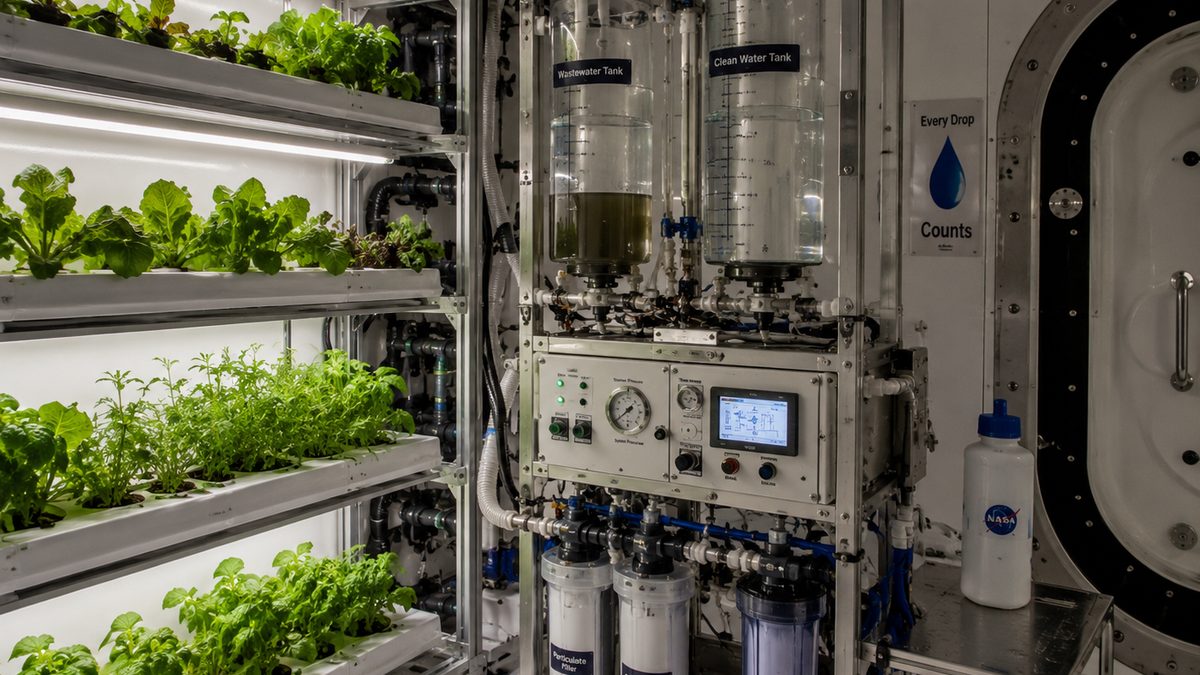
NASA is testing wastewater recycling technology that could help future crews recover water and nutrients during long missions. Editorial illustration by TheDailyGlobe.
Crews living far from Earth cannot treat water like something they can use once and throw away. On the Moon or Mars, every gallon would matter. So would the systems that handle the most ordinary parts of human life: bathrooms, wastewater, plants and stored waste.
NASA says a mobile wastewater treatment system built at Kennedy Space Center has arrived at the University of North Dakota for testing. The system is designed to turn crew wastewater into useful resources, part of the practical engineering that would be needed for future long-duration missions.
What NASA Is Testing
According to NASA, the facility includes three biological reactor systems, a vertical garden, water-polishing hardware, environmental monitoring, autonomous control software and safety systems. The goal is to study how wastewater can be treated in a habitat-like setting, rather than only in a standard laboratory.
The University of North Dakota site gives researchers a place to test the system under conditions meant to resemble some of the limits crews could face on another planetary surface. That does not mean the system has been tested in space. It means NASA is using an Earth-based analog environment to learn how the technology behaves before any future mission decision.
Why Wastewater Matters in Space
Space exploration is often described through rockets, landers and spacesuits. But long missions also depend on quieter systems that keep people alive day after day. A crew that can recover water, recycle nutrients and grow plants would be less dependent on constant resupply from Earth.
NASA says the work is part of its broader Bioregenerative Life Support Systems efforts. In plain terms, that means studying systems that use biological processes, including plants and microbes, to help support crews in closed or partly closed habitats.
What Remains Unknown
NASA has not said this exact system will be used on a specific Artemis surface mission, a Moon base or a Mars mission. Long-term reliability, crew operation and future spaceflight use remain open questions.
The next thing to watch is how the system performs in analog testing and whether NASA adapts the technology after those results. The lesson is simple: living beyond Earth will require more than reaching another world. Crews will need ways to make the basics last.
Reporting note: Reporting draws on NASA technology updates, University of North Dakota analog habitat materials, and reviewed background context. This article was produced with AI-assisted research and reviewed by an editor before publication.