NASA Mission Shows How Earth Weather Can Ripple Into Space
NASA's AWE mission studied how waves from Earth's atmosphere can reach near-Earth space, where satellites, navigation and communications can be affected.
Save Article
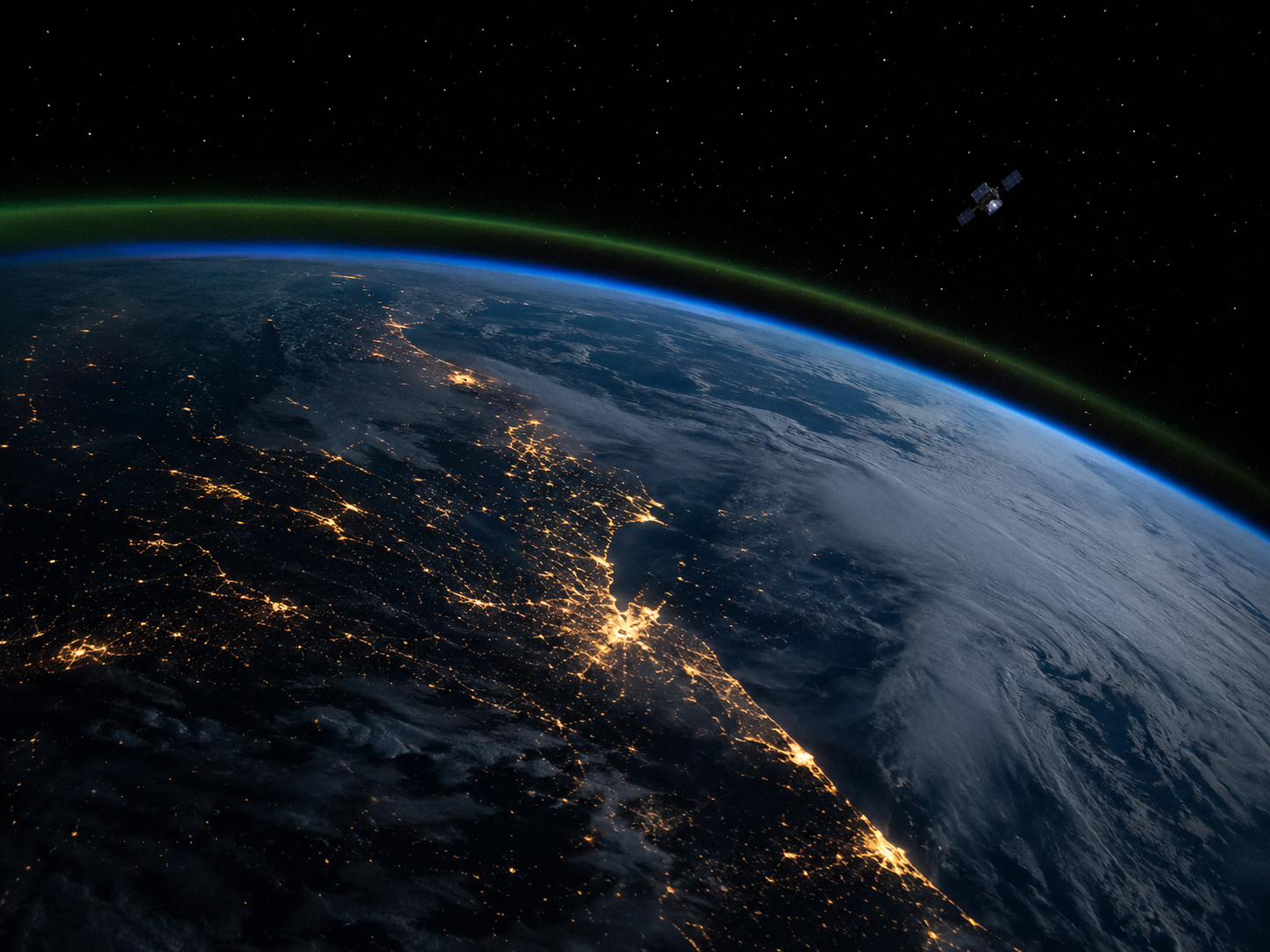
NASA's AWE mission studied how waves from Earth's atmosphere can reach near-Earth space, where satellites, navigation and communications can be affected. Editorial illustration by TheDailyGlobe.
Key Facts
- NASA said ground controllers powered down the AWE instrument on May 21, ending its data-collection phase.
- AWE was installed outside the International Space Station and studied atmospheric gravity waves.
- NASA said AWE captured more than 80 million nighttime images during its station residency.
- NASA says AWE research helps scientists understand how terrestrial weather affects the ionosphere and space weather.
- Mission data will continue to be studied, so the source material does not show that all findings are final.
NASA has ended the data-collection phase of a mission built around a surprising idea: weather on Earth can help shape conditions in near-Earth space.
The agency said ground controllers powered down the Atmospheric Waves Experiment, or AWE, instrument on May 21. The instrument was mounted outside the International Space Station and studied atmospheric gravity waves, which are wave patterns that can move energy through Earth's atmosphere.
For readers, the useful point is not that a single storm on Earth automatically knocks out a satellite. The point is that Earth's atmosphere and near-Earth space are connected in ways scientists are still working to measure, and those connections matter for satellites, navigation and communications.
What AWE Was Looking For
AWE studied atmospheric gravity waves, which are not gravitational waves from deep space. They are waves in Earth's atmosphere that can form when air is disturbed by weather, mountains or other forces and then tries to return to balance.
Those waves can move upward through layers of the atmosphere. By observing faint nighttime airglow from the International Space Station, AWE gave scientists a way to track wave patterns that are difficult to measure from the ground alone.
NASA said the instrument captured more than 80 million nighttime images during its time on the station. That image record gives researchers a large dataset to study how wave activity changes over time and across different regions.
Why Earth Weather Matters in Space
Space weather is often associated with the Sun, including solar storms that can disturb Earth's magnetic environment. AWE focused on another part of the picture: how activity lower in Earth's atmosphere can also influence the upper atmosphere and ionosphere.
The ionosphere is a region high above Earth where charged particles can affect radio signals, satellite communication and navigation systems. Scientists want to understand what makes that region change, because those changes can matter for technologies people use every day.
The connection should be described carefully. The source material supports the idea that terrestrial weather can affect the ionosphere and space weather. It does not show that AWE tied specific Earth storms to specific satellite failures.
What the Mission Adds
AWE's value is partly in the long record it collected from orbit. A single observation can show one wave pattern. Millions of images can help researchers compare patterns across nights, seasons and geographic regions.
That matters because scientists are trying to improve models of near-Earth space. Better models can help researchers understand when the ionosphere may become more disturbed and why some conditions develop even when solar activity is not the only factor.
The mission also helps make a hidden part of weather more visible. Most people experience weather as rain, heat, wind or storms near the ground. AWE studied how disturbances can travel much higher, into regions where the atmosphere begins to overlap with the space systems modern life depends on.
What Comes Next
The instrument's data-collection phase has ended, but the science work is not over. NASA's update indicates that the mission data will continue to be studied, which means the public should not read the end of operations as the end of the research.
Researchers will still need to analyze the image record, compare it with other observations and test how well the data improves understanding of atmospheric waves and space-weather conditions.
That process may be less dramatic than launching a spacecraft or installing an instrument on the station, but it is where much of the scientific value is likely to come from.
What Remains Unclear
It remains unclear what final findings will come from the full AWE dataset. The mission has completed data collection, but the source material does not show that every scientific result has been settled.
It is also important not to overstate the operational impact. AWE helps scientists study how Earth weather can affect near-Earth space, but the source material does not support blaming individual satellite or communication problems on specific weather events without additional evidence.
For readers, the clearest takeaway is that Earth's weather does not stop at the clouds we see from the ground. Some of its effects can ripple upward, and NASA's AWE mission gave scientists a sharper view of how those ripples may shape the space around our planet.
Reporting note: Reporting draws on NASA mission updates, NASA mission materials, Utah State University AWE resources, and reviewed space-weather background. This article was produced with AI-assisted research and reviewed by an editor before publication.