Juno Data Help Explain How Particles Gain Energy Near Jupiter
NASA’s Juno mission has given scientists new evidence about how high-energy particles can accelerate near Jupiter, adding detail to a larger cosmic-ray question that is not yet settled.
Save Article
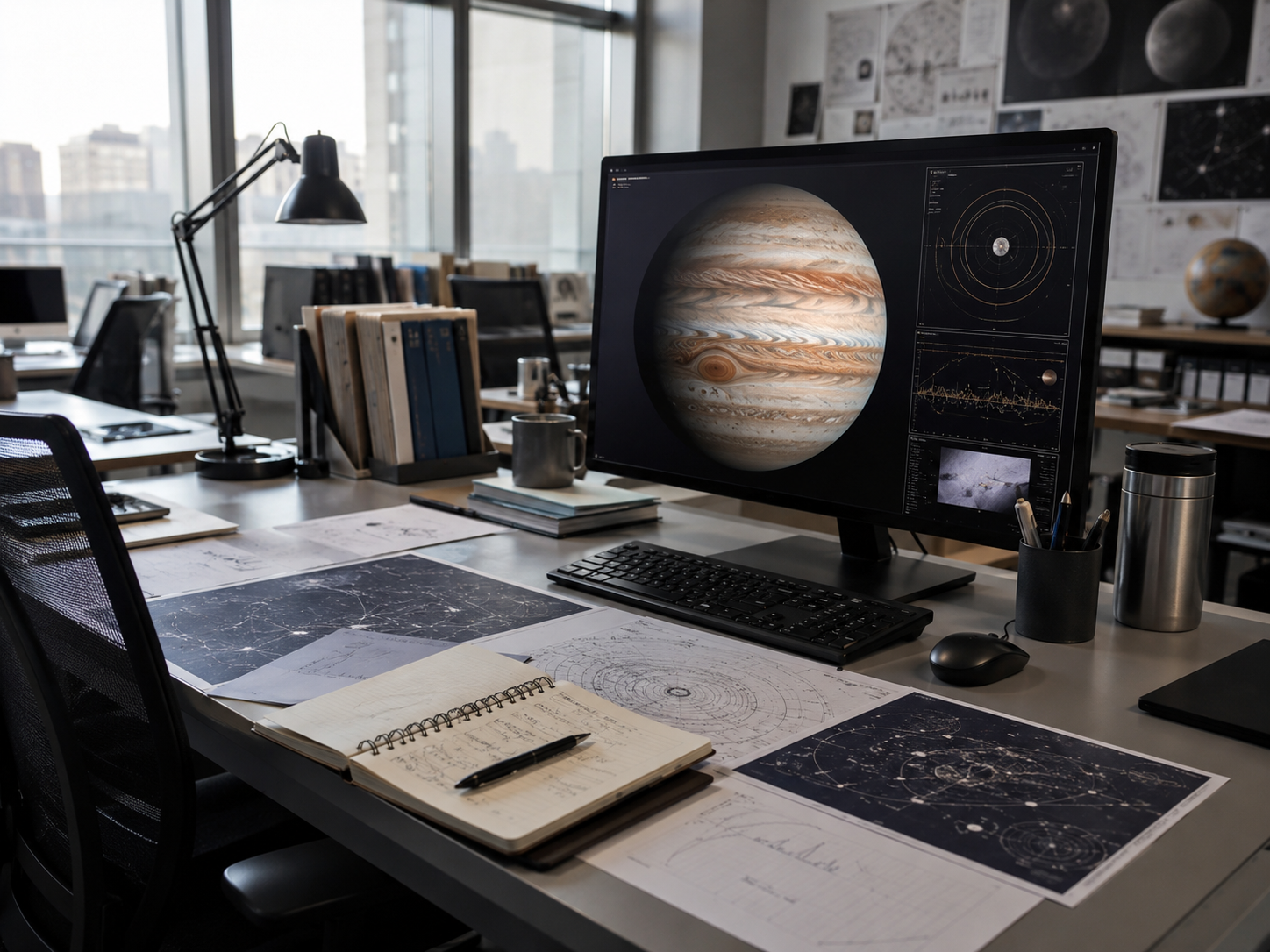
New Juno observations are helping scientists study how high-energy particles behave near Jupiter. Editorial illustration by TheDailyGlobe.
Key Facts
- NASA reported June 3 that Juno observed particles traveling close to the speed of light near Jupiter.
- Nature published a June 3 research article on relativistic electron acceleration at Jupiter’s bow shock.
- Juno is a NASA mission studying Jupiter and the planet’s surrounding environment.
- The finding adds evidence about particle acceleration, but it does not settle every question about cosmic-ray origins.
Earth is constantly being struck by high-energy particles from space. Most people never notice them, but scientists have spent decades trying to understand how some of those particles gain so much energy before they race through the solar system.
New data from NASA’s Juno mission at Jupiter is giving researchers a clearer look at one part of that question. NASA reported June 3 that Juno observed particles traveling close to the speed of light near Jupiter, and a Nature article published the same day examined relativistic electron acceleration at the planet’s bow shock.
That does not mean scientists have solved the full question of cosmic-ray origins. It does mean Juno has given researchers a rare close-up view of how particles can be energized in a powerful space environment around the solar system’s largest planet.
Why Jupiter Is a Useful Place to Look
Jupiter is not just a large planet with colorful storms. It is also surrounded by a powerful magnetic environment, radiation belts and boundaries where the solar wind interacts with the planet’s space environment.
One of those boundaries is called the bow shock. A bow shock forms where fast-moving solar wind slows and changes as it meets a planet’s magnetic shield. A simple way to picture it is the wave that forms in front of a boat moving through water, except this one happens in space, with charged particles and magnetic fields instead of water.
Those shock regions matter because they can act like natural particle accelerators. Scientists study them to better understand how particles can be pushed to very high speeds in planetary systems and in more extreme environments elsewhere in space.
What Juno Added
Juno has been studying Jupiter since it arrived at the planet in 2016. The mission was designed to investigate Jupiter’s atmosphere, interior, magnetic field and surrounding system. Over time, that long-running mission has also created opportunities to study the planet’s charged-particle environment in detail.
The new research focuses on particles observed near Jupiter’s bow shock. NASA’s update and the Nature article point to evidence that electrons can be accelerated to relativistic speeds there, meaning they are moving at a large fraction of the speed of light.
For readers, the important point is not the technical label. It is that Juno was able to observe a natural process that scientists think may help explain how energetic particles form and move through space.
What This Means for Cosmic-Ray Research
Cosmic rays are high-energy particles that travel through space. They can come from the Sun, from outside the solar system and from powerful astrophysical events. The details of how different particles gain energy in different environments remain an active research area.
Jupiter gives scientists a nearby laboratory for studying some of those processes. It is much easier to examine data from a spacecraft moving through Jupiter’s environment than to directly sample many distant cosmic sources.
That is why the Juno finding matters beyond Jupiter. If scientists can better understand how particles are accelerated at Jupiter’s bow shock, they may be able to compare that process with other shock environments in space.
The connection still needs care. A finding near Jupiter does not automatically explain every kind of cosmic ray, and it should not be treated as proof that one mechanism applies everywhere. The value is in the evidence it adds and the comparisons it makes possible.
What Remains Unclear
Several questions remain open. Researchers still need to understand how broadly Jupiter’s bow-shock behavior applies to other planetary systems and to more distant astrophysical shocks.
The finding also depends on careful interpretation of spacecraft data. Space environments are messy. Particles, magnetic fields and solar-wind conditions can change, and scientists have to separate what the instruments observed from what broader theory can safely conclude.
That is why the best way to read the Juno result is as a meaningful step, not a final answer. It gives scientists more evidence for how energetic electrons can be accelerated near Jupiter, while leaving room for future data to sharpen or limit that explanation.
What Scientists May Watch Next
Future analysis from Juno could help researchers compare particle behavior across different parts of Jupiter’s environment. Scientists may also compare the Jupiter findings with other planetary bow shocks and with shock regions farther from Earth.
For the public, the discovery is a reminder that long-running space missions can keep producing useful science years after arrival. Juno was sent to study Jupiter, but Jupiter also offers a way to study wider questions about how space works.
The larger question is still open: how do particles in space gain so much energy? Juno has not closed that case. It has given scientists a clearer place to look.
Reporting note: Reporting draws on NASA mission updates, peer-reviewed research, Jet Propulsion Laboratory mission materials, and reviewed background materials. This article was produced with AI-assisted research and reviewed by an editor before publication.