How Scientists Study Distant Planets Without Overpromising Life
NASA explainers show how scientists study exoplanets, what Webb can reveal about atmospheres, and why habitable does not mean inhabited.
Save Article
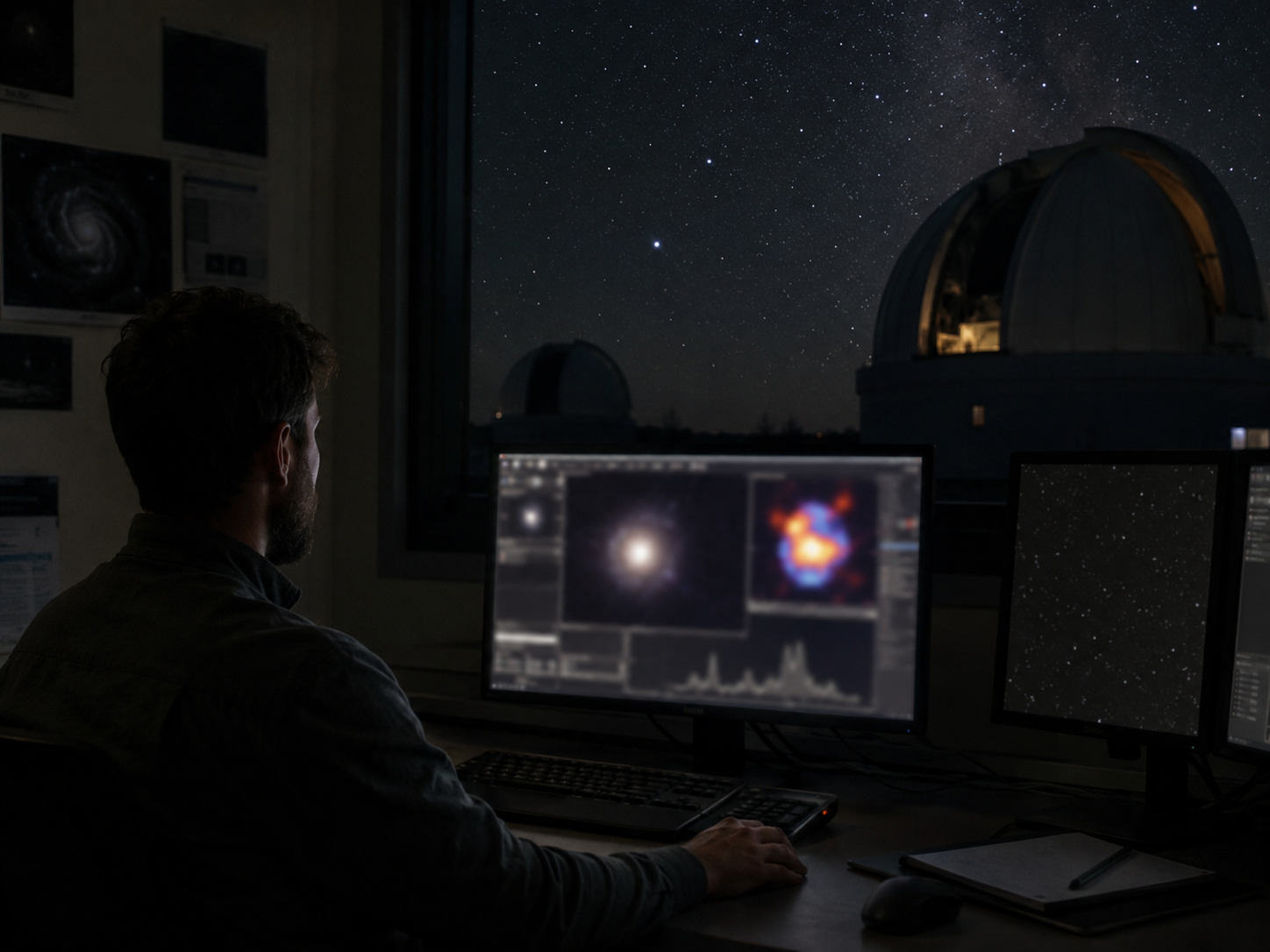
Exoplanet research helps scientists study distant worlds while leaving major questions about habitability and life unresolved. Editorial illustration by TheDailyGlobe.
Key Facts
- NASA says exoplanets are planets outside our solar system.
- NASA says researchers have identified many kinds of exoplanets, including rocky planets in habitable zones.
- NASA defines the habitable zone as the distance from a star where liquid water could exist on a planet's surface.
- NASA says the James Webb Space Telescope studies exoplanet atmospheres using instruments that analyze light spectra.
A headline about a possibly habitable planet can make a distant world sound almost familiar: another place, somewhere far away, where life might be waiting.
The science is more careful than that. NASA defines exoplanets as planets outside our solar system, and researchers have found many different kinds of them. Some are rocky. Some orbit in regions where liquid water could exist on a planet's surface. Some can be studied through the light that passes through or comes from their atmospheres.
But none of that, by itself, proves life. The real story is both more restrained and more interesting: scientists are learning how to study worlds they cannot visit, while also learning how easy it is for public language to run ahead of the evidence.
What Scientists Can Learn From Light
Scientists do not need to fly to an exoplanet to begin studying it. Telescopes can examine changes in light connected to a planet and its star. NASA's Webb explainers describe how the telescope can study exoplanet atmospheres by analyzing spectra, which are patterns in light that can reveal information about chemistry.
That kind of measurement can help researchers ask better questions. What gases appear to be present? How does the atmosphere behave? Is the planet more like a rocky world, a gas giant, or something unfamiliar? Each observation can narrow the possibilities, even when it does not deliver a simple answer.
This is where the wonder of exoplanet science is strongest. Scientists are trying to understand planets so distant that they appear only through indirect signs, yet the data can still reveal something real about their size, orbit, atmosphere, and place around a star.
Why Habitable Does Not Mean Inhabited
The phrase habitable zone is useful, but it is often misunderstood. NASA defines it as the distance from a star where liquid water could exist on a planet's surface. That is an important starting point because water is central to life as people understand it on Earth.
Still, a planet being in that zone does not prove it has water on the surface. It does not prove the planet has an atmosphere. It does not prove the atmosphere, if present, is friendly to life. And it does not prove anything is alive there.
That distinction matters for readers because many space headlines compress several scientific steps into one exciting phrase. A planet may be in a potentially interesting orbit. It may be worth studying more closely. It may help scientists test ideas about how planets form and change. Those are meaningful findings without turning them into claims about life.
Why Webb Changed the Conversation
The James Webb Space Telescope gives researchers a stronger tool for studying exoplanet atmospheres. NASA describes Webb's role in exoplanet research as part of a larger effort to characterize distant worlds in more detail, especially through infrared observations and spectroscopic measurements.
That does not make every observation definitive. Atmospheric interpretation can be complex. Data quality, modeling, the planet's star, and the limits of the observation all matter. Scientists may see evidence that points toward certain molecules or atmospheric conditions, but careful research often requires repeated observations and peer-reviewed analysis.
The value is not that Webb turns distant planets into solved mysteries. It is that the telescope helps move some questions from imagination toward measurement.
How to Read Future Planet Headlines
Readers can bring a few simple questions to future exoplanet stories. Is the article saying scientists found a planet, or studied its atmosphere? Does habitable mean the planet is in a useful orbital zone, or is there evidence of surface conditions? Is the claim based on one observation, several observations, or a broader body of research?
It also helps to separate possibility from proof. A rocky planet in a habitable zone is scientifically interesting. A possible atmospheric signal may be worth follow-up. A mission update can be important even when it does not answer the biggest question.
That biggest question, whether life exists beyond Earth, remains open. NASA's exoplanet work helps scientists search more intelligently, but it does not remove the need for caution.
What Comes Next
The next steps will come through future Webb observations, atmospheric studies, mission updates, and peer-reviewed findings that test what early data appears to show.
For readers, the best posture is curiosity with patience. Exoplanet science is not less exciting because scientists avoid overpromising. It is more trustworthy that way. The search for distant worlds is already remarkable; it does not need to pretend that every promising planet is a second Earth.
Reporting note: Reporting draws on NASA exoplanet explainers, James Webb Space Telescope mission materials, habitable-zone guidance, and reviewed science background. This article was produced with AI-assisted research and reviewed by an editor before publication.