Artemis II Crew Returns After First Human Moon Mission in More Than 50 Years
NASA's Artemis II astronauts returned to Earth after a nearly 10-day mission around the Moon, marking the first human lunar voyage in more than half a century and setting the stage for future Moon landings.
Save Article
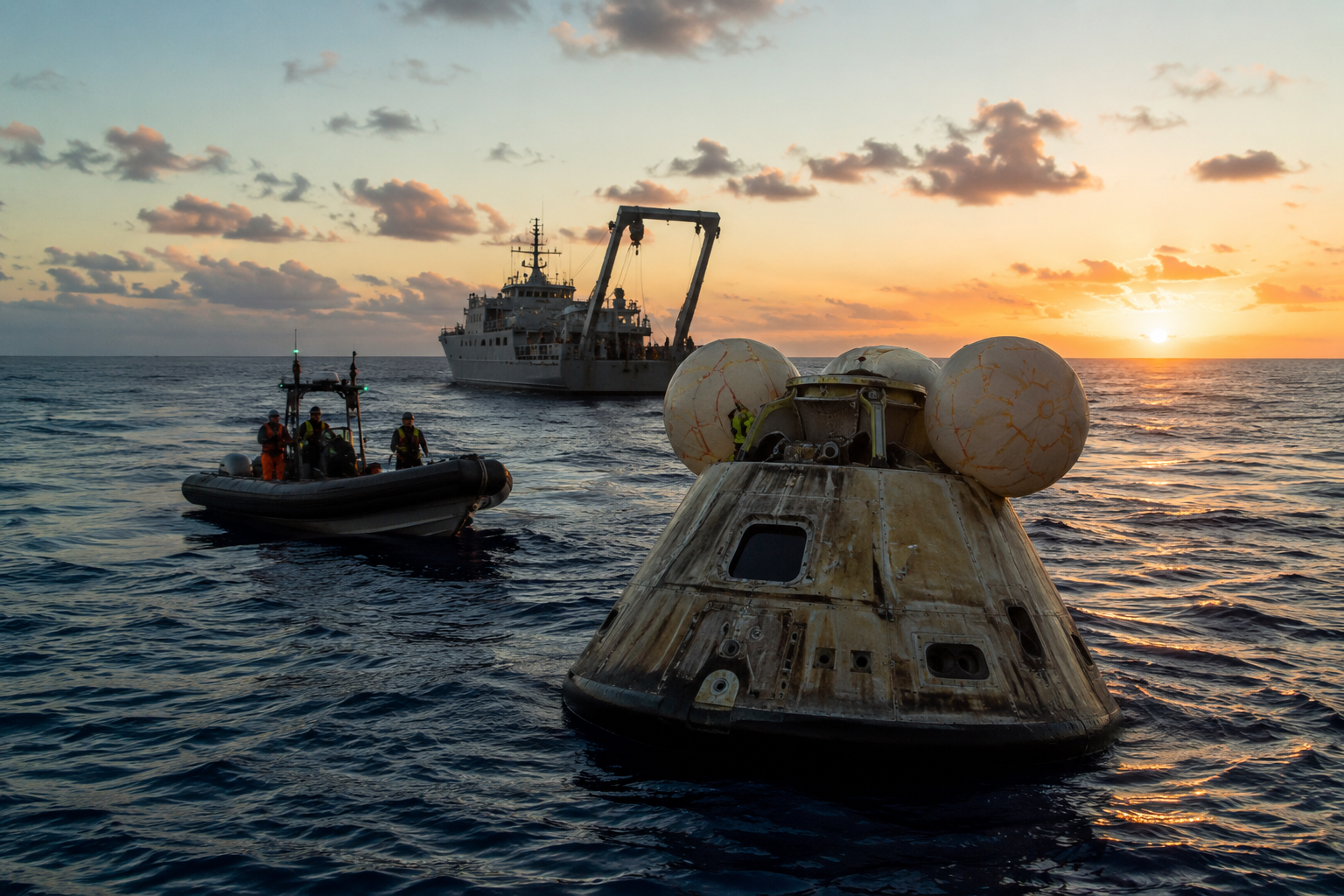
NASA's Artemis II astronauts returned to Earth after a nearly 10-day mission around the Moon, marking the first human lunar voyage in more than half a century and setting the stage for future Moon landings. Editorial illustration by TheDailyGlobe.
Key Facts
- The Artemis II crew splashed down off San Diego after a mission lasting nearly 10 days.
- The crew included Reid Wiseman, Victor Glover, Christina Koch and Jeremy Hansen.
- NASA says the mission was the first human journey to the Moon in more than 50 years.
- The flight tested spacecraft systems and mission operations for future lunar missions.
- NASA updated mission releases with official distance details after the mission concluded.
NASA's Artemis II crew returned safely to Earth after a nearly 10-day mission around the Moon, closing out the first human lunar voyage in more than 50 years. The crew splashed down in the Pacific Ocean off the coast of San Diego, where recovery teams moved in to secure the spacecraft and assist the astronauts after landing.
The mission carried NASA astronauts Reid Wiseman, Victor Glover and Christina Koch, along with Canadian Space Agency astronaut Jeremy Hansen. NASA described the crew as the first astronauts to travel to the Moon since the Apollo era ended in the 1970s.
Artemis II did not land on the Moon, but the mission was designed to test the systems, hardware and operations needed for future lunar missions. NASA says the flight was a major step toward returning astronauts to the lunar surface as part of the broader Artemis program.
A Historic Return to Lunar Spaceflight
The Artemis II mission marks one of NASA's most visible milestones in decades. Since Apollo 17 in 1972, no human mission had traveled beyond low Earth orbit and around the Moon. For many Americans, the return of astronauts to lunar space represents a major shift after decades focused mainly on the Space Shuttle program and operations aboard the International Space Station.
NASA officials have repeatedly described Artemis as a long-term effort aimed at establishing a sustainable human presence around and eventually on the Moon. The agency views lunar missions as both scientific projects and preparation for future deep-space missions, including possible human exploration of Mars.
Unlike the Apollo missions, Artemis relies on newer spacecraft systems and international partnerships. Canada participated directly in Artemis II through astronaut Jeremy Hansen, while other allied space agencies are expected to play roles in future missions tied to lunar research and infrastructure.
What Artemis II Tested
The mission was built around testing the Orion spacecraft and related systems under real deep-space conditions. NASA used the flight to evaluate navigation, communications, life-support systems and the ability of astronauts to safely operate the spacecraft during a lunar mission.
Engineers also monitored how the spacecraft handled the extreme environment of deep space, including radiation exposure and long-distance communications. Reentry into Earth's atmosphere and the final splashdown sequence were also critical parts of the mission because those systems must work reliably before future crews attempt lunar landings.
NASA has emphasized that Artemis II was a test mission first and a symbolic milestone second. The agency wanted to gather operational data before committing astronauts to more complex missions that could include lunar landings and extended stays near the Moon.
The Crew Behind the Mission
The four-person crew brought together astronauts with different backgrounds and experience levels. Reid Wiseman, a veteran NASA astronaut, served as commander. Victor Glover, also a NASA astronaut, became one of the few people in modern history to travel beyond low Earth orbit.
Christina Koch added another milestone to her career after previously spending extended time aboard the International Space Station. Jeremy Hansen became the first Canadian astronaut assigned to a mission around the Moon.
NASA has repeatedly highlighted the diversity of the Artemis crews as part of a broader effort to present the program as a new chapter in human spaceflight rather than a recreation of the Apollo era. Officials say the long-term goal is to expand participation in deep-space missions while building international cooperation.
What Comes Next
Artemis II is expected to feed directly into future lunar missions, including plans for astronauts to eventually return to the Moon's surface. NASA has described Artemis III as the mission intended to carry astronauts to a lunar landing site, although schedules for major space missions often shift as testing and engineering work continue.
Before any future landing mission moves ahead, NASA engineers will review data from Artemis II in detail. That process includes evaluating spacecraft performance, astronaut health data and operational procedures used throughout the mission.
The mission also serves as a public test of NASA's ability to manage large-scale human exploration projects after years of delays and budget pressures tied to modern space programs. A successful crewed flight around the Moon gives the agency stronger footing as it seeks support for future missions.
Why the Mission Matters
For scientists and engineers, Artemis II provides technical information that cannot be fully replicated in simulations or shorter missions closer to Earth. Real-world data from a human lunar mission helps NASA refine spacecraft systems and operational planning before attempting more ambitious missions.
For the public, the mission carries symbolic importance as well. Human missions beyond Earth's orbit have been absent from everyday life for generations. Artemis II brought astronauts back into deep-space travel and reminded many people of the scale and risk involved in human exploration.
NASA has argued that lunar exploration could eventually support scientific research, new technologies and international cooperation in space. Supporters also say Moon missions could help prepare astronauts for future missions farther from Earth, including possible journeys to Mars.
Questions remain about long-term costs, schedules and how quickly future Artemis missions can move forward. But with Artemis II safely back on Earth, NASA has now completed the first crewed step in its effort to return humans to lunar space.
Reporting note: Reporting draws on NASA news releases, official mission updates, and reviewed background materials related to the Artemis program. All claims This article was produced with AI-assisted research and reviewed by an editor before publication.