Board Games Are Back, and That Says Something Good About a Very Online Generation
Chess nights, mahjong tables, and old-school games are not just nostalgia. They are a hopeful sign that people still want real-world connection.
Save Article
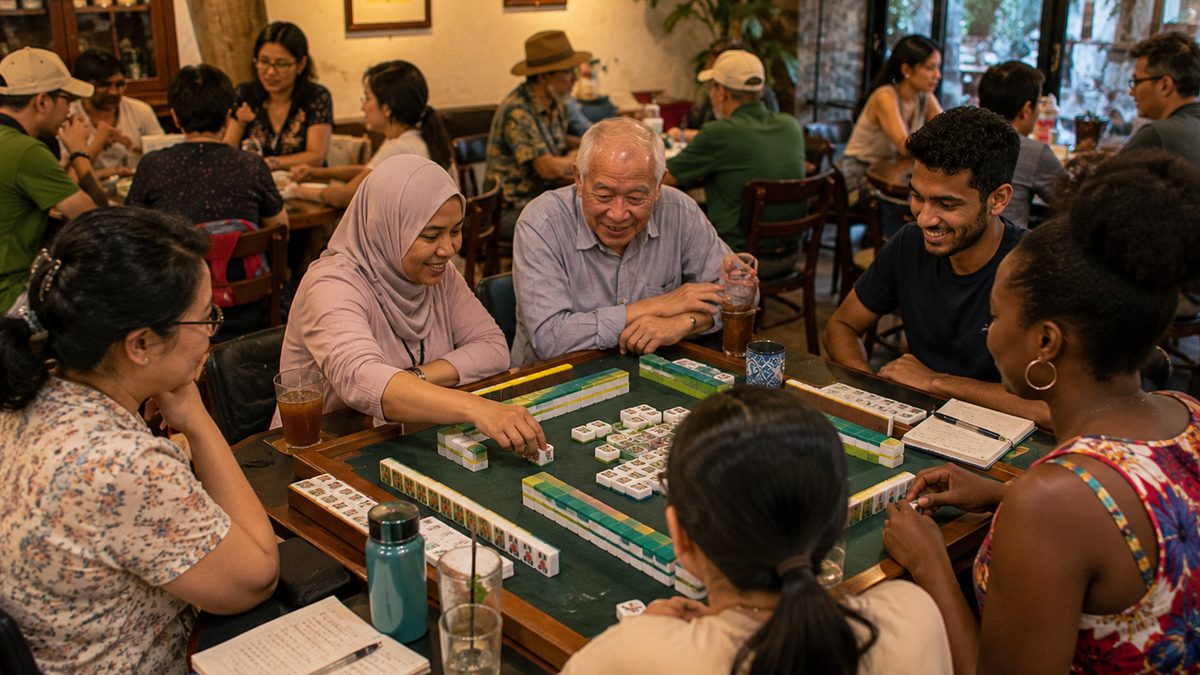
Analog games are finding new life as people look for low-pressure ways to spend time together offline. Editorial illustration by TheDailyGlobe.
One of the funnier turns in modern life is that the generation raised with endless entertainment in its pockets is now paying money to sit at a table and move little pieces around by hand.
Chess. Mahjong. Backgammon. Cards. Board games with rules that require eye contact, patience, and at least one person willing to explain what everyone else is doing wrong.
Recent reporting from New York has described younger adults gathering at old-school game clubs built around chess, mahjong, and backgammon. Other reporting has pointed to a broader rise in private clubs and curated social spaces, as people look for ways to meet outside the usual churn of work, apps, and feeds.
That could be easy to mock. It should not be. Beneath the quirky surface is something pretty healthy: people are trying to remember how to be together without turning every moment into content.
The Table Is the Point
The return of analog games is not just about nostalgia. Nostalgia is part of it, sure. There is comfort in wooden pieces, shuffled tiles, folded cards, and rules that existed long before anyone worried about screen time.
But the stronger pull is the table itself.
A game table does something a phone screen does not. It gives people a reason to gather without requiring them to perform. You do not need a perfect outfit, a polished opinion, or a personal brand. You need to show up, learn the rules, lose with some grace, and maybe come back next week.
That is a small thing, but small things are often where community begins. A recurring chess night can do what a thousand group chats cannot: put people in the same room long enough for conversation to happen naturally.
Digital Fatigue Is Turning Constructive
The internet made connection easier and, in many ways, thinner. People can keep up with friends, follow strangers, argue with anyone, watch everything, and still feel oddly alone at the end of the day.
Gallup has reported elevated loneliness and depression concerns among U.S. adults, while Pew Research Center has studied how Americans experience social connection. Those findings do not prove that board-game nights are a cure for loneliness. They do help explain why low-pressure, offline gathering places may feel newly valuable.
The hopeful part is that this is not digital fatigue turning into withdrawal. It is digital fatigue turning into ritual. People are not only saying they are tired of being online. Some are looking for places where being offline has a structure, a reason, and a little fun built in.
That matters because loneliness is rarely solved by telling people to go make friends. Friendship needs repeated contact. It needs shared activities. It needs places where showing up does not feel awkward.
Do Not Turn Community Into Another Luxury Product
There is a catch. The rise of private clubs and curated social spaces can also turn ordinary human connection into another thing with a velvet rope.
That is the part worth resisting. The good thing about old-school games is not that they can be packaged into expensive memberships. The good thing is that they are simple, repeatable, and social. A chessboard does not need a branding consultant. A deck of cards does not need a waitlist.
Not every analog trend is accessible to ordinary people. Some clubs will be expensive. Some will be fashionable for a season and then disappear when the next lifestyle trend arrives. Nostalgia can be marketed just as aggressively as anything else.
So the lesson is not that every city needs more exclusive clubs. The lesson is that people clearly want easier ways to gather in person. That is something communities can build without making it precious.
The Best Version Is Local and Low-Pressure
Libraries should steal this idea. Coffee shops should steal it. Churches, bars, parks departments, bookstores, community centers, apartment buildings, and small businesses should steal it too.
A weekly board-game night is not complicated. Neither is a chess table, a mahjong meetup, a cribbage group, a family game afternoon, or a beginner-friendly card night. The point is not to create a perfect scene. The point is to give people an excuse to come back.
That is what online life often struggles to provide. Feeds are built for novelty. Communities are built by repetition. You recognize the same faces. Someone remembers your name. You lose the same game three weeks in a row and start accusing the rules of bias.
That is not glamorous. It is better than glamorous. It is normal.
A Small Rebellion Worth Encouraging
The return of old-school games does not mean young people are rejecting technology altogether. That would be too tidy, and probably not true. People can love their phones and still know that a phone is a poor substitute for a room full of real voices.
What this trend suggests is more modest and more interesting. A very online generation may be showing the rest of us what digital fatigue looks like when it becomes constructive.
Not a lecture. Not a moral panic. Not another app promising to fix loneliness by sending more notifications.
Just a table, a game, a few people, and an hour where nobody has to refresh anything.
Reporting note: Reporting draws on lifestyle trend reporting, private-club coverage, public survey research, and reviewed background materials used to ground the argument. This article was produced with AI-assisted research and reviewed by an editor before publication.