AI Employers Owe New Graduates More Than Optimism
New graduates are being told to embrace AI while the first rung of the career ladder feels less stable. Employers and colleges need to build real pathways, not just repeat hopeful slogans.
Save Article

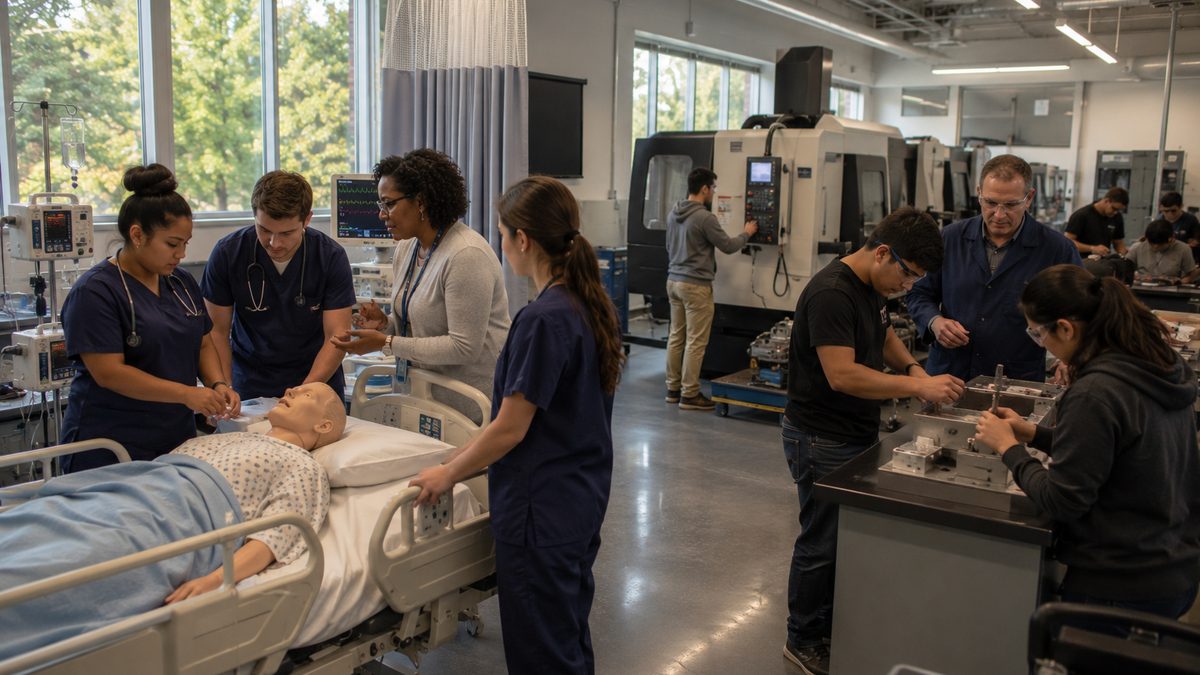
New graduates are entering a labor market where AI literacy may be expected before employers have explained how beginners are supposed to gain experience. Editorial illustration by TheDailyGlobe.
A new graduate can know how to use AI, understand why it matters, and still look at the job market with a reasonable question: if employers now expect AI-ready workers, where exactly are beginners supposed to become experienced?
That is the tension facing the Class of 2026. Students are being told to embrace AI as a tool for learning, productivity, and career preparation. At the same time, many are entering a labor market where the first job can feel harder to reach, and where employers often ask for experience from people who have not yet been given a real chance to earn it.
The problem is not that AI is useless or that every entry-level job is disappearing. That would be too simple, and it is not supported by the evidence. The problem is that optimism has become cheaper than responsibility. Employers and colleges cannot keep telling young people to adapt unless they are also protecting the paths that make adaptation possible.
AI Is Already Part of Student Life
Handshake reported that more than 80% of rising seniors have used generative AI tools, often as collaborators or study aids. That matters because this is not a generation ignoring the technology. Many students are already using it to write, research, organize, practice, and prepare.
That should undercut the lazy claim that young workers are simply unprepared because they resisted change. Many have done what they were told to do. They learned the tools. They experimented. They added AI language to resumes and portfolios. They listened while companies, colleges, and public figures said AI literacy would be essential.
But tool fluency is not the same thing as professional judgment. A graduate may know how to prompt software and still need a manager, a mentor, a first client, a first project, a first mistake, and a first workplace where someone teaches the difference between a passable answer and good work.
The First Rung Still Matters
Entry-level work has never been only about cheap labor or simple tasks. It is where people learn deadlines, clients, office norms, judgment, ethics, teamwork, and the quiet habits that do not show up in a syllabus. It is also where employers find out who can grow.
If companies use AI to eliminate too many beginner tasks without replacing them with supervised training, they may save money in the short term while weakening their own talent pipeline. Today’s junior worker is tomorrow’s manager, analyst, engineer, designer, teacher, editor, accountant, or operator. If no one trains beginners, the future expert pool gets thinner.
That does not mean every old job should be preserved exactly as it was. Some work will change. Some tasks should change. AI may help workers learn faster, reduce repetitive work, improve productivity, and create new roles that do not yet have familiar job titles.
But none of that removes the obligation to train people. A company that praises AI efficiency while quietly cutting the ladder behind new workers is not building the future of work. It is borrowing from it.
Anxiety Is Not the Same as Proof
The public concern is real. CNBC and SurveyMonkey have reported student and worker worries about the AI-shaped job market and whether higher education feels less worthwhile. Pew Research Center found U.S. workers are more worried than hopeful about future AI use in the workplace, and Pew’s broader 2026 summary shows Americans remain cautious even as AI spreads into work, school, health care, and daily life.
Those findings should be taken seriously, but not inflated. Concern is not the same as proof that AI alone is causing entry-level hiring problems. Interest rates, sector slowdowns, remote-work shifts, company cost cutting, credential inflation, and employer hiring habits all matter too.
That distinction is important. If the story becomes “AI killed the first job,” it invites panic and lets institutions off too easily. The better question is more practical: as AI changes the shape of work, are employers and colleges redesigning the first step into that work, or are they leaving graduates to figure it out alone?
Employers Should Help Create AI-Ready Talent
Employers say they want adaptable workers. Then they should act like adaptability is something they help build. That means preserving internships, apprenticeships, junior roles, rotational programs, paid training, and supervised first assignments.
It also means being honest in job postings. If a role is truly entry level, it should not require years of experience. If AI tools are required, employers should say which ones matter and how they are used. If junior employees are expected to review AI-generated work, they need training in accuracy, judgment, privacy, bias, and accountability.
Colleges have work to do as well. Applied experience cannot remain a bonus for students who already have the time, money, connections, or luck to land it. Work experience, project-based learning, internships, career coaching, and practical AI literacy should be built into degree programs more seriously.
Optimism Has to Come With a Plan
AI may create opportunity. It may help some new workers move faster. It may make certain jobs better and open doors for people who use the tools well. That possibility is real.
But optimism is not a workforce strategy. It is not a substitute for training, hiring, mentorship, or institutional honesty.
New graduates do not need another speech about embracing disruption. They need employers willing to hire and teach beginners, and colleges willing to make real work preparation a core part of education rather than a résumé decoration.
The first rung of the career ladder has always mattered. If AI changes the ladder, the answer is not to pretend young workers can jump higher. The answer is to rebuild the rung.
Reporting note: Reporting draws on workforce surveys, polling, research summaries, institutional analysis, and reviewed background materials used to ground the argument. This article was produced with AI-assisted research and reviewed by an editor before publication.