White House Checkpoint Shooting Leaves Key Security Questions Unanswered
A shooting near a White House security checkpoint left a suspect dead and a bystander wounded, with investigators still reviewing how the incident unfolded.
Save Article
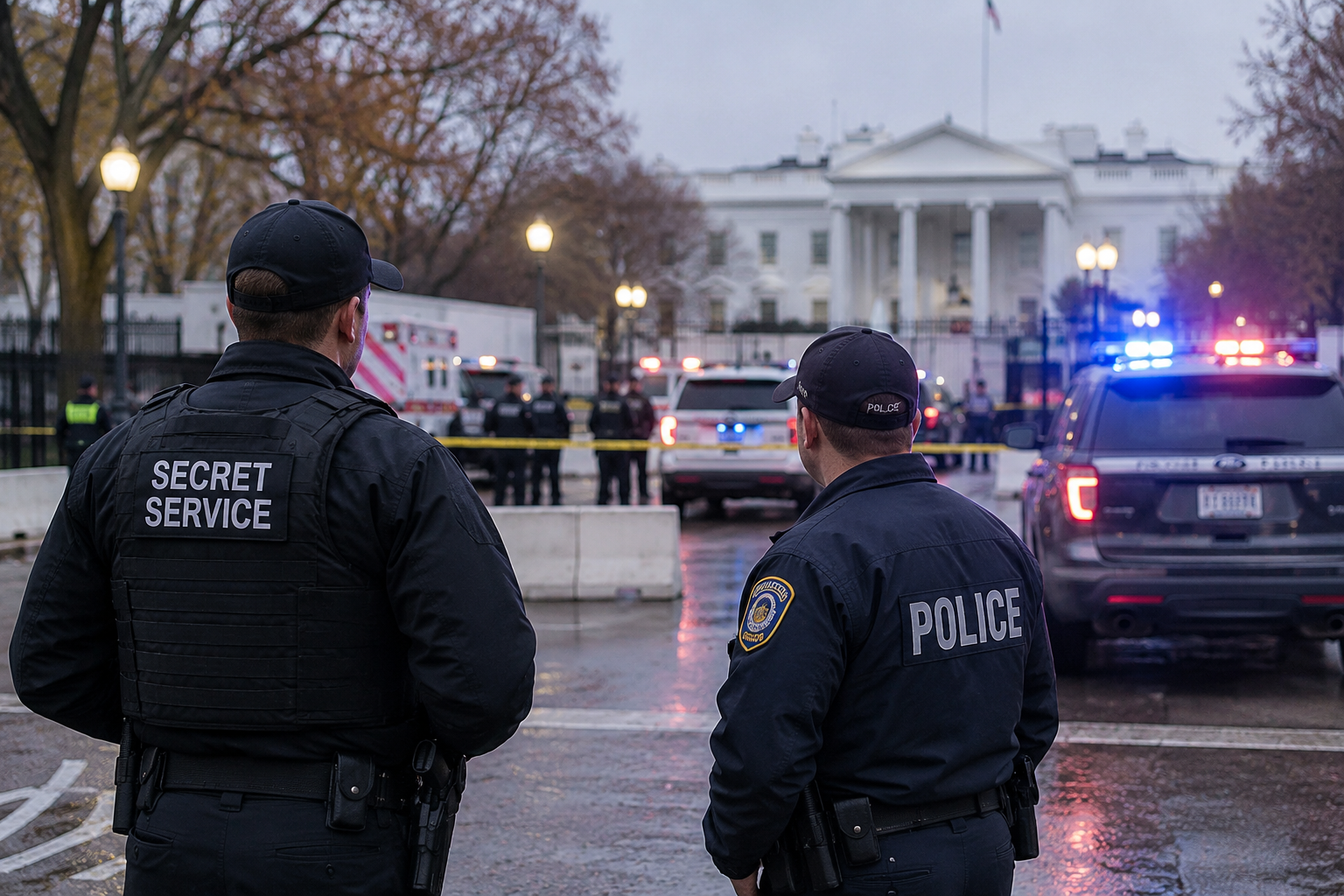
Authorities continued reviewing a shooting near a White House security checkpoint. Editorial illustration by TheDailyGlobe.
Key Facts
- A man opened fire near a White House security checkpoint on May 23.
- Secret Service officers returned fire, and the suspect later died.
- A bystander was struck during the incident.
- Officials said it was unclear whether the bystander was hit by the suspect’s gunfire or during the exchange.
- No Secret Service members were reported hurt.
A man opened fire near a White House security checkpoint on May 23, prompting Secret Service officers to return fire in an exchange that ended with the suspect dead and a bystander wounded, according to Secret Service-attributed statements and news reports.
The incident drew national attention because it happened near one of the most heavily protected government sites in the country. But several important facts remain under investigation, including which gunfire struck the bystander and whether officials will recommend any security changes after reviewing the shooting.
For readers, the central question is not only what happened outside the White House. It is how public safety officials sort through a fast-moving armed encounter near a national institution while avoiding early conclusions that the evidence does not yet support.
What Officials Have Said So Far
The available accounts describe a brief but serious encounter near a White House checkpoint. A man opened fire, Secret Service officers responded with gunfire, and the suspect later died. Reports also said a bystander was wounded and was in serious condition after the shooting.
No Secret Service members were reported hurt. That fact helps narrow the known harm from the incident, but it does not answer the larger investigative questions about how the shooting began, what led up to it, and how the bystander was struck.
Officials have not publicly settled whether the bystander was hit by the suspect’s gunfire or during the exchange. That uncertainty is important. In a crowded or secured public area, determining the source of an injury can require review of physical evidence, witness accounts, video, officer statements, and the sequence of shots.
Why the Location Matters
A shooting near the White House carries a different public weight than a similar incident in a less visible location. The White House is both a working government complex and a national symbol. Security around it is designed to protect officials, staff, visitors, law enforcement officers, and the public spaces nearby.
That does not mean every incident near the White House points to a larger plot or policy failure. The source material does not establish a motive, and it does not show whether the suspect had any broader plan. A careful account has to hold both points at once: the location makes the incident nationally important, but the known facts do not support speculation about why it happened.
The public safety concern is more practical. Armed incidents near protected federal sites test how quickly officers identify a threat, protect bystanders, contain the scene, and preserve evidence for review. Those questions matter even when the motive is unknown.
The Bystander Question
The wounded bystander is one of the most important unresolved parts of the case. Officials have acknowledged the injury but have not confirmed which gunfire caused it.
That distinction matters for accountability and for any review that may follow. If the bystander was hit by the suspect’s gunfire, investigators would examine that as part of the alleged attack. If the bystander was struck during the exchange of fire, officials would also need to review how officers responded under dangerous conditions and whether any procedures should be changed.
The available information does not support blaming any person or agency before the investigation is complete. It does support a narrower conclusion: investigators still have to determine exactly how the bystander was injured.
What Remains Under Review
The motive for the shooting has not been established in the source material. Officials have not said whether the investigation will identify a motive, whether the suspect had any known connection to the White House, or whether the incident will lead to changes in checkpoint operations.
It is also unclear whether any formal policy or procedural review will follow. Incidents involving gunfire near high-security federal locations often draw internal review, but the available reporting does not confirm what review process, if any, officials will use here.
Those unknowns should not be treated as gaps to fill with guesses. They are the parts of the story that need confirmation before readers can understand whether this was an isolated armed encounter, a preventable security failure, or something else.
What Happens Next
The next step is the investigation. Authorities will need to reconstruct the shooting, determine the sequence of gunfire, review how the suspect approached the checkpoint, and clarify how the bystander was wounded.
For now, the confirmed picture is limited but serious: a man opened fire near a White House checkpoint, Secret Service officers returned fire, the suspect died, a bystander was wounded, and no Secret Service members were reported hurt.
That is enough to make the incident a national public safety story. It is not enough to assign motive, assume a wider threat, or conclude what should change before investigators finish their work.
Reporting note: Reporting draws on Secret Service-attributed statements, Associated Press reporting, ABC reporting, Washington Post/AP reporting, and reviewed public safety context. This article was produced with AI-assisted research and reviewed by an editor before publication.