Washington Paper Mill Tank Rupture Leaves Nine Workers Missing
Two people are confirmed dead and nine workers are missing and presumed dead after a caustic chemical tank ruptured at a Longview paper mill.
Save Article
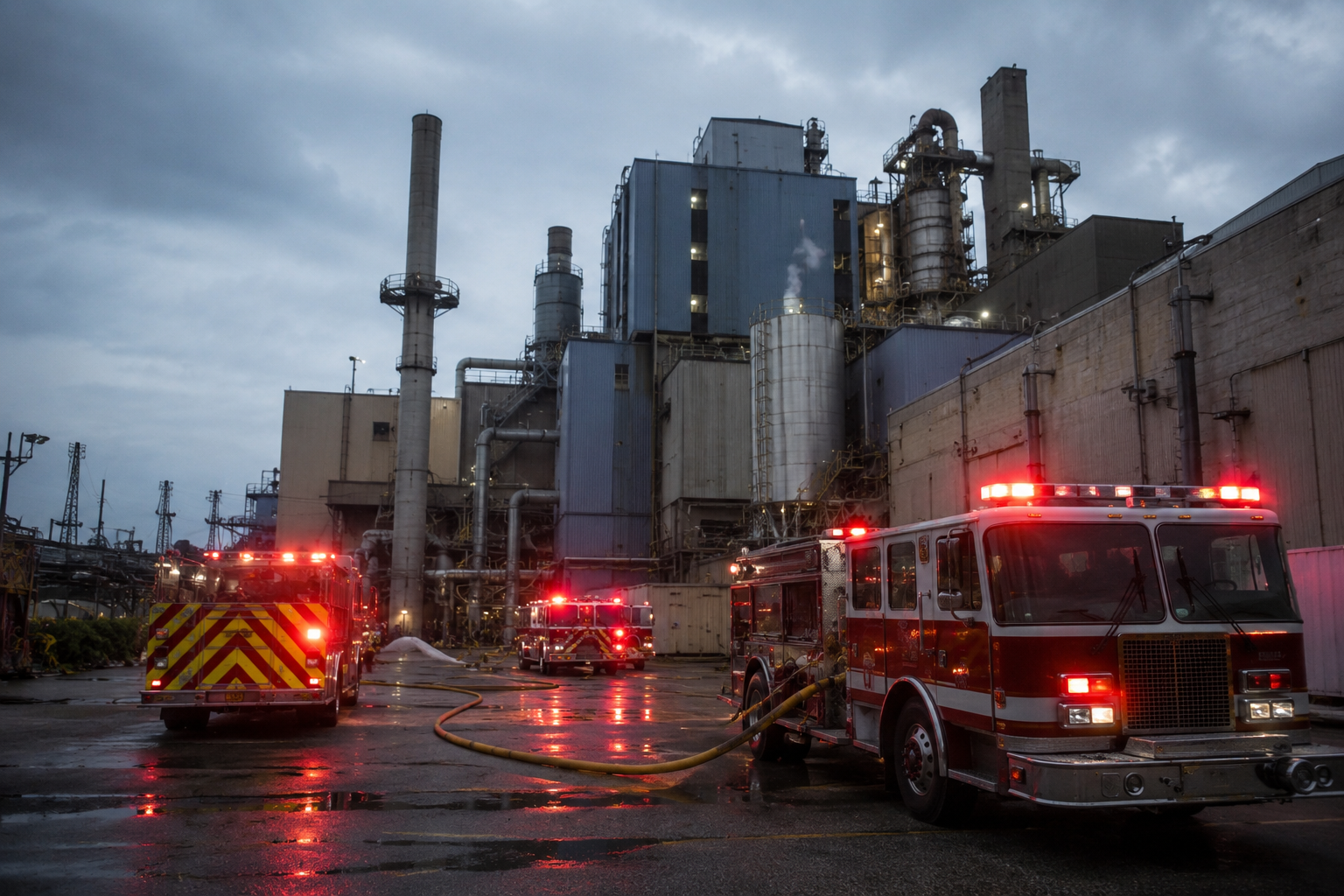
Federal and local officials are investigating a deadly tank rupture at a Longview, Washington, paper mill. Editorial illustration by TheDailyGlobe.
Key Facts
- A tank ruptured at Nippon Dynawave Packaging Co. in Longview, Washington.
- Officials reported two confirmed deaths and nine workers missing and presumed dead.
- The tank involved white liquor, a caustic chemical used in papermaking.
- The U.S. Chemical Safety and Hazard Investigation Board has opened an investigation.
- Officials reported that Longview's air and drinking water were not affected, while environmental monitoring continues.
Families in Longview, Washington, are waiting through the worst kind of industrial emergency: a search that officials say has shifted from rescue toward recovery.
A tank ruptured Tuesday at Nippon Dynawave Packaging Co., leaving two people confirmed dead and nine workers missing and presumed dead, according to officials and reporting reviewed by TheDailyGlobe. The tank involved white liquor, a caustic chemical mixture used in papermaking.
The cause has not been determined. Federal investigators have opened an inquiry, and local officials are still working through recovery, safety and environmental questions around the mill site near the Columbia River.
What Happened at the Mill
The rupture occurred at a paper mill in Longview, a southwest Washington city along the Columbia River. The facility is operated by Nippon Dynawave Packaging Co., which is connected to Nippon Paper Group.
Officials and news reports identified the chemical involved as white liquor. In papermaking, white liquor is used in the pulping process. It is caustic, which means it can burn skin and damage tissue, and it requires careful handling when stored or transported.
The immediate emergency was made more difficult by the condition of the damaged tank, and the need to protect responders. Recovery work at an industrial site can move slowly because crews must first make sure the area is stable enough to enter.
The Human Toll Comes First
The confirmed toll remains two dead, with nine workers still missing and presumed dead. As of publication, officials had not confirmed all of the missing workers as fatalities, and victim identities should not be published unless families and officials have confirmed them.
That distinction matters in a developing tragedy. There is pressure to treat the likely outcome as final, but families, coworkers and the community deserve accuracy while recovery work continues.
Longview is not only the location of the accident. It is the community that now has to absorb the loss, wait for answers and watch as investigators determine what failed.
Why Federal Investigators Are Involved
The U.S. Chemical Safety and Hazard Investigation Board has opened an investigation. The board examines major chemical incidents and looks for root causes, safety gaps and lessons that may apply beyond one site.
That does not mean investigators have already found fault. It means the accident is serious enough to require a federal fact-finding process focused on chemical safety.
The questions are basic but important: what caused the tank to rupture, what safeguards were in place, whether maintenance or operating conditions played any role, and whether the response protected workers, responders and the surrounding community.
Environmental Monitoring Is Still Underway
Officials reported that Longview's air and drinking water were not affected. That is important public-safety information for nearby residents.
At the same time, environmental monitoring is continuing after chemical material reached the Columbia River. The full extent of any environmental impact has not been determined, and readers should be careful not to treat early public-safety assurances as the same thing as a completed environmental assessment.
For people near the site, the practical next step is to follow local public-health, environmental and emergency-response updates rather than rumors or unofficial claims.
What Remains Unknown
The cause of the rupture remains unknown. Investigators have not publicly established whether the failure was tied to equipment, maintenance, operating conditions, design, inspection history or another factor.
The final death toll also has not been fully formalized for all missing workers. Recovery and identification can take time, especially when the site remains hazardous.
The environmental picture is also incomplete. Officials have reported no effect on public air or drinking water, but monitoring continues, and the full impact on surrounding water and nearby systems remains under review.
What To Watch Next
The next updates to watch are recovery announcements, confirmed victim information from officials and families, environmental monitoring results, company statements and any state or federal workplace-safety action.
The Chemical Safety Board investigation may take months or longer. Those findings could matter well beyond Longview if investigators identify safety lessons for chemical storage, tank maintenance or emergency planning at similar industrial sites.
For now, the clearest fact is also the hardest one: people went to work one day, a tank ruptured, and now families are waiting for answers. The public deserves those answers, but not before investigators have the facts to support them.
Reporting note: Reporting draws on Associated Press coverage, local public-media reporting, company and public information, federal investigation confirmation, emergency-response updates, and reviewed industrial-safety context. This article was produced with AI-assisted research and reviewed by an editor before publication.