Washington Chemical Tank Implosion Raises Questions About Industrial Risk
A chemical tank implosion at a Longview paper mill left workers dead, injured or missing and brought renewed attention to industrial emergency response.
Save Article
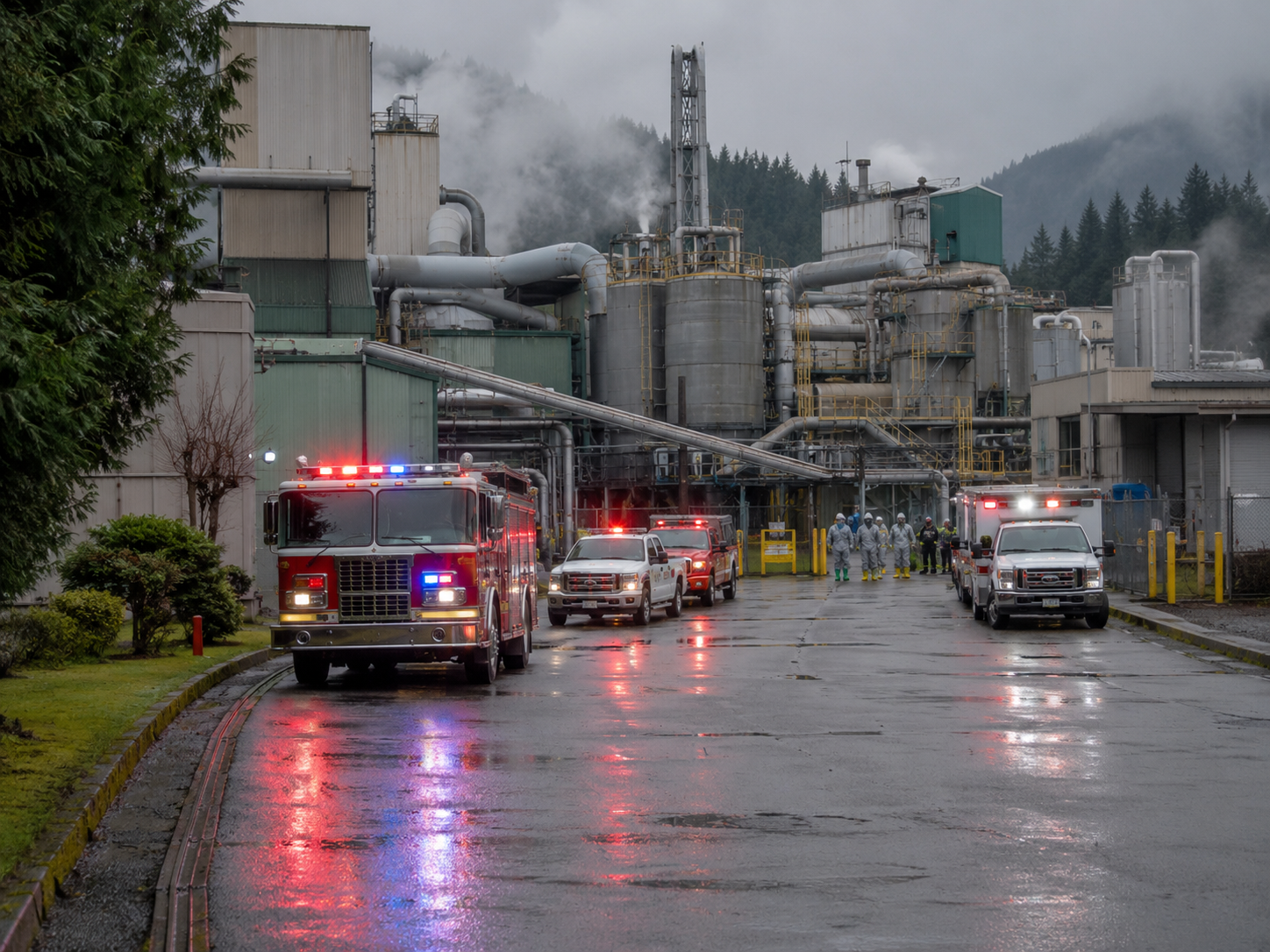
A chemical tank implosion at a Washington paper mill raised worker-safety and emergency-response questions. Editorial illustration by TheDailyGlobe.
Key Facts
- AP reported a chemical tank implosion at Nippon Dynawave Packaging Co. in Longview, Washington.
- AP reported at least one person was dead and nine others were missing.
- AP reported several people suffered chemical burns and inhalation injuries.
- The tank contained white liquor, a corrosive chemical mixture used in papermaking.
- Local officials said hazardous conditions complicated response and recovery efforts.
A chemical tank implosion at a paper mill in Longview, Washington, left workers dead, injured or missing Tuesday and turned an industrial workplace emergency into a wider public safety response.
AP reported that the implosion happened at Nippon Dynawave Packaging Co. and that at least one person was dead and nine others were missing. AP also reported that several people suffered chemical burns and inhalation injuries.
The immediate story is a workplace disaster. The larger question is what happens when heavy industrial work, hazardous chemicals and emergency response collide in a place where workers have only seconds to react and responders may face dangerous conditions before they can reach everyone.
What Is Known About the Incident
The confirmed facts remain limited. The incident involved a chemical tank at a paper mill. The tank contained white liquor, a corrosive chemical mixture used in papermaking. Casualty numbers were still being reported as authorities worked through dangerous conditions.
That is why the numbers should be handled carefully. AP reported at least one death and nine people missing. The final number of fatalities was not clear in the source material used for this draft.
The Guardian and Forbes also reported on the incident, but AP provides the core confirmed account used here. The article does not name victims because names were not provided in the handoff and because the public safety issue can be explained without identifying workers before officials and families do so.
Why the Chemical Matters
White liquor is part of the papermaking process, but for workers and responders the important point is simpler: it is corrosive, and an incident involving it can create serious injury risk.
AP reported chemical burns and inhalation injuries. That makes this more than a structural failure at a facility. It was also a hazardous-materials emergency, where the danger can come from the force of the event, the condition of the site and the chemical exposure risk afterward.
The available source material does not support broader claims about contamination, long-term health effects or the company’s compliance history. Those questions would require official findings, regulatory records or additional reporting.
A Worker-Safety Story First
Industrial incidents often become public stories because of explosions, smoke, road closures or emergency alerts. But the first impact is usually on workers.
People inside a facility face the immediate danger before the public understands what happened. They may be working near tanks, valves, pipes, chemicals, equipment or confined areas where a sudden failure leaves little room for escape. Their coworkers may also become the first people trying to account for who is safe, who is injured and who is missing.
That worker-centered view matters here. The incident is not just about an industrial site. It is about the people who were inside it when something went badly wrong.
What Responders Have to Manage
Local officials said hazardous conditions complicated response and recovery efforts. In a chemical incident, responders may have to move slowly even when the need feels urgent.
They have to determine whether the area is stable, whether chemicals remain active or leaking, whether air conditions are safe, what protective equipment is needed and whether damaged structures create new hazards. Those steps can be painful for families waiting for news, but they are part of keeping rescuers from becoming additional victims.
That is one reason industrial emergencies can take longer to resolve than the public expects. The scene has to be made safe enough for search, recovery and investigation.
What Remains Unknown
The cause of the tank implosion was not clear in the source material used for this draft. It also remained unclear whether regulators would open or expand a formal investigation, whether there were prior warning signs, or whether safety issues at the facility played any role.
Those unknowns should not be filled in with guesses. Industrial failures can involve equipment, procedures, maintenance, pressure, chemicals, human error or other factors. Until investigators identify a cause, the careful wording is that the tank imploded and that the cause remains unclear.
The final casualty count also remained unclear. That uncertainty matters because early reports during an industrial emergency can change as crews reach more areas and account for workers.
Why This Matters Beyond One Mill
The Longview incident has broader relevance because industrial facilities are part of daily American life, even when most people rarely think about them. They make paper, chemicals, fuel, plastics, food products, metals and other materials used across the economy.
Many Americans work in those facilities. Others live near them. A serious incident can affect workers first, then emergency crews, nearby roads, local hospitals and surrounding communities.
That does not mean every facility is unsafe. It does mean industrial risk is real, and public safety depends on prevention, training, monitoring, emergency planning and clear communication when something fails.
The careful takeaway is this: a chemical tank implosion at a Washington paper mill left workers dead, injured or missing, and hazardous conditions made the response more difficult. What happened next depends on the search, the official investigation and whether authorities can determine why the tank failed.
Reporting note: Reporting draws on reputable wire reporting, public safety updates, local emergency response information, and reviewed background materials. This article was produced with AI-assisted research and reviewed by an editor before publication.