Pentagon Releases UFO Files
The Pentagon has begun releasing declassified UFO and UAP records from across the federal government, giving the public new access to decades of reports, videos, images, and documents while leaving many sightings unresolved.
Save Article
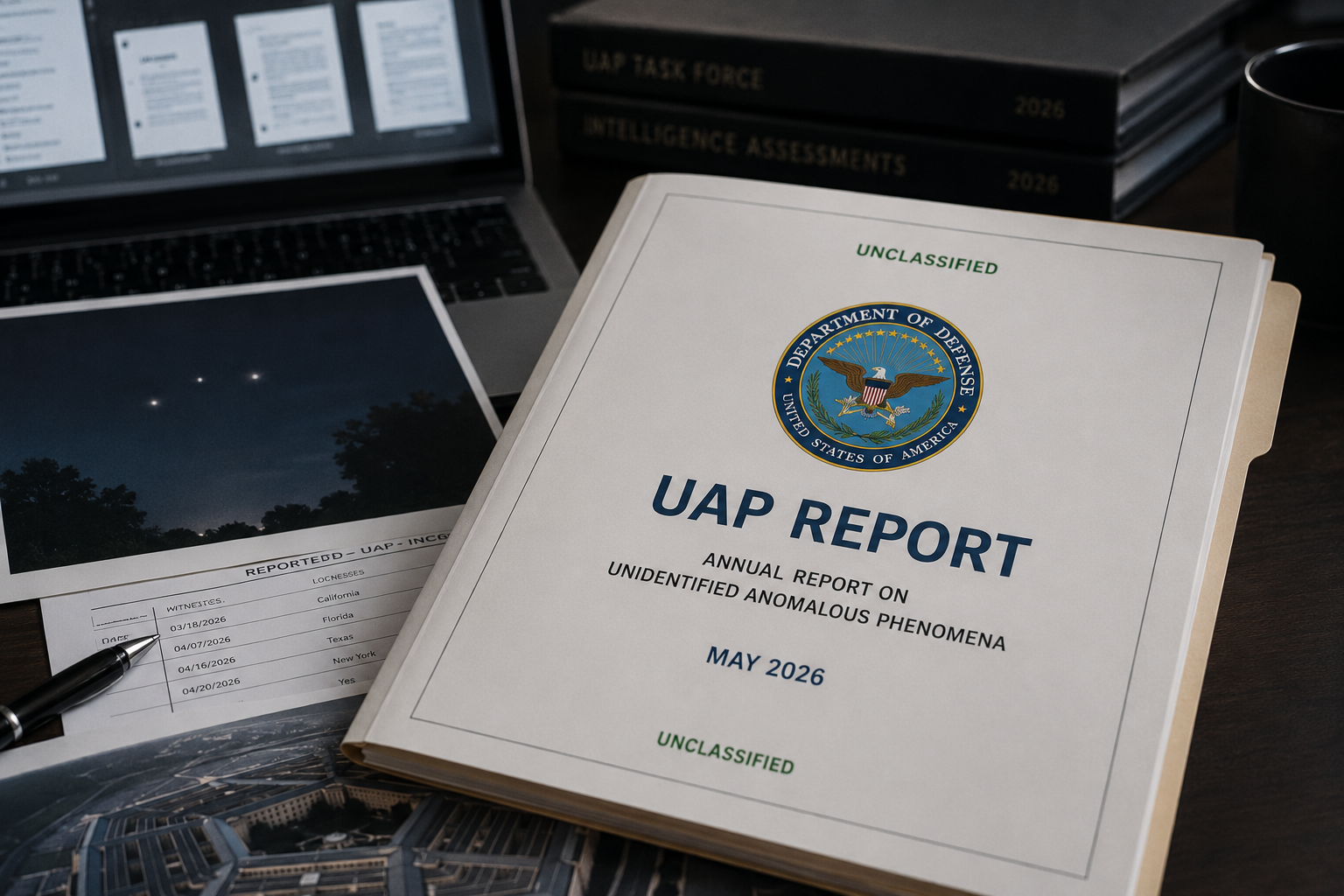
The Pentagon has begun releasing declassified UFO and UAP records from across the federal government, giving the public new access to decades of reports, videos, images, and documents while leaving many sightings unresolved. Editorial illustration by TheDailyGlobe.
Key Facts
- The Pentagon has begun releasing declassified UFO and UAP files from across the federal government.
- Some of the records date back to the late 1940s.
- The release includes documents, videos, photos, reports, transcripts, and historical records.
- The Pentagon said more files will be released on a rolling basis.
- AARO’s public release page includes newly listed UAP documents and imagery reports from U.S. military commands.
- The release does not prove that any sighting involved extraterrestrial technology.
The Pentagon has begun releasing a new batch of declassified UFO and unidentified anomalous phenomena files, opening a public window into decades of government records that have long drawn interest from lawmakers, researchers, skeptics, and believers.
The release includes documents, videos, photos, reports, transcripts, and historical files from multiple federal agencies. Some records date back to the late 1940s. The government now uses the term unidentified anomalous phenomena, or UAP, instead of UFO, but public interest remains focused on the same basic question: what did military personnel, pilots, sensors, and agencies actually see?
The short answer is that the new files show many reported sightings, but they do not prove one simple explanation. Some cases remain unresolved. Some are still being analyzed. Others appear likely to involve ordinary objects, sensor limits, birds, balloons, drones, aircraft, or other known causes. The release is important because of what it makes public, not because it settles the larger debate.
What Was Released
The Pentagon said the files are being posted through a new government access point meant to collect declassified UAP material in one place. The release includes records from different parts of the federal government rather than one single office or era.
The All-domain Anomaly Resolution Office, known as AARO, now lists newly released UAP report documents and imagery entries. The public-facing records include mission reports, range fouler debriefs, still images, and video reports submitted by U.S. military commands.
Several entries involve infrared or electro-optical footage collected by U.S. military platforms. Some descriptions say the reporter did not provide a written or oral account of the observation. Other entries provide AARO assessments, including cases that remain unresolved and at least one case assessed with high confidence as birds.
Why This Matters
The release matters because UAP transparency has become a serious public issue, not just a fringe topic. Members of Congress have pressed defense officials for more information. Former military personnel have testified about unusual sightings. Pilots have described objects they could not identify. The public has asked why so much material remained classified or difficult to access.
At the same time, serious reporting on UAPs requires caution. An object being unidentified does not mean it is alien. It means the available evidence was not enough to identify it. A blurry video, a heat signature, a radar track, or a pilot account can be interesting without being conclusive.
That distinction is important. The government can release real records of unexplained sightings while still having no final answer for many of them. Public access does not automatically turn mystery into proof.
What the Files Show
The files appear to cover a wide range of cases. Some are old historical reports. Others involve more recent military sensor footage. Some entries describe objects captured by infrared systems. Others include still images or documents from past investigations.
AARO’s public listings show reports connected to several U.S. military commands, including Central Command, European Command, Africa Command, Indo-Pacific Command, the Army, and the Air Force. The reports include short videos, longer footage, still images, and documents tied to reported UAP events.
Some cases are labeled unresolved because the available information was not enough to make a final determination. In other cases, AARO has reached more ordinary explanations. One public entry assessed objects in Europe as almost certainly birds, based on their appearance and behavior.
What the Files Do Not Show
The release does not show that the government has confirmed alien spacecraft, non-human technology, or a hidden crash-retrieval program. It also does not mean every unresolved case is extraordinary.
Many UAP reports are difficult to evaluate because the evidence is limited. A camera may show only a short clip. A sensor may lack enough detail. A witness may have seen something briefly under stressful or unusual conditions. Without enough information about speed, distance, weather, sensor performance, aircraft movement, and other objects in the area, investigators may not be able to identify what was seen.
That is why the government’s release is best understood as a transparency step, not a final verdict. It gives the public more material to inspect, but it does not remove the need for careful analysis.
Why the Government Uses the Term UAP
The term UAP is broader and more formal than UFO. It is meant to cover unexplained objects or phenomena observed in the air, sea, space, or across domains. Government officials use the newer language partly because UFO has long carried cultural baggage from movies, conspiracy theories, and decades of public speculation.
Using UAP does not make the subject less strange. It does make the government’s work sound more like an intelligence, aviation, and national security issue. For the military, the first concern is not science fiction. It is whether something unidentified is operating near aircraft, training ranges, ships, bases, or sensitive sites.
The National Security Angle
For defense officials, UAP reports can matter even when the explanation is ordinary. A drone near a military range, an aircraft operating without clear identification, a sensor error, or a foreign surveillance platform can all raise security questions.
That is why pilots and service members are encouraged to report unusual observations without stigma. If people are embarrassed or afraid to report what they saw, the military may miss patterns that could matter for flight safety or national security.
The challenge is separating signal from noise. A UAP database can include truly unusual cases, misidentified objects, incomplete reports, sensor artifacts, and normal objects seen from unusual angles. Analysts have to sort those carefully instead of jumping to the most exciting explanation.
What Happens Next
The Pentagon has said more files will be released on a rolling basis. That means the public record will likely grow over time. Future releases may include additional videos, documents, agency files, and older records that were previously difficult to access.
The next question is whether the releases will satisfy lawmakers and the public. Some people will see the release as a major step toward openness. Others will argue that the most important material remains classified or that the files still do not answer enough questions.
For now, the most responsible reading is simple: the government has released a significant new batch of UAP material, some of it historical and some of it tied to more recent military reporting. The files show that unexplained sightings have been taken seriously enough to document and review. They do not prove the most dramatic claims.
The Bigger Picture
UAP stories tend to pull people toward extremes. One side wants every unexplained object to be proof of something extraordinary. Another side wants to dismiss the entire subject as nonsense. Neither approach is careful enough.
The better approach is to treat the records as records: official documents that deserve public review, honest skepticism, and serious analysis. Some cases may turn out to be ordinary. Some may stay unresolved. Some may raise real questions about airspace, sensors, intelligence, or military operations.
The release does not answer every question. It does make one thing clearer: the public now has more of the government’s UAP record in front of it, and the debate over what those records mean is likely to continue.
Reporting note: Reporting draws on Pentagon statements, AARO public release materials, ABC News reporting, reviewed federal UAP records, and public background materials. This article separates confirmed release details from unresolved claims and has been reviewed under TheDailyGlobe editorial standards.