Google I/O Shows AI Becoming the Default Layer Across Everyday Tech
Google’s I/O announcements show AI moving deeper into search, phones, browsers and apps, but many features will arrive through staged rollouts rather than all at once.
Save Article
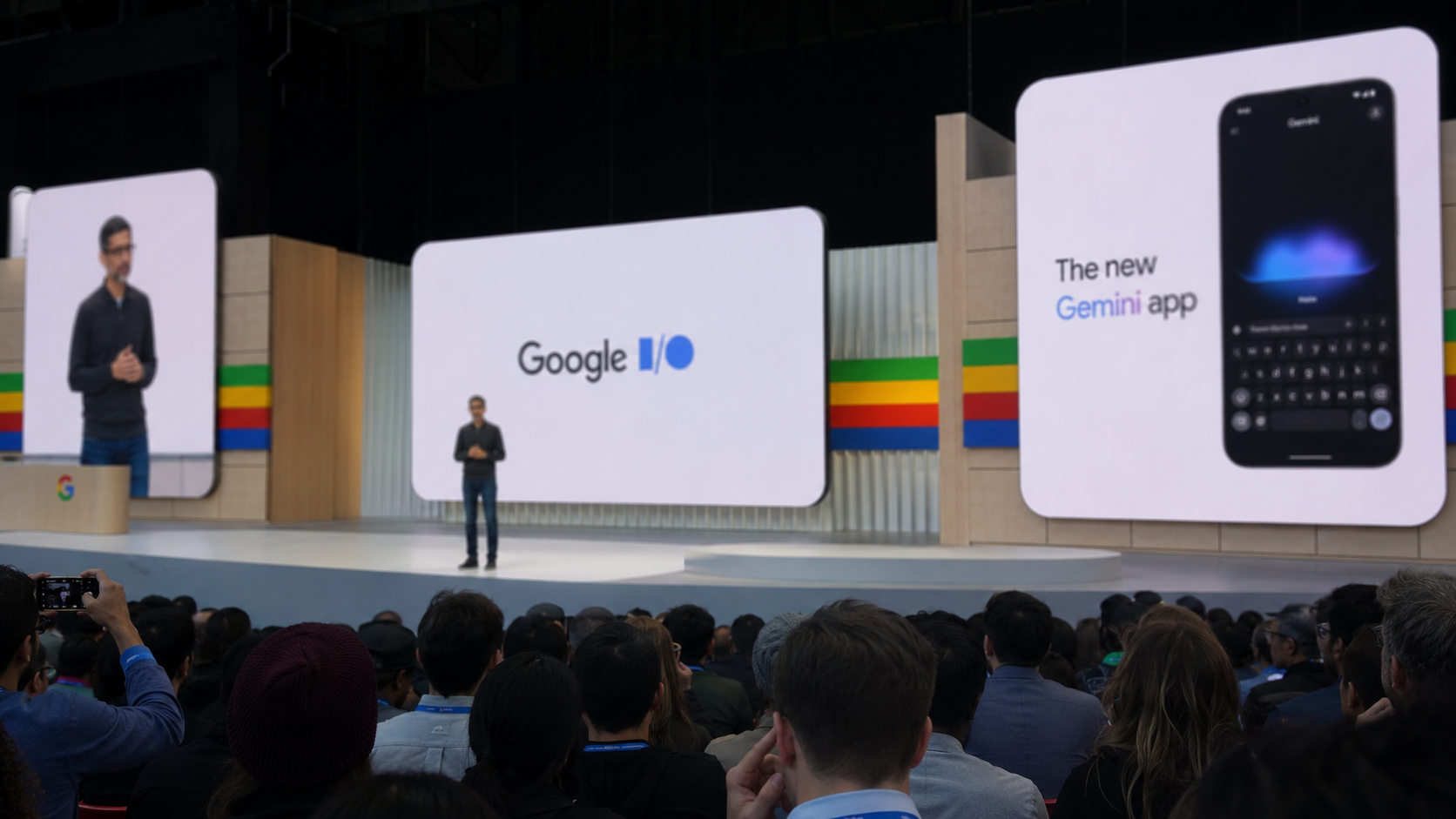
Google’s I/O announcements show AI moving deeper into search, phones, browsers and apps, but many features will arrive through staged rollouts rather than all at once. Editorial illustration by TheDailyGlobe.
Key Facts
- Google I/O 2026 included updates across Gemini, Android, Chrome, Cloud and AI models.
- Google announced Gemini Spark and related Gemini app and model changes.
- AP reported that Google announced AI advances across assistant features, search and smart glasses.
- The announcements point to AI becoming more deeply embedded in products people already use.
- Some announced features may arrive through staged rollouts rather than appearing for all users at the same time.
Google’s latest developer conference was not just about a new chatbot, a new phone feature or one more AI demo. The larger message was that AI is becoming part of the basic operating layer across products many people already use.
At Google I/O 2026, the company announced updates tied to Gemini, Android, Chrome, Cloud, search and AI models. AP reported that Google announced AI advances across assistant features, search and smart glasses. Taken together, the announcements show how Big Tech companies are trying to make AI feel less like a separate destination and more like something built into phones, browsers, apps and everyday digital work.
For regular users, the useful question is not whether Google made a lot of AI announcements. It is where those changes may show up, what they might change about familiar products and what remains unclear before the features reach everyone.
AI Is Moving Into the Products People Already Use
The shift matters because most people do not experience technology as a list of model names. They experience it through search results, phone settings, browser tools, email drafts, maps, documents, photos, subscriptions and apps.
That is where Google’s strategy is becoming clearer. Gemini is not only being presented as a standalone AI assistant. It is also being tied to the company’s wider ecosystem. That means AI features may increasingly appear inside the products people already open every day instead of asking users to visit a separate AI service.
That can make AI more useful, but it can also make it harder to notice when a product is changing. A search box that summarizes information, a phone that suggests actions, a browser that helps interpret pages or an app that generates text can all feel like small convenience features. Together, they show a deeper change in how major platforms are being built.
Why Search, Android and Chrome Matter
Search remains one of the clearest places where AI could affect daily habits. When AI appears inside search, it can change how people find information, how much of an answer they see before clicking elsewhere and how they judge whether an answer is complete. That makes accuracy, sourcing and user control important questions, especially when a search result touches health, money, law, news or public safety.
Android matters because phones are where many people interact with digital services all day. If Gemini-era features become more embedded into Android, AI could become part of common tasks such as messaging, reminders, photos, navigation, app actions and device settings. That does not mean every user will see the same experience immediately, but it shows why mobile operating systems are becoming one of the main battlegrounds for consumer AI.
Chrome matters for a different reason. Browsers sit between users and much of the web. AI tools built into a browser could help summarize pages, assist with writing, compare information or manage tasks. They could also raise questions about what the browser sees, what data is processed and how much control users have over AI features while they browse.
The Rollout Question Is Part of the Story
One reason tech announcements can be confusing is that a conference demo does not always mean a feature is available to everyone right away. Some AI updates may roll out gradually, arrive first to certain countries or users, require specific devices, or sit behind paid plans.
That staged rollout matters for readers because it separates what was announced from what will actually change on a person’s phone or laptop this week. A feature can be real without being universal. It can also change between announcement and release as companies test performance, safety, cost and user demand.
That is especially true for AI features because they can be expensive to run and difficult to evaluate at scale. Companies need to balance speed, reliability, safety and business model questions. Users may see a polished presentation first and a slower, more uneven rollout afterward.
What Consumers Should Watch
The biggest consumer questions are practical. Does the feature save time? Is it accurate enough to trust? Is it easy to turn off? Does it explain where information comes from? Does it require a subscription? Does it work on older devices? Does it send more personal data into systems users do not fully understand?
Those questions matter because AI embedded into platforms can become ordinary very quickly. When a feature is built into search, a phone or a browser, people may use it without thinking of it as a separate AI product. That can be convenient, but it also puts more responsibility on companies to make limits clear.
The privacy question is not only whether an AI tool records something dramatic. It is also whether small pieces of daily activity, such as searches, documents, device use or browsing context, are handled in ways users understand. As AI becomes more integrated, the line between helpful context and too much access becomes more important.
What This Says About Big Tech’s Direction
Google’s I/O announcements show that the AI race is moving from standalone tools into platform control. The companies with search engines, operating systems, browsers, cloud services and app ecosystems can place AI in front of users without asking them to adopt an entirely new product.
That gives Google a major advantage, but it also raises the stakes. If AI becomes part of the default layer of digital life, errors and design choices may affect far more than early adopters. They can affect how people search, work, shop, communicate and make decisions online.
The careful way to read Google I/O is not as proof that every announced AI feature will transform daily life. It is evidence that the direction of travel is clear. AI is being built into the products people already depend on. The next test is whether those features are useful, understandable and trustworthy enough to deserve that central place.
Reporting note: Reporting draws on Google product materials, Associated Press technology reporting, Wired technology reporting, and reviewed background context on consumer technology platforms. This article was produced with AI-assisted research and reviewed by an editor before publication.