Portable TB Test Could Help Clinics Get Answers While Patients Are Still There
NIH says a portable tuberculosis test produced rapid, accurate results in a multi-country study, but real-world adoption and missed cases remain important questions.
Save Article
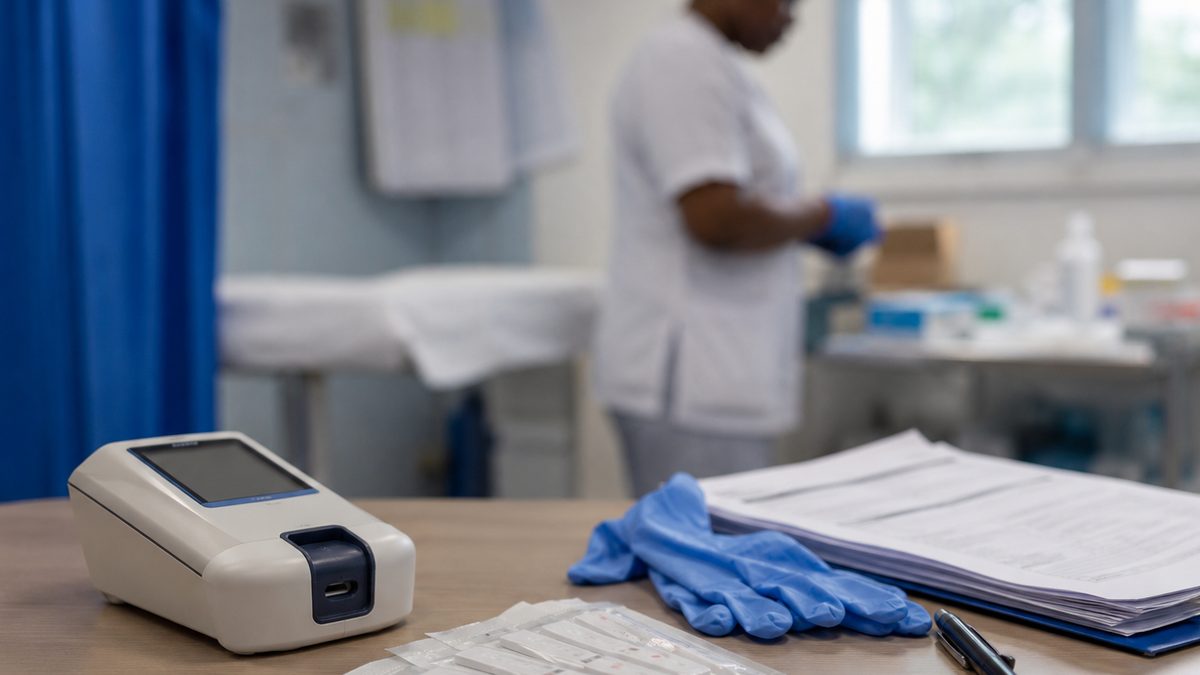
Portable diagnostic tools could help some clinics get tuberculosis test results faster. Editorial illustration by TheDailyGlobe.
Key Facts
- NIH reported June 2, 2026 that a new portable diagnostic test for tuberculosis produced rapid and accurate results.
- The findings were published in the New England Journal of Medicine on April 29, 2026.
- The MiniDock MTB test uses a simple test card and a low-cost portable device that can run on batteries.
- NIH said the device can detect DNA specific to tuberculosis bacteria and provide results in less than 30 minutes.
- Researchers tested samples from 1,380 participants aged 12 and older with suspected tuberculosis in clinics in seven countries in Asia and Africa.
For a patient with possible tuberculosis, the hardest part of testing is not always the test itself. In some clinics, especially where laboratory access is limited, the bigger problem is time: waiting for a result, returning for follow-up and starting care before the trail goes cold.
That is the practical promise behind a new portable tuberculosis test highlighted by the National Institutes of Health. NIH reported June 2 that researchers found the MiniDock MTB test produced rapid and accurate results in a study of people with suspected tuberculosis at clinics in seven countries in Asia and Africa.
The finding is not a cure, and it does not mean the test is already available everywhere. But it points to a real health-care problem that diagnostic science can help solve: patients often need answers while they are still at the clinic, not days or weeks later.
What The Test Does
The MiniDock MTB test is designed to detect DNA specific to tuberculosis bacteria. According to NIH, it uses a simple test card and a portable device that can run on batteries, making it potentially useful in clinics that do not have easy access to full laboratory testing.
Speed is the central feature. NIH reported that the test can provide results in less than 30 minutes. In a clinic setting, that difference matters because a patient may be able to receive counseling, next steps or referral guidance during the same visit instead of being told to come back later.
The study included samples from 1,380 participants aged 12 and older who had suspected tuberculosis. Testing took place in clinics across seven countries in Asia and Africa. That study setting is important because it focused on places where portable, lower-cost testing could be especially useful, but it was not the same as proving universal performance in every health system.
How Well It Performed
NIH reported that the test correctly identified more than 85% of confirmed tuberculosis cases using sputum samples. Using tongue swabs, it correctly identified almost 80% of confirmed cases.
Those results are encouraging, but they also show the limits clearly. A test that misses some confirmed cases cannot be treated as perfect. It also should not be seen as replacing clinical judgment, follow-up testing or medical care. For tuberculosis, a missed diagnosis can matter because untreated disease can worsen and can spread to others.
The tongue-swab result is still notable because swabs can be easier to collect than sputum samples in some settings. But easier collection does not erase the performance gap. The practical question is how health systems would decide when a portable test is enough, when another sample is needed and how to handle patients whose symptoms still raise concern despite a negative result.
Why Faster Diagnosis Matters
Tuberculosis remains a serious infectious disease, and diagnosis is one of the places where health care can slow down. When patients have to wait for lab-based results, clinics may lose the chance to act while the patient is present. That can be especially difficult in areas where travel is hard, clinic access is limited or follow-up systems are stretched.
A faster portable test could help clinics move sooner from suspicion to decision-making. That may mean earlier treatment evaluation, faster referral or clearer advice about what happens next. The reader-facing point is not that the device solves tuberculosis. It is that diagnosis is often the front door to treatment, and a slow front door can delay everything behind it.
This is also why the battery-powered design matters. A device built for portability could be more practical in clinics that do not have the equipment, staffing or infrastructure of a large laboratory. The study gives a clearer picture of what such a tool can do under research conditions.
What Still Has To Be Proven
The next questions are not only scientific. They are practical. It remains unclear how quickly the test could be adopted outside study settings, how much it would cost in real-world use, what training clinics would need, how supply chains would work and what regulatory decisions would be required.
Performance across broader patient groups is another question. The study involved participants aged 12 and older with suspected tuberculosis in clinics in seven countries in Asia and Africa. That is a meaningful test population, but it does not answer every question about how the device would perform across all ages, regions, health systems or patient circumstances.
For now, the MiniDock MTB test is best understood as a promising diagnostic tool with limits, not a guaranteed solution. The next things to watch are further validation, rollout decisions, possible public-health guidance and whether clinics in places with limited lab access can actually use the test in daily care.
Reporting note: Reporting draws on NIH research materials, a peer-reviewed New England Journal of Medicine study, CDC tuberculosis background, public health information, and reviewed background materials. This article was produced with AI-assisted research and reviewed by an editor before publication.