Redistricting Battles Intensify After Supreme Court Voting Rights Ruling
A Supreme Court decision involving Louisiana's congressional map has renewed attention on mid-decade redistricting fights in several states, with voter representation and the 2026 House map now under sharper scrutiny.
Save Article
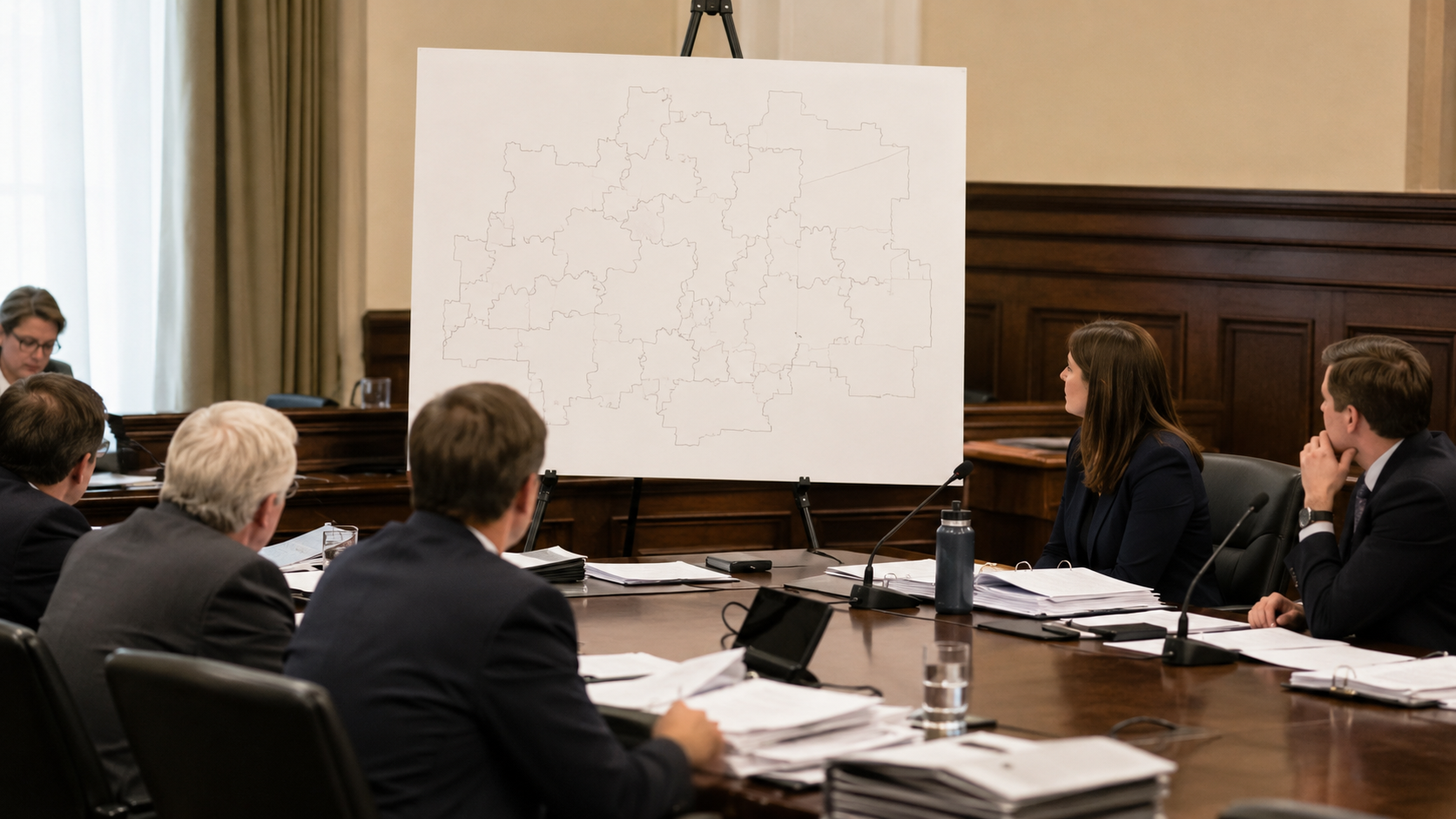
A Supreme Court decision involving Louisiana's congressional map has renewed attention on mid-decade redistricting fights in several states, with voter representation and the 2026 House map now under sharper scrutiny. Editorial illustration by TheDailyGlobe.
Redistricting is moving back to the center of national politics after a Supreme Court ruling involving Louisiana's congressional map added new pressure to an already active fight over representation before the 2026 midterm elections.
The Supreme Court decided Louisiana v. Callais on April 29, 2026. The case addressed Louisiana's congressional map and Section 2 of the Voting Rights Act, the federal law provision often used in redistricting cases involving claims that minority voters' electoral power has been diluted.
The immediate impact is legal, but the political consequences could be broader. Across several states, lawmakers, courts, and voting-rights groups are now confronting a familiar question with renewed urgency: who gets represented, and how much power should voters have to shape the districts that choose members of Congress?
What changed after the Louisiana ruling
The Louisiana case placed the relationship between race, representation, and congressional mapmaking back before the Supreme Court. Redistricting cases often require courts to balance competing legal rules. On one side, the Voting Rights Act can require states to address maps that weaken minority voters' ability to elect candidates of their choice. On the other, the Constitution limits how heavily states may rely on race when drawing district lines.
That tension matters because congressional districts are not just lines on a map. They can determine whether communities remain politically unified or are divided across multiple districts. They can also influence whether a district gives voters a realistic chance to elect a representative who reflects their preferences.
The Supreme Court's ruling does not end every dispute over redistricting, and it does not answer every question facing states. But it does sharpen the legal environment in which state officials and courts are now operating. States considering new maps will have to weigh how the ruling affects Voting Rights Act claims, constitutional limits, and the risk of future lawsuits.
Tennessee moves on a new Memphis-area map
In Tennessee, lawmakers enacted a new U.S. House map affecting a majority-Black Memphis-based district. AP reporting described the new map as reshaping the Memphis district and splitting voters who had previously been grouped together.
Supporters of redistricting plans often argue that states have authority to revise maps and account for legal, demographic, or political considerations. Opponents often argue that splitting communities can weaken voter representation, particularly when the communities affected have historically faced barriers to political power.
The Tennessee fight is important because it shows how the Supreme Court's ruling may quickly intersect with state-level map decisions. The confirmed fact is that Tennessee has enacted a new map affecting a majority-Black Memphis-based district. What remains subject to further legal and political developments is how courts, voters, and advocacy groups may respond.
Virginia court blocks voter-approved plan
Virginia has also become part of the national redistricting fight. The Virginia Supreme Court struck down a voter-approved redistricting plan in a 4-3 ruling, according to PBS/AP reporting. The decision adds another example of courts playing a central role in determining whether new maps can move forward before the 2026 elections.
The Virginia case is different from Tennessee's in one important way: it involved a voter-approved plan that was later rejected by the state's highest court. That makes the case not only a fight over district lines, but also a fight over process. When voters approve a redistricting change, and a court later strikes it down, the result can leave voters with basic questions about who has final authority over election rules.
For now, the confirmed development is the court ruling itself. Any further appeals, legislative responses, or replacement plans would need to be evaluated as they happen.
Why mid-decade redistricting matters
Congressional maps are usually redrawn after the census, which happens once every 10 years. Mid-decade redistricting happens when states revisit maps before the next census cycle. That can happen because of court rulings, legal settlements, changes in state law, or political efforts to alter the balance of representation.
The National Conference of State Legislatures is tracking mid-decade redistricting activity, and the current map fights show that this is no longer a quiet technical issue. Multiple states are now engaged in debates over whether congressional lines should change before the 2026 elections.
For voters, the stakes are practical. A new district map can change which candidates appear on a ballot, which communities are grouped together, and whether a district is competitive. It can also change the relationship between voters and incumbents, sometimes placing representatives into newly drawn districts or dividing familiar communities across different congressional seats.
For the House of Representatives, even small map changes can matter. The chamber is often closely divided, and redistricting fights in a handful of states can affect the broader battlefield. But the voter-centered question is bigger than partisan advantage: whether the rules for drawing districts are clear, fair, legally durable, and understandable to the public.
What remains uncertain
Several things remain unsettled. Courts may still review new or revised maps. States may continue considering changes. Advocacy groups may challenge maps they believe violate voting-rights protections. Lawmakers may also respond to court rulings by proposing alternative districts.
That means voters should treat the current redistricting landscape as active, not final. The Supreme Court's Louisiana decision is a major legal marker, Tennessee's map is a major state-level development, and Virginia's ruling is another reminder that courts can still alter the path of redistricting before Election Day.
The clearest takeaway is that redistricting is no longer just a post-census process happening in the background. It is now one of the main election issues shaping representation before 2026. The debate will likely continue in courtrooms, statehouses, and local communities, where the central question remains simple: whether voters are choosing their representatives under maps that fairly reflect their communities.
Reporting note: Reporting draws on the U.S. Supreme Court opinion in Louisiana v. Callais, AP reporting on Tennessee's newly enacted House map, PBS/AP reporting on Virginia's redistricting ruling, and the NCSL tracker on mid-decade redistricting. All claims This article was produced with AI-assisted research and reviewed by an editor before publication.