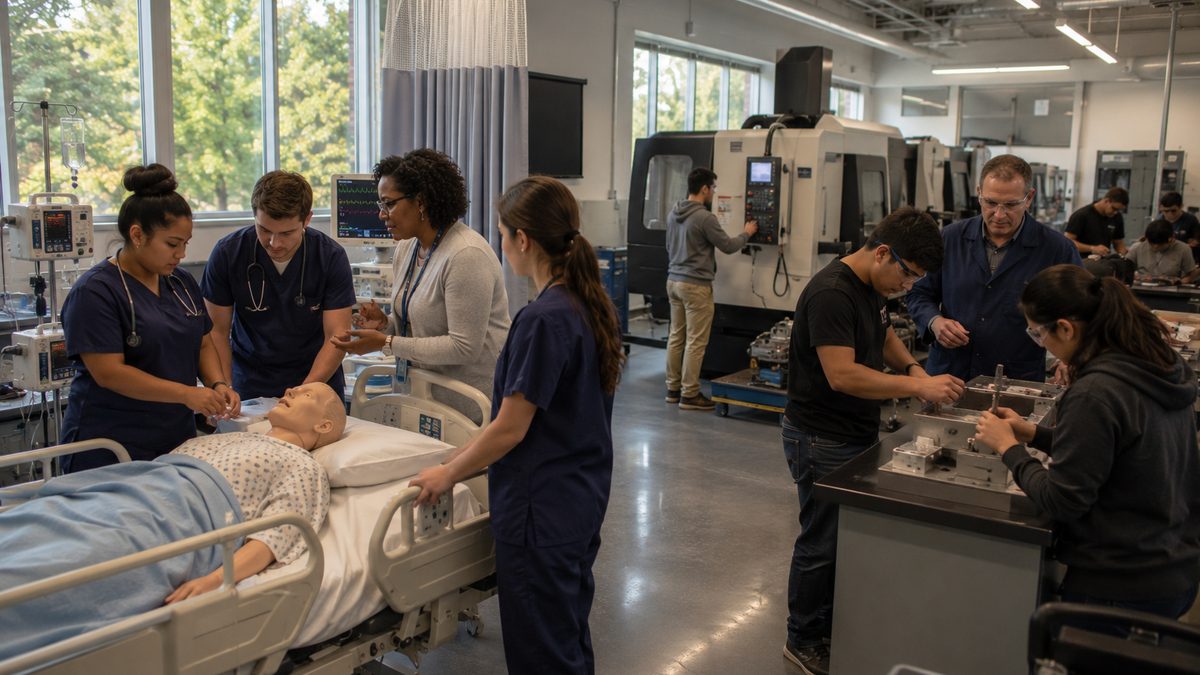
Community Colleges Are Becoming a Practical First Stop for Career Change
For adults weighing a new job path, community colleges can offer a lower-cost way to test a field, earn a credential and build skills without committing immediately to a four-year degree.
Save Article
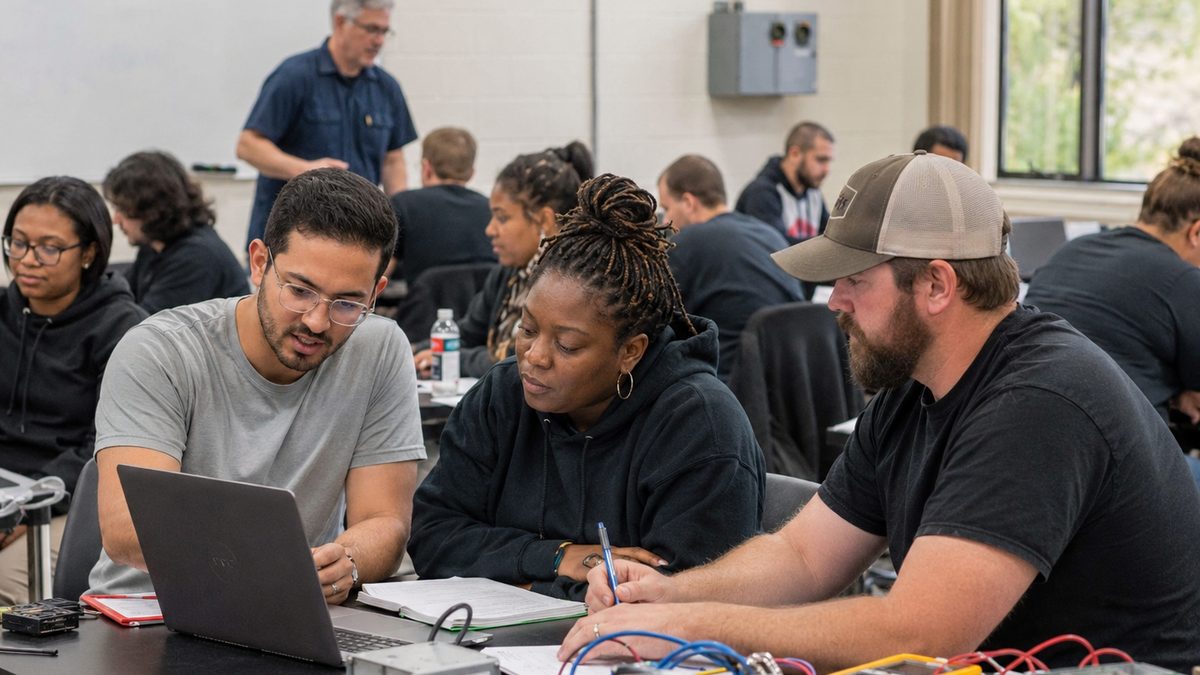
Community colleges often serve adults looking for flexible, lower-cost routes into new skills, certificates and career pathways. Editorial illustration by TheDailyGlobe.
Key Facts
- Community colleges commonly offer associate degrees, certificates, workforce training, transfer pathways and continuing education.
- Many programs are designed for adults who need flexible schedules, local campuses or lower tuition costs.
- Shorter credentials can help students test a field before deciding whether to continue toward a longer degree.
- Program quality, transfer rules, financial aid and employer connections vary, so students should compare options before enrolling.
Changing careers can feel like a leap. For many adults, the hard part is not only deciding what comes next, but figuring out how much time, money and risk to put behind that decision.
That is one reason community colleges remain an important part of the education system. They can give workers, parents, veterans, recent graduates and career changers a practical place to start without immediately committing to a full four-year degree or an expensive private program.
The appeal is straightforward. A student interested in health care, manufacturing, information technology, education support, business, public safety or skilled trades may be able to take an introductory course, complete a certificate, or begin a degree path at a lower cost than many alternatives. In some fields, community colleges also work directly with local employers, hospitals, school districts or workforce boards.
That local connection matters. A national job trend may sound promising, but a student needs to know what is hiring nearby, what credentials employers actually recognize and whether a program has clinical placements, apprenticeships, internships or job-placement support. Community colleges are often built around those regional needs.
A Way To Test A Direction
One of the most useful parts of a community college pathway is that it can be incremental. A student does not always have to decide on day one whether to pursue a full degree. Some programs are built in steps, allowing a student to earn a shorter certificate first, then continue toward a longer credential if the field feels like a good fit.
That can reduce pressure. A person who is curious about a new field can take a lower-risk first step. If the work is not what they expected, they have learned that before spending years and thousands of dollars on a path that may not suit them. If it does fit, the early coursework may still count toward a larger goal.
For adults already working, schedule flexibility is often as important as tuition. Many community colleges offer evening, weekend, hybrid or online options, though availability varies by program. A welding lab, nursing clinical or automotive course may require in-person training, while business, general education or technology courses may offer more flexible formats.
Questions To Ask Before Enrolling
Community colleges are practical, but students still need to ask careful questions. The first is whether the credential matches the job they want. A certificate that sounds impressive may not carry much value if local employers do not recognize it. Students should ask which employers hire graduates, what jobs recent students received and whether the program publishes completion or placement information.
Transfer rules are another important detail. Students hoping to continue to a four-year college should ask whether credits transfer cleanly and whether the community college has formal transfer agreements. A low-cost course loses some value if it does not count toward the next credential.
Financial aid also deserves attention. Some programs qualify for federal financial aid while others may not. Students should ask about tuition, fees, books, equipment, uniforms, certification exams and transportation. A program that looks affordable on the surface may still come with required costs outside the classroom.
Advising can make a major difference. A student should be able to speak with someone who understands the program sequence, prerequisites, transfer options and career pathway. If a school cannot clearly explain the steps from enrollment to completion, that is worth slowing down to clarify.
Why It Still Matters
The larger value of community colleges is that they keep education close to real life. Not every student is 18. Not every student can leave work for school full time. Not every career move requires a four-year degree at the start. Many people need a bridge between where they are and where they hope to go.
A community college is not the answer for every person or every job. But for many adults, it is one of the most practical places to compare options, learn the basics, talk to advisors and move forward without making the biggest possible commitment first.
For households thinking about a career change, the useful question may be simple: before paying for a costly program or delaying the decision entirely, what does the local community college offer, and how closely does it connect to real jobs nearby?
Reporting note: Reporting draws on U.S. Department of Education resources, community college workforce program materials, state higher-education background information, and reviewed education policy materials. This article was produced with AI-assisted research and reviewed by an editor before publication.