Colorado River Faces New Pressure After Record-Low Snowpack Forecast
Federal forecasts point to exceptionally weak flows into Lake Powell this summer, renewing pressure on the Colorado River system as Western states negotiate how to share a shrinking supply.
Save Article
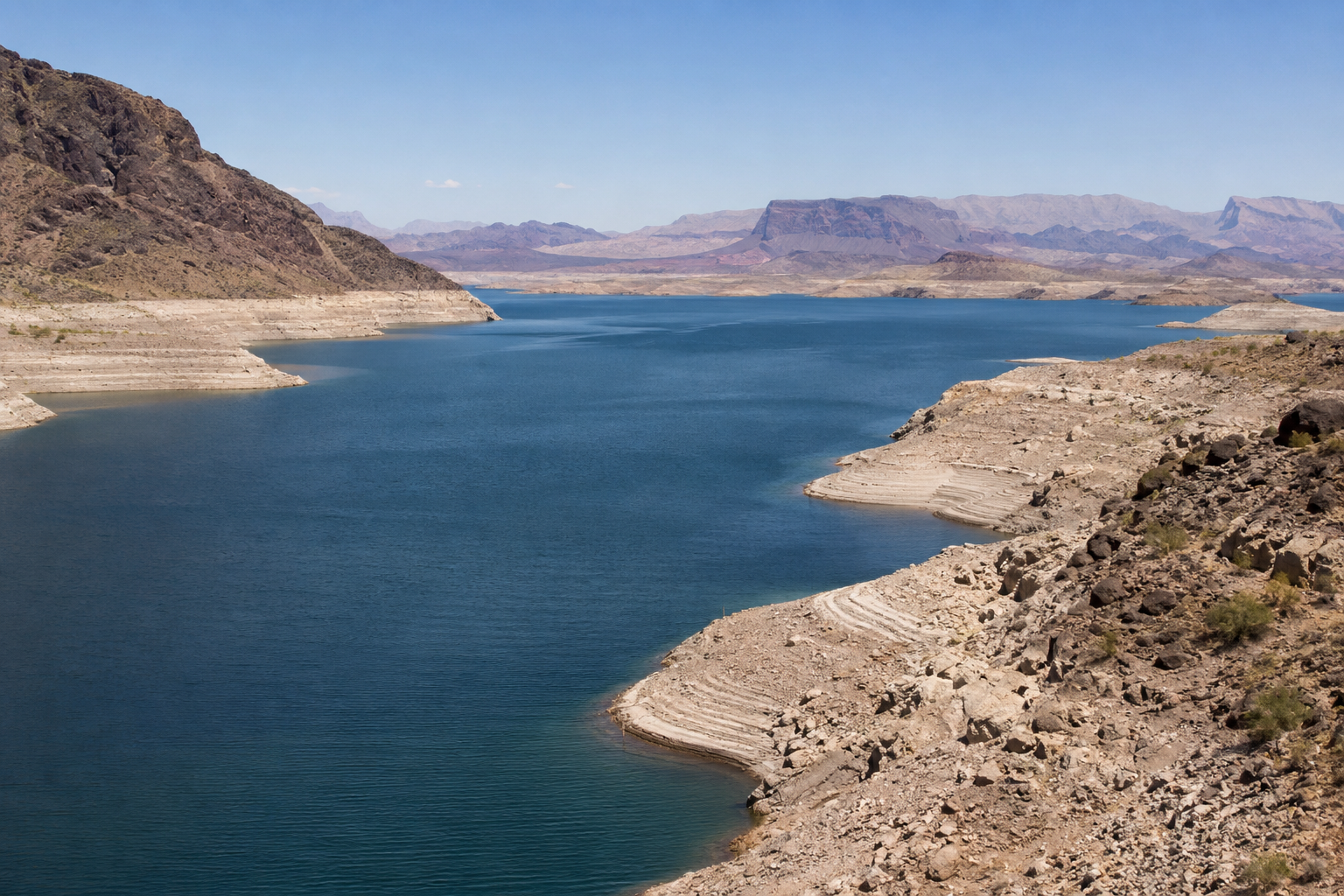
Federal forecasts point to exceptionally weak flows into Lake Powell this summer, renewing pressure on the Colorado River system as Western states negotiate how to share a shrinking supply. Editorial illustration by TheDailyGlobe.
The Colorado River is entering another difficult summer with less mountain snow to feed it, lower expected flows into a major reservoir, and no settled long-term agreement among the states that depend on it.
Federal forecasts now point to extremely low inflows into Lake Powell, the large reservoir on the Utah-Arizona border that helps regulate water and power supplies across the Colorado River Basin. Reuters reported that flows into Lake Powell are expected to hit record lows this summer after the worst recorded Rocky Mountain snowpacks in key Upper Basin states, including Colorado, Utah, and Wyoming. Snowpack data used by the Upper Colorado Snowpack Database, which is based on provisional NRCS and USDA data, also shows sharply weak conditions across the basin.
The forecast does not mean every Western city is about to run out of water. It does mean the river system is facing another stress test at a time when reservoirs, farms, cities, tribal communities, power producers, and state negotiators are already under pressure.
Why snowpack matters
The Colorado River begins with snow. Much of the water that eventually reaches Lake Powell, Lake Mead, irrigation canals, municipal systems, and power facilities starts as winter snow in the Rocky Mountains. When that snowpack is deep and melts gradually, it can help replenish reservoirs and support summer water deliveries. When it is thin, melts early, or soaks into dry ground before reaching streams, the river receives less runoff.
That is why a snowpack forecast can become a national water story. The Colorado River system supplies water to roughly 40 million people and supports major agricultural regions, fast-growing cities, tribal water rights, recreation economies, and hydropower generation. It is not a local stream with a local consequence. It is infrastructure for a large part of the American West.
Lake Powell is especially important because it stores water from the Upper Basin and helps determine releases downstream toward Lake Mead, which serves the Lower Basin states. Low inflows into Powell can make it harder to rebuild storage, protect hydropower production at Glen Canyon Dam, and maintain confidence that the system can meet downstream obligations.
What is confirmed
The core facts are clear. Federal forecasts show extremely low expected inflows into Lake Powell this summer. The low-flow outlook follows record-poor snowpack conditions in key Upper Basin states. Arizona, California, and Nevada have offered additional water-use cuts as part of a temporary plan to help manage the river system. Federal and state officials are still trying to shape longer-term operating rules for the years ahead.
The Washington Post has reported broader context around the crisis, including continued concern over Lake Powell and Lake Mead, the two largest reservoirs in the Colorado River system, and the difficulty of reaching an agreement among the basin states. The Lower Basin states of Arizona, California, and Nevada have proposed additional conservation, while the broader seven-state process remains unsettled.
What remains uncertain
Several major questions remain open. Forecasts can change, especially when late-season storms, temperature swings, and soil conditions alter runoff. The final amount of water reaching Lake Powell will depend not only on snowpack but also on how quickly snow melts, how much water is absorbed by dry ground, and how water managers operate reservoirs through the summer.
It is also uncertain whether the basin states can reach a durable long-term agreement. The current talks are not only about a bad year. They are about how to operate the river under conditions that may be drier and less predictable than the assumptions used in older water-sharing rules. That makes the negotiations both technical and political.
The hardest question is how to divide reductions. Upper Basin states rely heavily on natural runoff and argue that their use is constrained by what the river provides. Lower Basin states draw from major reservoirs and include some of the largest agricultural and urban water users in the system. Any long-term plan must account for reservoir levels, legal entitlements, tribal rights, farms, cities, and federal authority.
Why it matters for households and farms
For most households, the effect of a weak snowpack will not appear as a single dramatic event. It is more likely to show up through conservation rules, local water rates, landscaping limits, drought messaging, and the cost of adapting city systems to use less water over time. Some communities have already invested in conservation, reuse, and turf removal programs. Others may face more pressure if reservoir conditions worsen.
For agriculture, the stakes are more direct. The Colorado River supports irrigation in some of the country's most productive farming regions. Water cuts can affect what is planted, how much land is fallowed, how much compensation farmers receive for conservation, and how food supply chains absorb higher costs or lower output. Agricultural water use is often central to conservation deals because farms use large volumes of water and can sometimes reduce demand faster than cities can.
That does not make the issue simple. Fallowing fields can save water, but it can also hurt rural economies, farmworkers, local tax bases, and food production. Urban conservation can save water, but city demand is tied to population growth, housing, business development, and long-term planning. The policy challenge is not whether water should be saved. It is how to save enough water without shifting all the damage onto one group.
The power question
The Colorado River is also an energy issue. Lake Powell and Lake Mead are tied to hydropower production at major dams. When reservoir levels fall, power generation can become less efficient and, at extreme levels, more difficult to sustain. That can affect utilities and customers that rely on relatively low-cost hydropower as part of their energy mix.
Hydropower is not the only reason officials care about reservoir elevations, but it is one reason low inflows matter beyond water deliveries. Protecting reservoir levels can help preserve operational flexibility. Losing that flexibility can force more difficult tradeoffs between upstream storage, downstream deliveries, power generation, and emergency conservation.
A temporary plan, not a final answer
Arizona, California, and Nevada have offered additional water-use cuts to help stabilize the system while longer-term rules are negotiated. Such proposals can buy time, but they do not by themselves settle the future of the river. Temporary conservation can slow a decline in reservoir levels, but a durable plan must match water use more closely with the amount of water the river can reliably provide.
That is the central issue facing federal and state officials. The river was divided under legal and political assumptions formed in a different climate and a different West. The region now has more people, more infrastructure, more agricultural dependence, and a warmer climate that can reduce runoff even when precipitation does not collapse.
The latest forecast is therefore best understood as a warning light, not a final verdict. It signals that the system has little room for delay. It also shows why negotiations over operating rules are not abstract. They will influence what happens to reservoirs, farms, cities, tribal communities, power generation, and household conservation expectations across the West.
What to watch next
- Updated federal runoff forecasts for Lake Powell as spring snowmelt continues.
- Reservoir elevation projections for Lake Powell and Lake Mead through the summer and fall.
- Whether the proposed Arizona, California, and Nevada water-use cuts receive the approvals needed to move forward.
- Progress or continued deadlock in seven-state negotiations over longer-term Colorado River operating rules.
- Local conservation measures that may affect households, farms, and businesses in Western states.
The West is not facing a single-year problem with a single-year fix. But the current snowpack forecast makes the next round of decisions more urgent. The Colorado River system can still be managed, but the margin for avoiding harder choices is narrowing.
Reporting note: Reporting draws on Reuters coverage of federal Lake Powell inflow forecasts and Rocky Mountain snowpack conditions, Washington Post context on the Colorado River system and state negotiations, and Upper Colorado Snowpack Database information based on provisional NRCS and USDA snow data. This draft is AI-assisted and This article was produced with AI-assisted research and reviewed by an editor before publication..