Tiny Security Chips Could Help Protect Pacemakers From Future Quantum Attacks
MIT researchers developed an ultra-efficient chip that could help bring post-quantum cryptography to small wireless medical devices such as pacemakers and insulin pumps.
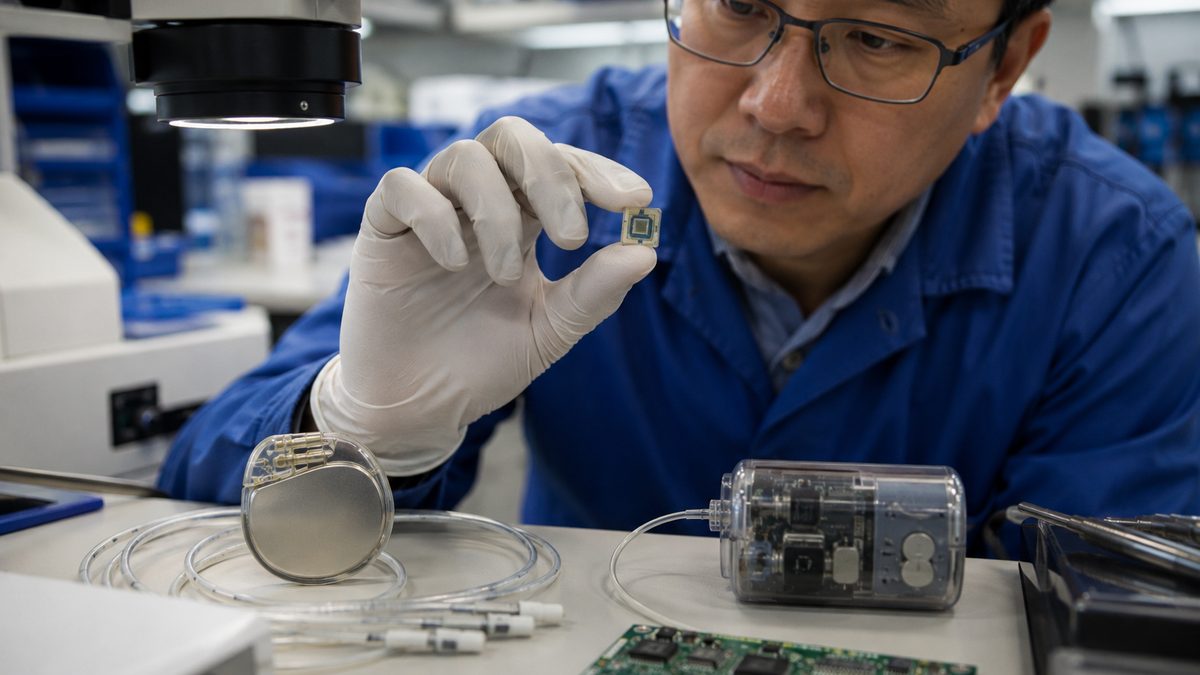
Small wireless medical devices need strong security without large batteries or heavy computing hardware. Editorial illustration by TheDailyGlobe.
Key Facts
- MIT researchers developed an ultra-efficient chip for post-quantum cryptography in constrained biomedical devices.
- The target use cases include small, wireless medical devices such as pacemakers and insulin pumps.
- Future quantum computers could threaten some forms of today's encryption, creating pressure to develop quantum-resistant security.
- Medical devices are a difficult use case because they are small, power-limited and cannot rely on heavy computing hardware.
- The research does not mean current pacemakers are broadly facing quantum attacks or that the chip is already deployed in medical devices.
A pacemaker, insulin pump or other wireless medical device has to do a difficult job quietly. It needs to communicate securely, use very little power and fit inside or near a human body without the kind of battery or computing hardware a laptop or phone can carry.
That size and power problem is one reason medical-device security is a hard engineering challenge. Stronger security usually asks more from a device: more computation, more energy and more room for hardware. Small biomedical devices do not have much of any of those to spare.
MIT researchers developed an ultra-efficient chip meant to help bring post-quantum cryptography to constrained biomedical devices such as pacemakers and insulin pumps. The work points to a future security problem that is not about current pacemakers being broadly under quantum attack, but about preparing small wireless devices for encryption risks that could grow as quantum computing advances.
Why Future Encryption Matters
Encryption is part of how modern connected devices protect information and communication. In health care, that can matter because a wireless device may need to send data, receive updates or communicate with nearby equipment while still protecting the patient and the device.
The post-quantum concern is that future quantum computers could eventually weaken some of the encryption methods used today. That does not mean quantum attacks are now a routine threat to implanted medical devices. It means engineers are trying to prepare for a world where today's protections may not be enough.
For large computer systems, upgrading security can still be difficult, but those systems usually have more power and processing capacity. A tiny biomedical device has much tighter limits. That is why a smaller, more efficient security chip matters as a research direction.
Why Medical Devices Are So Hard to Protect
Wireless biomedical devices face a different set of tradeoffs than ordinary consumer electronics. A phone can be charged every day. A laptop can run a larger processor. A medical implant may need to operate for long periods with strict limits on heat, power use and physical size.
That creates a security problem. A device can need strong cryptography, but strong cryptography can require work the device is not built to handle easily. If the protection drains too much power or requires too much hardware, it may not fit the medical use case.
The point of an ultra-efficient chip is to make stronger protection more practical for devices that cannot simply add a bigger battery or more computing hardware. For pacemakers, insulin pumps and similar devices, efficiency is not a side detail. It is part of whether a security idea can work at all.
What the MIT Chip Changes
The MIT research focuses on bringing post-quantum cryptography into a much smaller and more power-conscious form. Instead of treating quantum-resistant security as something only larger systems can handle, the chip is designed for constrained biomedical devices.
That matters because security upgrades often fail in the real world when they are too heavy for the device that needs them. A hospital system, phone or server may have room for more demanding software. A small implant or wearable may not.
The research is best understood as an enabling step. It does not make medical devices immune to every future threat. It does not prove deployment is immediate. It shows that quantum-resistant security may be possible in a smaller, more efficient package than many readers might expect.
Why This Is Not a Panic Story
The careful framing matters. The story is not that current pacemakers are being widely attacked by quantum computers. The story is that connected medical devices can stay in use for years, and security planning has to look ahead.
Medical technology tends to move cautiously for good reason. Devices that interact with a person's health have to be reliable, tested and regulated. A new chip cannot simply move from a lab result to widespread use without additional development, validation and approval steps.
That caution is especially important when the device is implanted or tied to medication delivery. Strong security has to be balanced with safety, battery life, communication reliability and medical performance.
What Still Has to Happen
Several questions remain before this kind of technology becomes part of everyday medical devices. Researchers and manufacturers would need to show that the chip can work reliably in real device conditions, not just as a promising research result.
It also remains unclear how quickly medical-device makers would adopt post-quantum security hardware, how it would fit into existing device designs and what testing would be required before use with patients.
The next step to watch is whether ultra-efficient post-quantum security can move from research toward practical medical-device design. The goal is not to scare patients about current devices. It is to make sure the next generation of wireless medical technology can stay secure without asking tiny devices to carry hardware or batteries they were never built to hold.
Reporting note: Reporting draws on MIT research materials, biomedical device cybersecurity context, post-quantum cryptography background, and reviewed technology materials. This article was produced with AI-assisted research and reviewed by an editor before publication.